Field Staff Expense Management: Policy, Cards and Mileage
Field teams (sales reps, collection officers, service engineers, site staff) spend company money in dozens of places a day: fuel, tolls, local transport, meals, small repairs, client samples. Their spend is small, frequent and far from head office, which is exactly why it is hard to control. Finance sees it weeks later as claims and bills, and has to take most of it on trust.
This guide covers the four decisions that make field spend manageable:
- A field expense policy people can follow on the road
- How staff pay: cash advance, reimbursement, or prepaid card and UPI
- Mileage claims backed by recorded trips, not memory
- Rolling out cards to a field team quickly
Write a field expense policy, not an office one
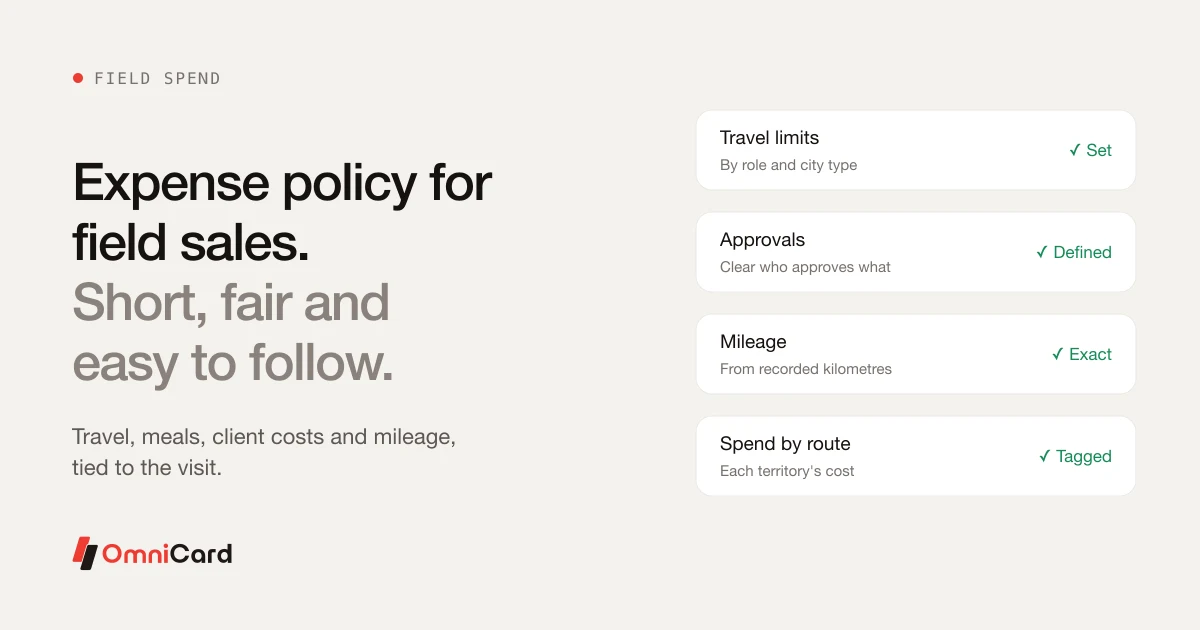
A policy written for an office doesn't fit someone who spends in five towns a day, and one that is too rigid slows deals. A good field policy is one page, specific, and enforced at the time of payment.
What to cover
| Area | What to decide | Example |
|---|---|---|
| Travel | Fuel, tolls, local transport, stays; class of travel | Two-wheeler fuel within the territory; stays up to ₹2,500 a night in tier-2 cities |
| Meals | A daily amount while travelling | ₹400 a day outside the home city |
| Client costs | Samples, small gifts, meeting costs | Up to ₹1,000 a visit, with the client name noted |
| Mileage | Rate per km and how distance is measured | ₹4 a km for two-wheelers, from recorded trips |
| Approvals | What needs a manager, and who covers when they're away | Anything above the daily limit |
The figures are examples. Set your own from three months of real field spend.
Make it easy to follow
- Set limits by role and by city type. A rep in a metro and one in a small town have different costs.
- Say what needs approval and who approves, with a named backup for every approver.
- Show the limit where staff pay, in the same app, so nobody has to remember the policy.
- Keep it to one page. A twenty-page policy is not read on the road.
Tie spend to the visit
Spend tagged by route or visit lets sales leaders see what each territory costs, and set that against what it brings in. Without it, field spend is one large line in the accounts that nobody can question.
Cash advance, reimbursement or prepaid card?
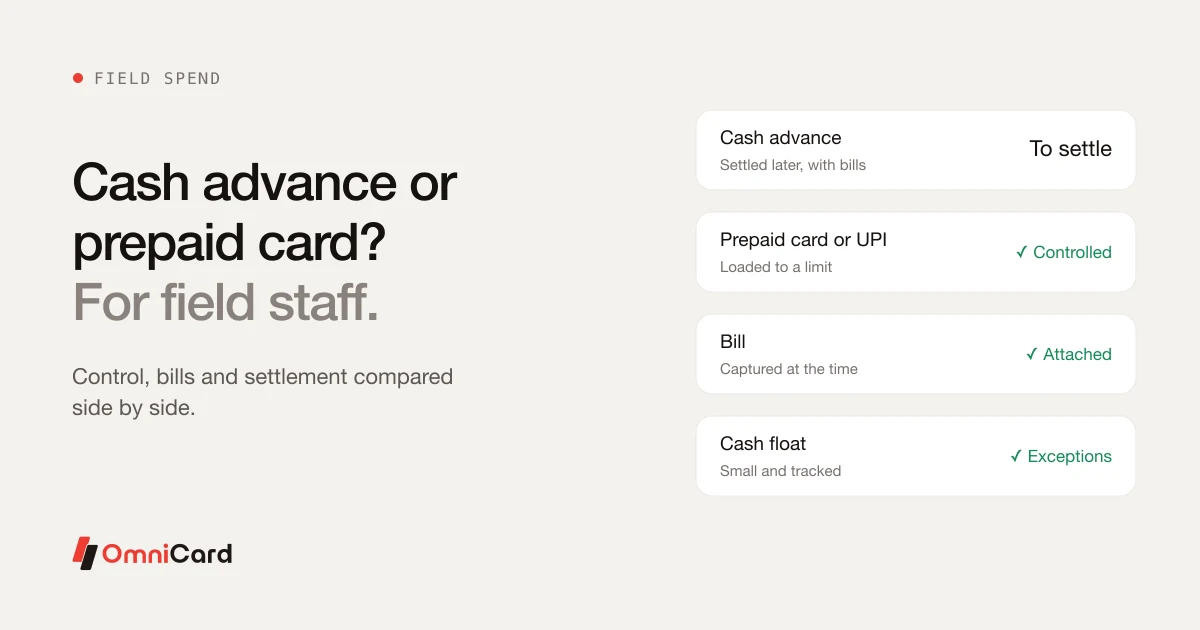
Field staff often need money before they spend it. There are three usual answers, and they behave very differently once the money is out.
| Cash advance | Pay personally, claim later | Prepaid card or company UPI | |
|---|---|---|---|
| Who funds the spend | Company, in advance | Employee, until repaid | Company, at the point of purchase |
| Control over what it's spent on | None until settlement | None until the claim | Limits by category, merchant, location and time, before payment |
| Bills | Collected at settlement, often late | Attached to the claim, often late | Captured at the time of payment |
| Work afterwards | Settle the advance; chase open ones | Approve, check and pay each claim | Little: payments are already recorded |
| Risk | Open advances build up; cash goes missing | Staff out of pocket; delays hurt trust | Low, if limits are set well |
When a cash advance still makes sense
For places where cards and UPI aren't accepted, or for a one-off cash need. Keep these advances small, track each one by person, and settle them within a week.
Why paying personally is the worst default
When staff pay from their own pocket, the company waits weeks for the bill, the employee waits weeks for the money, and the payment often doesn't carry the company's GST details. Our guide on why employees shouldn't pay company expenses from their own account covers the tax and reporting side.
A mixed approach works best
Use prepaid cards and company UPI for the bulk of field spend, since almost every fuel station, shop and transport operator now accepts one or the other. Keep a small, tracked cash float for the exceptions. That moves most field spend from "claim later" to "recorded when paid".
Mileage: from self-reported kilometres to recorded trips
Mileage is one of the hardest claims to check. Self-reported kilometres are easy to round up and hard to audit, so finance either accepts them or spends time questioning each one.
Why self-reported mileage is difficult
- Distances are estimated from memory
- Trips are logged days later
- There is no link between the visit and the claim
A better method
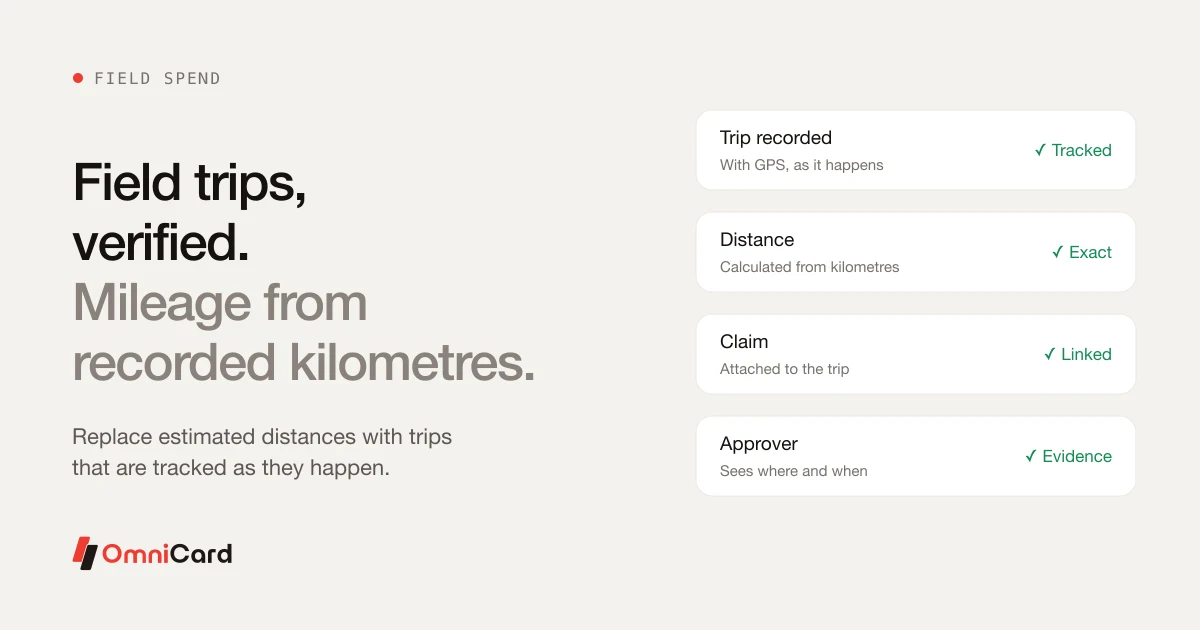
- Record the trip as it happens, with GPS on the employee's phone.
- Calculate distance from the recorded kilometres, not an estimate.
- Apply the company's rate for the vehicle type.
- Attach the trip to the claim, so the approver sees where and when.
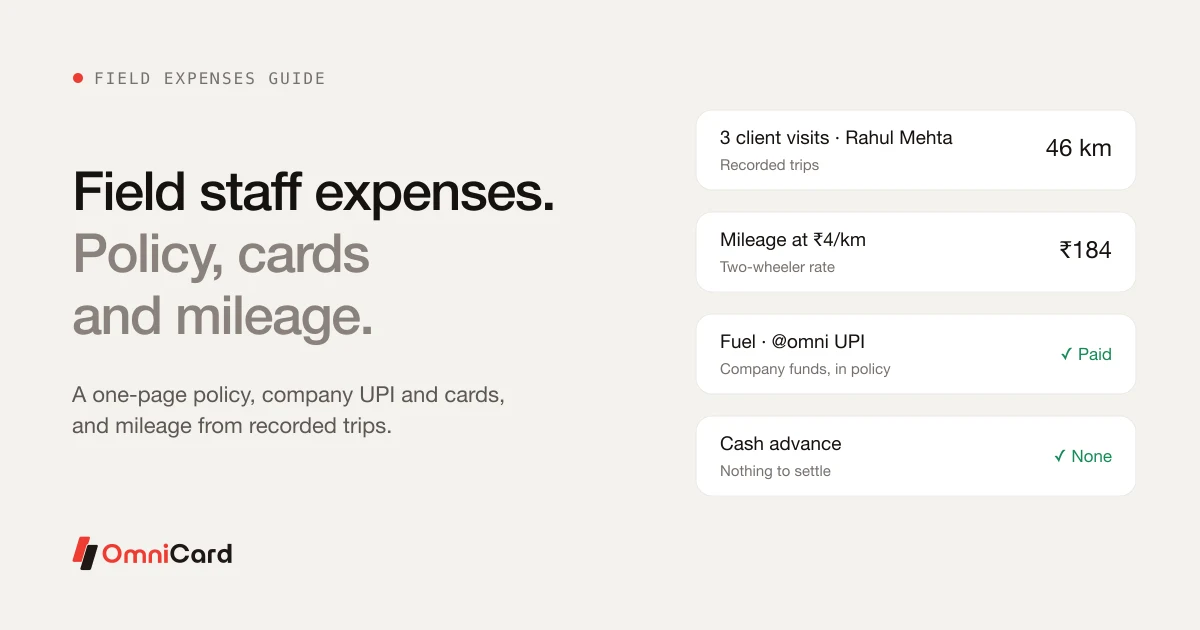
Example: Rahul Mehta, a field sales rep, records three client visits in a day. The trips add up to 46 km. At an example rate of ₹4 a km for a two-wheeler, the claim is ₹184, with the route and visit times attached. His manager approves in one tap, because the evidence is on the screen.
What it changes: managers approve with evidence, finance stops questioning round numbers, and staff are paid on the figure that was recorded, which tends to be fairer for them too.
Rolling out cards to a field team in a day
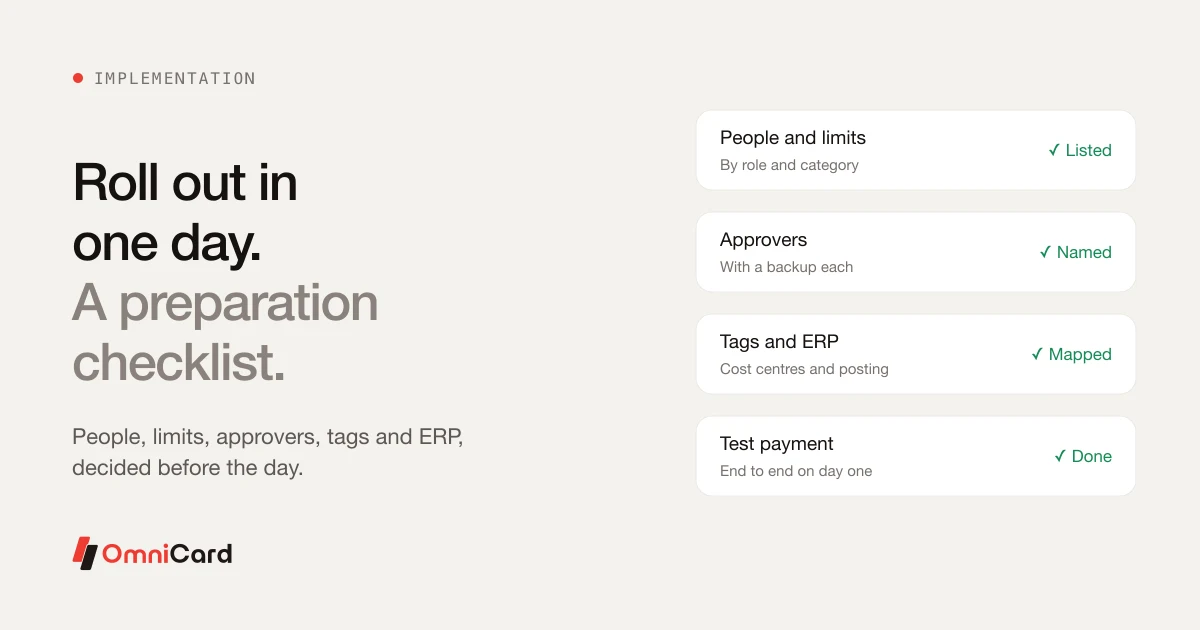
A same-day rollout is possible when the decisions are made beforehand. Most delays come from questions nobody had answered, not from the technology.
Before the day
- List everyone who will spend, with their team and manager.
- Decide limits by role and category, and the territories for location rules.
- Name approvers, with a backup for each.
- List cost centres and projects for tagging.
- Choose the ERP and agree how entries will post.
On the day
- Create users and limits
- Issue cards or UPI IDs
- Send staff a short note: what they can spend on, how to capture a bill, who to ask
- Test one payment end to end, from purchase to the ERP entry
After week one
Review declined payments and adjust limits that are too tight. Check that entries reached the ERP correctly, and that open cash advances from the old process are being settled.
Field expense checklist
- One-page field policy, with limits by role and city type
- Prepaid card or company UPI for each person who spends
- Location and time rules matched to territories and working hours
- Bills captured at payment, not at month-end
- Mileage from recorded trips, at a published rate
- A small tracked cash float for exceptions, settled weekly
- Spend tagged by route, visit or territory
- A weekly look at declines and exceptions in the first month
How OmniCard fits
On OmniCard, field staff pay by company UPI (an @omni UPI ID) or a RuPay prepaid card from company funds. Limits by employee, department, cost centre, category, merchant, location (geo-fencing) and time are checked before the payment goes through, and the bill is captured by OCR. OmniCard Motion handles field and travel spend, with GPS-verified trips, mileage calculated from KMs, and spend tagged by route. For the claims that remain, Reimburse360 gives managers one-tap approvals and settles automatically.
Businesses can go live the same day. OmniCard is run by Eroute Technologies Pvt. Ltd., an RBI-authorised Prepaid Payment Instrument (PPI) issuer and a direct NPCI issuer for RuPay cards, UPI (the @omni handle) and FASTag, with no sponsor bank in between.
For field-heavy sectors, see how this works for BFSI and NBFC lenders and logistics and fleet operators.
Frequently asked questions
What is field staff expense management?
It is how a company funds, controls and records the spending of employees who work away from the office: sales reps, collection officers, service engineers and site staff. It covers the expense policy, how staff pay, how bills are captured, and how mileage and travel are claimed.
Is a prepaid card better than a cash advance for field staff?
For most field spend, yes. A prepaid card or company UPI ID lets you set limits by category, merchant, location and time before the payment, and captures the bill at the time, so there is nothing to settle later. A small cash float is still useful where cards and UPI aren't accepted.
How should mileage be calculated for field staff?
From recorded trips rather than self-reported distances: record the trip with GPS as it happens, calculate kilometres from the record, apply the company's rate per km for the vehicle type, and attach the trip to the claim.
How long does it take to give a field team expense cards?
The rollout itself can take a day if users, limits, approvers, cost centres and ERP posting are decided beforehand. Plan a week of reviewing declines and adjusting limits afterwards.
What should a field sales expense policy include?
Travel (fuel, tolls, local transport, stays), meals while travelling, client costs, the mileage rate and how distance is measured, what needs approval, and who approves when the manager is away. Keep it to one page.
Keep reading

How Telecom Companies Improve Field Operations with Smart Expense Management
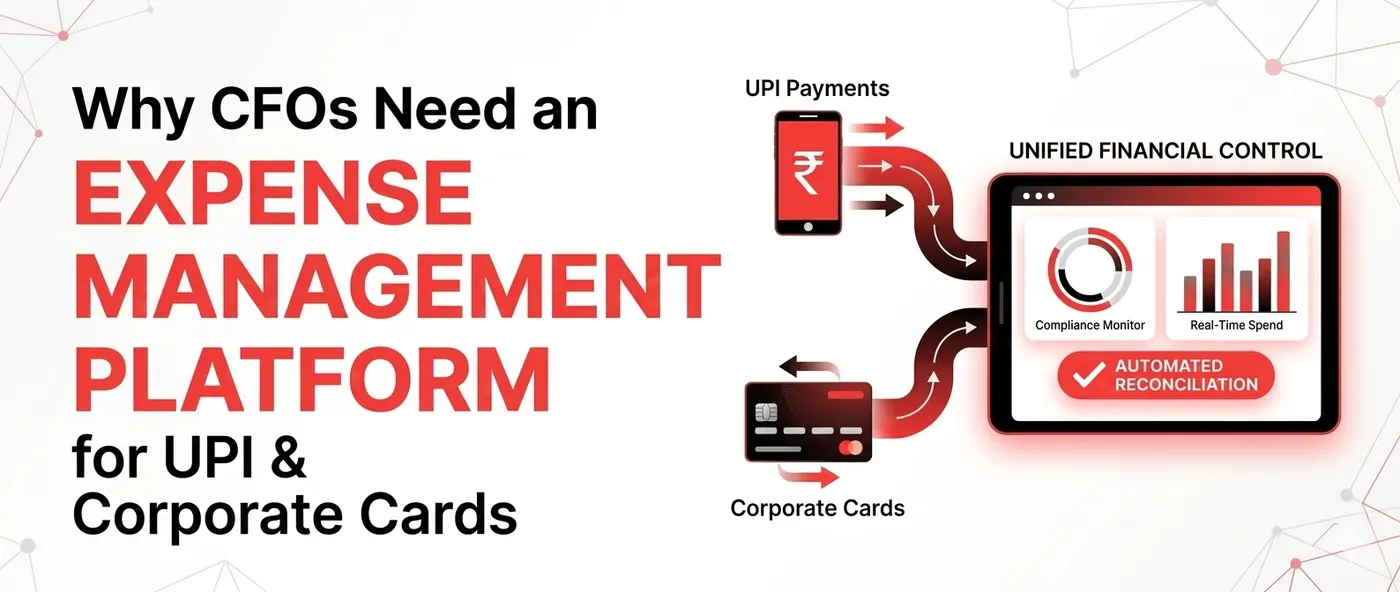
Why CFOs Need an Expense Management Platform for UPI & Corporate Cards
How Corporate Cards Streamline Spend Management
Which Expense Platforms Work Well for Companies with Both Office Staff & Large Field Forces like FMCG or Microfinance?
Why Every Business Needs Expense Management