Which Expense Platforms Work Well for Companies with Both Office Staff & Large Field Forces like FMCG or Microfinance?
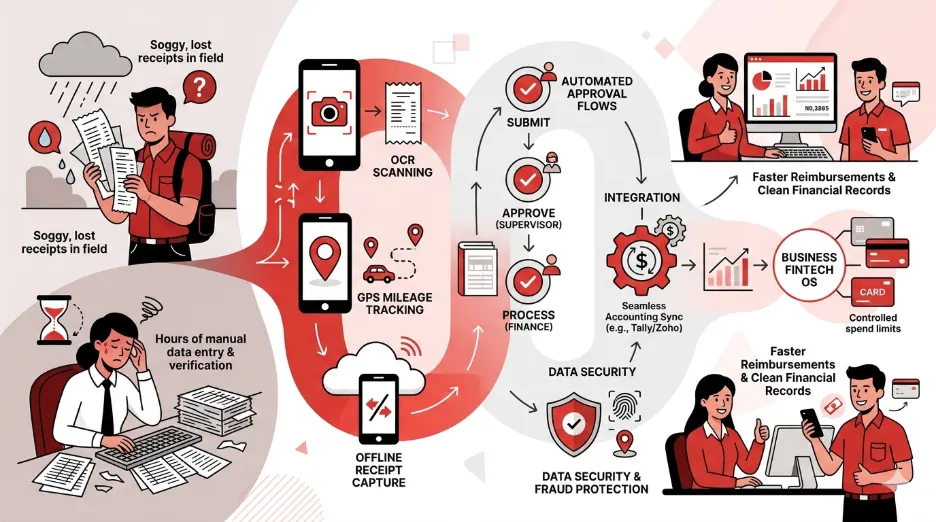
Picture your field agent standing in the rain with a soggy paper receipt, while your office accountant stares at a blank spreadsheet. This disconnect creates massive friction for hybrid workforces operating both on the road and behind a desk. We have all seen that dreaded shoebox of physical receipts at the end of the month, which causes exhausting headaches for everyone involved.
In practice, industries relying heavily on mobile teams, like FMCG or microfinance, pay a steep hidden tax of manual administrative overhead. Every lost piece of paper delays reimbursements and frustrates hard-working staff who just want to be paid back. The gap between a crumpled receipt in a delivery truck and a recorded line in an accounting ledger is exactly where businesses bleed productivity.

What to Expect from This Blog?
Navigating the complexities of a distributed workforce requires more than just a digital spreadsheet. In this guide, we break down:
The true cost of manual tracking and why physical receipts are a liability for Indian businesses.
The mechanics of modern expense management platforms and how they bridge the gap between field and office.
Specific solutions for FMCG and Microfinance, including GPS tracking and offline sync.
How to prevent fraud and ensure tax compliance with digital audit trails.
A practical comparison of tools, including how a Business FinTech OS like OmniCard simplifies corporate spending.

The High Cost of Lost Receipts: Why Hybrid Teams Struggle
A delivery driver rummaging through a truck cab for a faded fuel receipt, while an office administrator waits by a blank spreadsheet, illustrates the harsh reality of old-school tracking for hybrid teams. Most companies severely underestimate this administrative burden. Research suggests that traditional manual expense reporting costs businesses significantly in labor per single report just to process.
In the Indian context, these costs are amplified by:
Processing labor: Office staff spend hours chasing down FMCG reps for missing mileage or lunch details via WhatsApp or phone calls.
Human error: Manually typing numbers from a crumpled coffee receipt into a computer practically guarantees costly mistakes.
Tax reclamation gaps: When physical receipts fade in the sun or get lost entirely, businesses cannot legally claim GST input tax credit, leaving free money on the table.
Employee Frustration: Constant reimbursement delays frustrate field employees who shouldn’t have to float company costs from their personal bank accounts.
Fixing this broken system starts with transitioning from a cardboard shoebox to a smartphone with dedicated expense management platforms.
What is an Expense Management Platform? Bridging the Gap
Many view expense management software as just a digital shoebox, but it is actually a smart communication tool. For an Indian business, the magic begins with OCR (Optical Character Recognition).
Eliminating Manual Entry: Think of it like taking a photo for social media, except the camera instantly reads the numbers on a fuel receipt and types them out for you.
Automated Approval Flows: Instead of an employee physically handing paper to a manager, the "baton" passes instantly.
Instant Routing: When a delivery driver submits a cost from their phone, it routes directly to their supervisor for a one-click approval.
Accounting Integration: This feature acts as a universal translator, converting approved field expenses into the format your Tally or Zoho Books needs.
Centralized Control: A Business FinTech OS like OmniCard takes this further by providing corporate cards that eliminate the need for reimbursements entirely, as the spend is tracked the moment the card is swiped.
Solving the FMCG Logistics Puzzle: GPS and Offline Sync
When a delivery driver buys fuel on a rural route in Bihar or Karnataka without cell service, an internet-dependent app is useless. Expense management for FMCG requires specialized features:
Offline Synchronization: The ability to save data without a signal and automatically upload it once reconnected is a lifeline.
GPS Mileage Tracking: Replaces manual odometer logs with precise digital maps, ensuring drivers are paid fairly for the actual distance covered.
Automated Mileage Reimbursement: Uses GPS verification to calculate the exact route, preventing accidental overestimations and saving significant fuel costs.
Per Diem Management: Instead of tracking every single tea break, companies can use a fixed daily allowance (Per Diem) within the platform to keep the distributed fleet happy.
Bulk Receipt Upload: Lets agents submit an entire week’s worth of expenses in one tap when they return to a high-speed Wi-Fi zone.
Stopping Fraud in Microfinance: Digital Trails and Security
Managing cash across decentralized branches creates unavoidable risks. Expense management for microfinance must address the "distance" between the agent and the head office.
Location Stamping: Records the exact GPS coordinates where a receipt photo is taken. This proves an employee was actually at a client’s village.
Duplicate Detection: An automated scanner that instantly flags matching dates, amounts, or vendor names to prevent double-billing.
Audit-Ready Records: Digital trails remove the awkward internal friction of an accountant having to question an agent’s whereabouts.
Real-time Visibility: Using financial management apps allows head-office teams to see exactly how much cash is being spent across various districts in real-time, rather than waiting for month-end reports.
Choosing the Right Tool: Comparing Top Platforms
Finding the perfect fit means looking beyond flashy dashboards and focusing on "field friendliness."
Mobile App Quality: Is the UI simple enough for a driver to use with one hand while standing at a petrol pump?
Integration Ease: How smoothly does it connect to your current payroll and accounting tools?
Scalability: Can the software handle 10 agents today and 1,000 next year?
Comprehensive Suites: For companies looking for an all-in-one solution, OmniCard offers a unified platform where you can issue cards, set spend limits, and track every rupee spent in the field without the paperwork.
While tools like Expensify or Zoho Expense are popular for general use, larger companies often require the heavy-duty API capabilities of SAP Concur to sync with enterprise-level ERPs.
The Role of Financial Management Apps in Modern India
India's digital payment revolution (UPI, corporate cards) has changed how we view "spending." Financial management apps are no longer just for tracking; they are for empowering the workforce.
Reducing "Out-of-Pocket" Stress: By using corporate cards or digital wallets, field staff don't have to use their personal savings for company fuel or repairs.
Compliance with Indian Tax Laws: Ensuring that every expense has a valid GST-compliant invoice attached digitally makes year-end audits seamless.
Customizable Spending Limits: Managers can set daily limits for field agents, ensuring budgets are respected without needing constant manual oversight.
Your 4-Week Roadmap to Digitized Expenses
Moving from chaos to control doesn't happen overnight, but it can happen in a month.
Week 1: The Pilot Program: Choose five of your most adaptable field agents and run a simple trial of an automated workflow.
Week 2: Integration Testing: Connect your chosen platform to your accounting software to ensure data flows correctly.
Week 3: Feedback & Training: Gather input from the pilot group. Did the GPS tracking work? Was the offline sync reliable?
Week 4: Full Rollout: Onboard the rest of the team and officially retire the "shoebox" method.
By the end of this roadmap, you will find that technology does more than track Rs. 500 fuel slips; it protects the people moving your business forward and allows your accountants to focus on strategy rather than data entry.
Key Takeaways
Manual Costs: Traditional reporting costs businesses roughly Rs. 1,500+ in labor per report when including chasing, verifying, and correcting errors.
Field-First Features: GPS mileage tracking and offline sync are non-negotiable for industries like FMCG and logistics.
Fraud Prevention: Digital footprints (GPS stamping) and duplicate detection are the best defenses against "ghost expenses" in microfinance.
Unified Systems: Transitioning to a Business FinTech OS like OmniCard can eliminate the reimbursement cycle entirely by providing field agents with controlled corporate spending tools.
Tax Efficiency: Digital records ensure you never miss out on GST input tax credits due to faded or lost paper receipts.
FAQs
Q: Will an expense management platform work if my field agents travel to remote areas?
A: Yes, provided you choose a platform with "Offline Sync" capabilities. This allows agents to capture receipts and data without an active internet connection; the data uploads automatically once they reach a networked area.
Q: How do digital platforms prevent employees from over-claiming mileage?
A: Most modern financial management apps use GPS-based tracking. Instead of manual logs, the app calculates the exact distance between points A and B, ensuring the reimbursement matches the actual route taken.
Q: Is it difficult to integrate these tools with Tally or Zoho?
A: Most leading expense management platforms offer direct integrations or simple CSV exports designed specifically for popular Indian accounting software, making the transition quite smooth.
Q: Can these platforms help with GST compliance?
A: Absolutely. By requiring a photo of the invoice at the point of purchase, the system ensures that the GSTIN and other mandatory details are captured before the receipt is lost or damaged.
Q: Why should I choose a Business FinTech OS over a simple tracking app?
A: A simple app only tracks what has already happened (the spend). A platform like OmniCard allows you to manage the spend before it happens via cards with set limits, eliminating the need for employees to use their own money and wait for reimbursements.