Why CFOs Need an Expense Management Platform for UPI & Corporate Cards
Why CFOs Need an Expense Management Platform for UPI & Corporate Cards
Digital payments in India have evolved rapidly; from UPI-led vendor transfers to corporate card spends for digital ads and employee travel. For CFOs, this growth brings both opportunity and complexity.
While traditional tools simplify transaction routing, many finance teams still struggle with fragmented visibility, delayed reconciliation, and compliance gaps across UPI and prepaid card systems.
The real question for finance leaders is not just how to enable digital payments—it is how to centralize control, governance, and reporting across all of them.
What Is an Expense Management Platform in India?
An expense management platform is a digital ecosystem designed to automate and govern the end-to-end lifecycle of business spending. Unlike simple payment tools, it provides a centralized framework to authorize, track, and reconcile all company outflows, including vendor payments via UPI and employee spends on corporate cards in real-time.
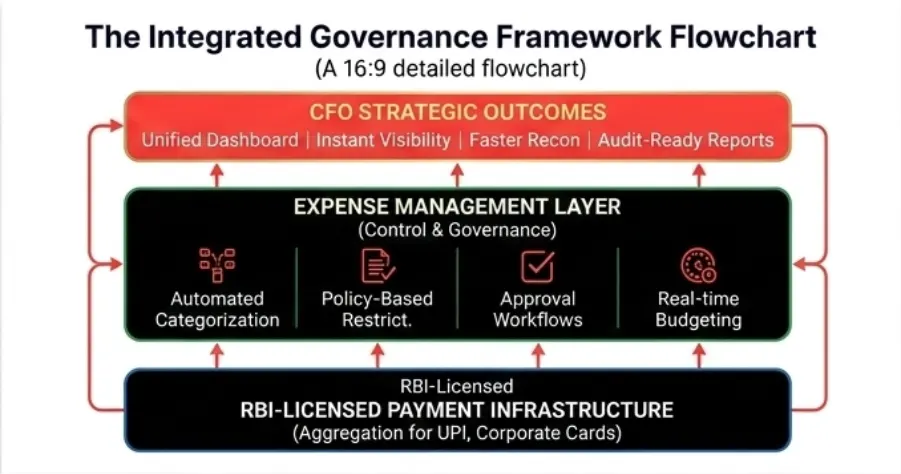
In India, advanced platforms often operate with an RBI-authorized PPI (Prepaid Payment Instrument) license, allowing them to issue secure corporate cards and digital wallets. This ensures that every transaction is not only processed efficiently but is also backed by strict regulatory compliance, multi-level approval workflows, and instant policy enforcement.
Why Payment Fragmentation Is a CFO-Level Risk?
Most mid-to-large Indian businesses today operate across multiple payment rails:
- UPI for business payments to vendors, freelancers, and partners.
- Corporate or prepaid cards for marketing spends, SaaS subscriptions, and employee travel.
- Separate reconciliation tools and disconnected tracking systems.
While each system works independently, this fragmentation creates operational blind spots:
- Delayed reconciliation cycles: Finance teams spend days matching bank statements to internal vouchers.
- Manual settlement tracking: High margin for human error in data entry and expense filing.
- Policy enforcement challenges: Difficulty in stopping unauthorized spends before they happen.
- Audit complexity: Fragmented data leads to longer, costlier, and more stressful audit cycles.
For CFOs responsible for financial governance, this fragmentation increases risk, not just operationally, but from a compliance standpoint.
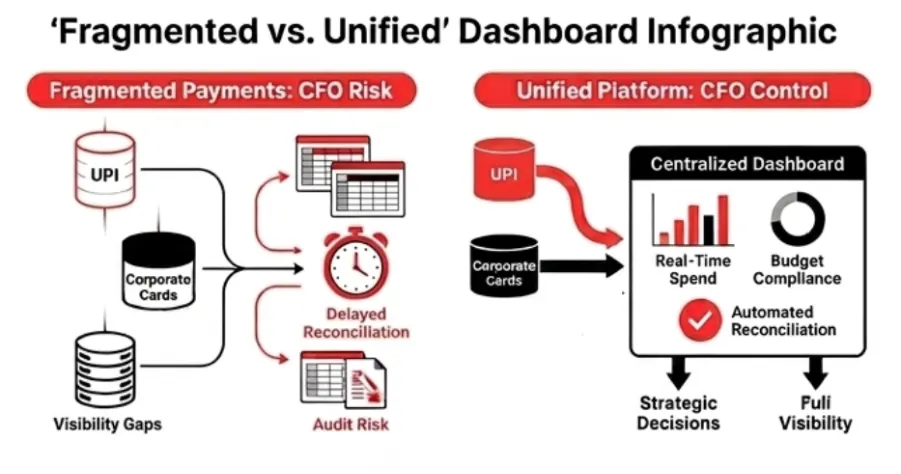
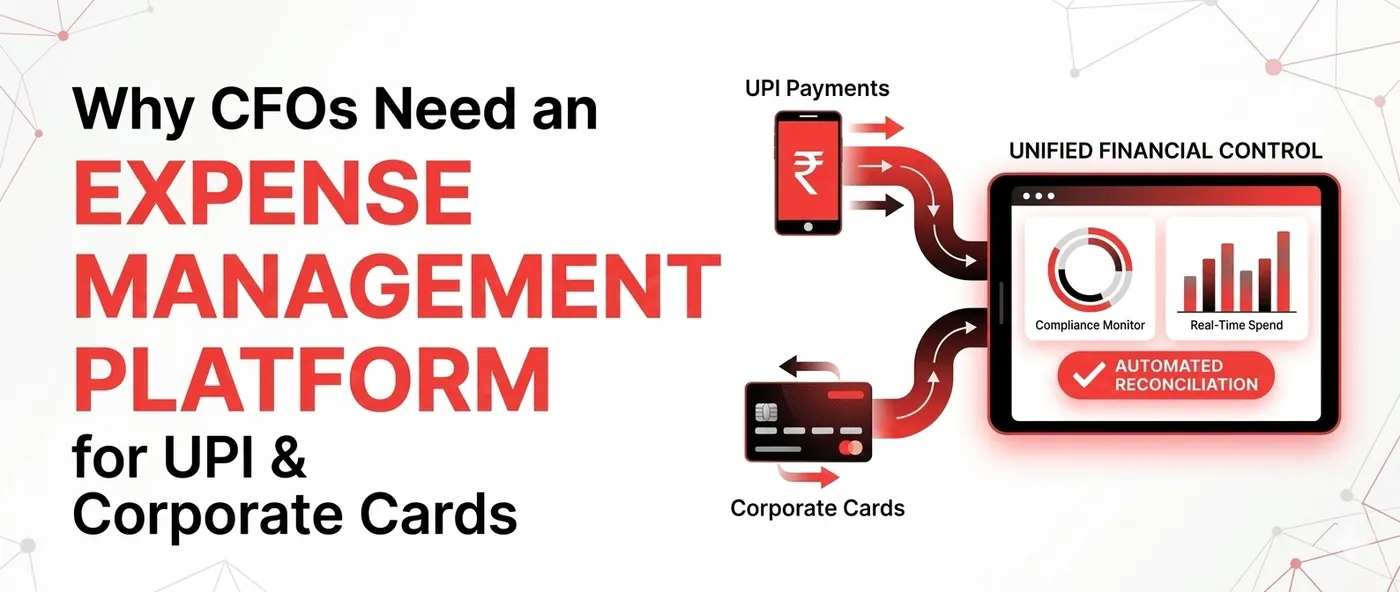
The Need for Centralized Payment Management : An expense management platform simplifies the front-end of digital payments, but finance leaders need more than just "pipes"; they need a "brain" for their money.
An expense management platform simplifies the front-end of digital payments, but finance leaders need more than just "pipes"; they need a "brain" for their money.
Centralization provides:
- Unified Dashboards: One single view for every rupee leaving the organization.
- Real-time Visibility: Instant insights into marketing, travel, and operational spends.
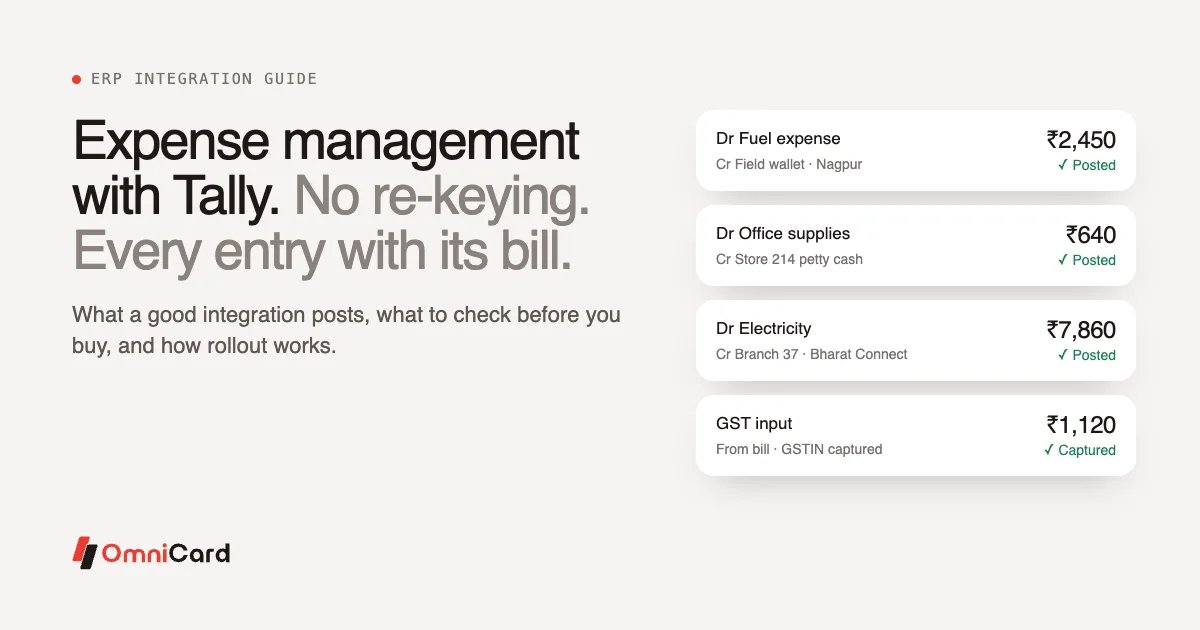
- Automated Reconciliation: Syncing transactions directly with ERPs like Tally, Zoho, or SAP.
- Policy-driven Controls: Setting spend limits by employee, department, or specific vendor categories.
The shift CFOs are making today is from “accepting payments efficiently” to “managing payments strategically.”
Integrating UPI & Prepaid Cards Under One Control Layer :
UPI for Business UPI is now the default for B2B payments in India. However, standalone UPI lacks the structured reporting required at enterprise scale. An integrated platform adds an approval layer to UPI transfers, ensuring every vendor payment is authorized and categorized the moment it happens.
Prepaid Cards for Businesses Using an RBI-authorized PPI license, businesses can allocate controlled spend limits to employees or departments. These cards are essential for managing digital marketing budgets and travel expenses, drastically reducing the risk of fund misuse or overspending.
The Strategic Advantage of Unification
When UPI payments and prepaid corporate instruments flows are integrated into one system, CFOs gain:
- Consolidated reporting
- Cross-functional spend tracking
- Faster reconciliation
- Budget-to-actual comparison visibility
- Stronger compliance posture
This is where modern digital payment solutions for businesses must evolve from siloed tools to integrated financial infrastructure.
Why Basic Payment Routing Alone Is Not Enough?
Many organizations assume that having a payment gateway or a basic bank portal solves the problem. However, those tools only handle the "movement of money."
An expense management platform governs the "control of money."
It adds:
Automated Categorization: Instantly knowing what was spent on SaaS vs. Marketing vs. Travel.
Budget Enforcement: Automatically blocking card transactions that exceed pre-set monthly limits.
Approval Workflows: Multi-stage digital signoffs for high-value UPI vendor payments.
As an RBI PPI-licensed provider, OmniCard combines these payment instruments with expense governance tools, allowing businesses to manage everything within one structured ecosystem.
What CFOs Should Look for in an Expense Management Platform?
Regulatory Compliance: Full alignment with RBI guidelines and strict data localization.
Integration Capabilities: API-based connectivity with existing accounting and ERP systems.
Reporting & Visibility: Real-time dashboards with customizable views for different cost centers.
Governance Mechanism: Robust audit trails and instant policy enforcement features.
The CFO’s Strategic Shift - From Payments to Financial Control:
India’s digital payments ecosystem is only becoming more complex. UPI adoption continues to grow, card-based corporate spending is expanding. The CFO’s mandate today includes:
- Reducing reconciliation cycles
- Strengthening financial controls
- Ensuring regulatory compliance
- Improving cash flow visibility
- Minimizing fraud exposure
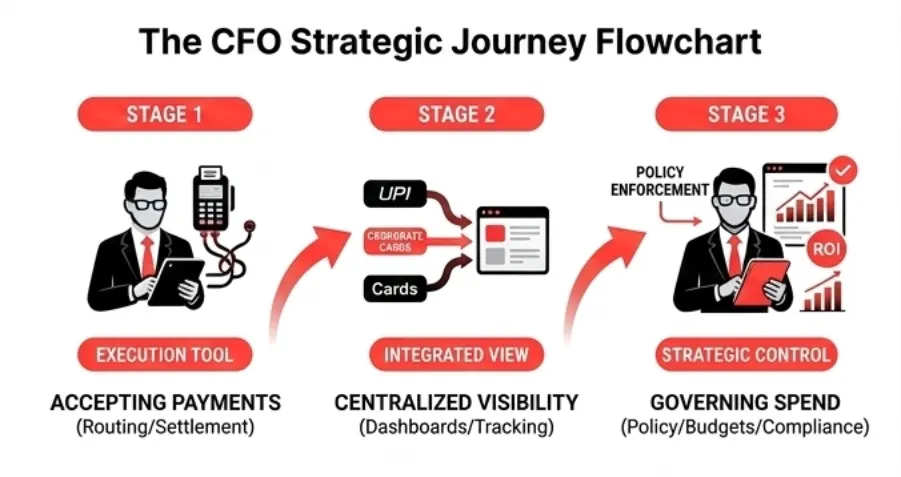
The transition from fragmented payment tools to a unified expense management platform is no longer just a technical upgrade, it is a strategic necessity. Forward-thinking CFOs are already moving away from siloed bank portals toward integrated platforms like OmniCard. By centralizing UPI and corporate card spends today, you aren't just simplifying your reconciliation; you are future-proofing your organization's financial infrastructure.