Why Employees Shouldn't Pay Company Expenses From Their Own Account
In many Indian companies, field staff, store managers and sales teams pay for fuel, travel, vendors and supplies from their own UPI, debit or credit card, then claim the money back. It feels convenient, but it creates problems for the employee and for the company: tax records that don't match income, lost GST credit, weeks of waiting for money, and spend that nobody controls until it's already gone.
Pay business costs from company money instead. With OmniCard, staff pay by UPI or RuPay prepaid card from company funds, within limits checked before each payment. See how it works →
1. It can show up in the employee's tax records
Banks and card issuers report certain high-value transactions to the Income Tax Department as Specified Financial Transactions (SFT). For credit cards, this covers bill payments that add up to ₹10 lakh or more in a financial year (or ₹1 lakh or more paid in cash). These transactions appear in the person's Annual Information Statement (AIS).
When an employee puts large company expenses on a personal card, the spend sits in their records, not the company's. If it looks high compared with the income they declare, the department may ask them to explain it, for example through a compliance message or a notice. The reimbursement is usually not taxable income when it's for actual business expenses backed by bills, but the employee may still have to show the paperwork.
What this means: don't make employees carry company spend on their personal cards and accounts. Keep business spend in business money.
2. The company can lose GST input tax credit
To claim input tax credit, the tax invoice generally has to be in the company's name with its GSTIN. When an employee pays at a counter from their own account, the bill often carries no GSTIN, or the employee's name, and the credit is lost.

3. Employees wait for their own money
Out-of-pocket spend means employees fund the company's working capital until the claim is approved and paid, often weeks later. For field teams on modest salaries, that's a real burden, and late reimbursements hurt morale.
4. Nobody controls the spend until it's gone
With personal payments, policy is checked at month-end when the claim arrives, if at all. By then the money is spent, bills may be lost, and duplicate or inflated claims are hard to spot.
The better way: company money, controlled at the point of payment
Give employees a way to pay from company funds, with your rules applied before the money moves:
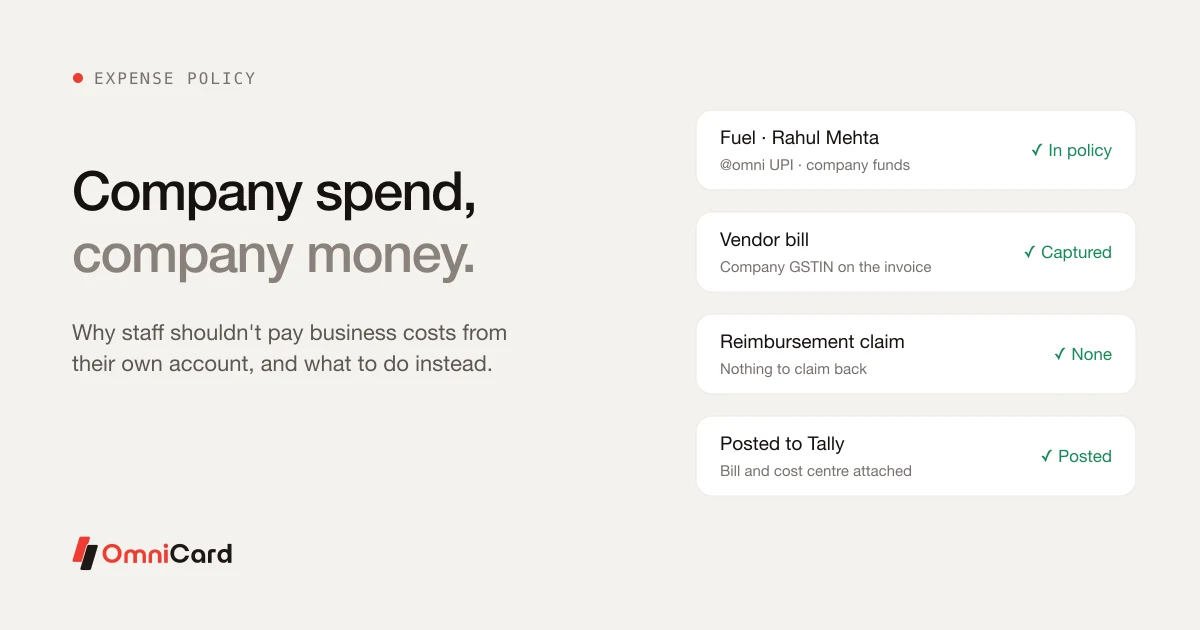
- Company UPI IDs and prepaid cards. OmniCard gives each employee an @omni UPI ID and a RuPay prepaid card loaded by the company. They pay vendors, fuel stations and stores from company money, not their own.
- Rules checked before payment. Limits by employee, department, cost centre, category, merchant, location and time are checked at authorisation; an out-of-policy payment is declined.
- Bills captured on the spot. Staff snap the bill in the app; OCR reads and files it with the payment.
- Posted to your books. Approved spend posts to Tally, SAP, Oracle, Zoho or Microsoft Dynamics, with the bill and cost centre attached.
- Nothing to claim back for spend made this way. For genuine out-of-pocket costs, Reimburse360 handles OCR bills, one-tap approvals and automatic settlement.
OmniCard is an RBI-authorised Prepaid Payment Instrument issuer and a direct NPCI issuer for RuPay cards and UPI.
See expense management → · Reimburse360 →
FAQs
Is a reimbursement of business expenses taxable for the employee? Generally no, when it reimburses actual expenses incurred for the employer's business and is backed by bills. Fixed allowances or reimbursements without proof can be treated differently. Check your case with a tax adviser.
Why would company spend on a personal card matter for the employee's taxes? High-value card payments are reported to the Income Tax Department and appear in the employee's AIS. Large spending that doesn't match declared income can lead to questions, even when the money was later reimbursed.
How do we stop employees paying from their own money? Give them company-funded payment methods with built-in limits, such as company UPI IDs and prepaid cards, so business spend never goes through personal accounts.
This article gives general information, not tax advice. Rules change; please consult a tax adviser for your situation.