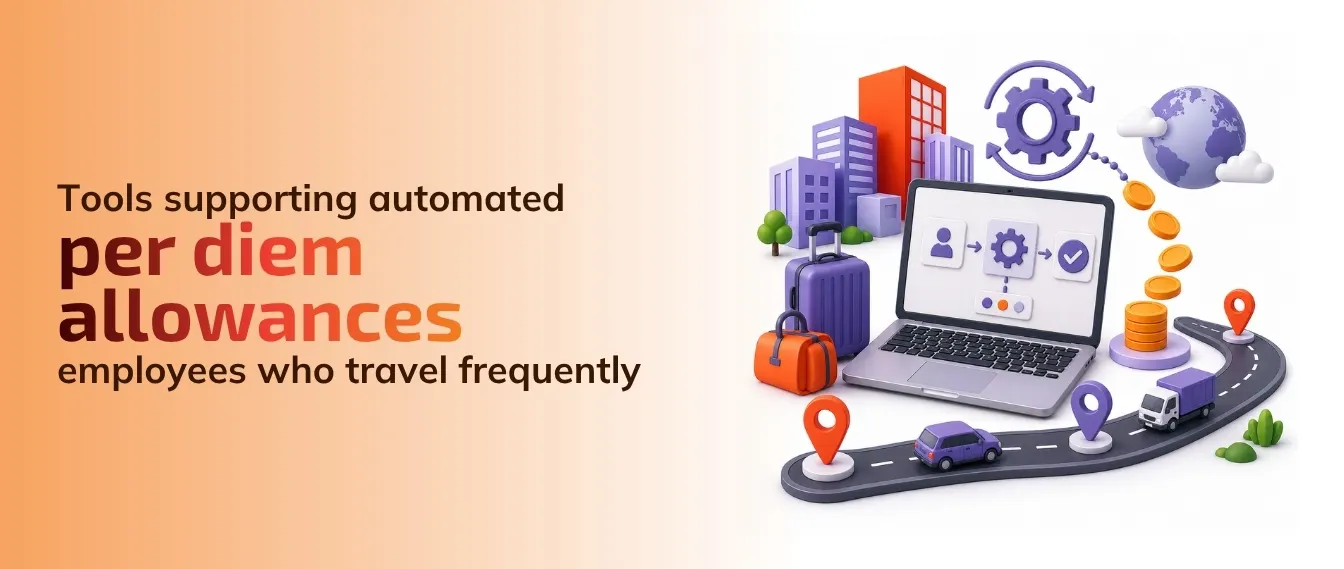
We want to automate per diem allowances for employees who travel frequently. Which tools support this well in India
Recall your last business trip to Mumbai. Between back-to-back client meetings and navigating city traffic, you likely ended up with a wallet stuffed full of crumpled auto-rickshaw slips and faded restaurant bills. For most professionals, returning home simply marks the beginning of the dreaded paperwork phase, trying to match actual spending to fragile pieces of paper.
What to Expect from This Blog?

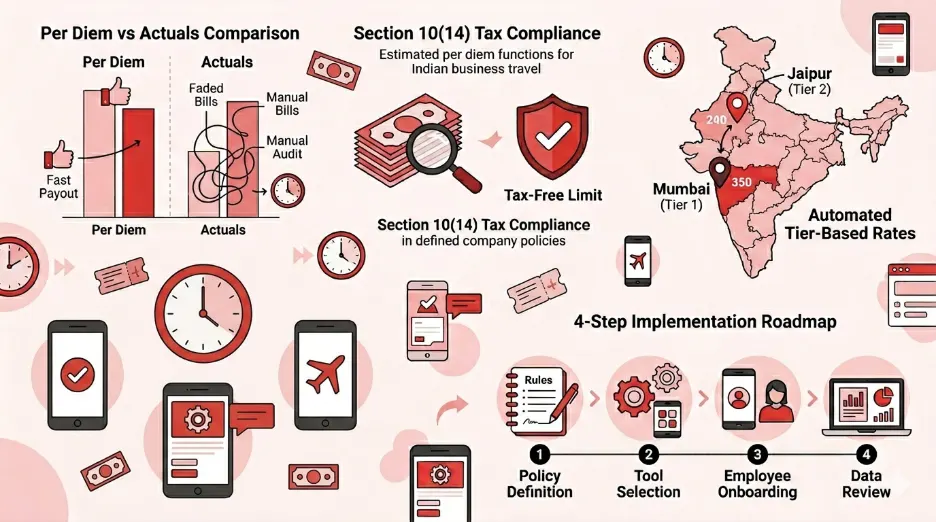
A deep dive into why fixed per diems are superior to the "Actuals" model for frequent Indian travelers.
Clarity on Section 10(14) of the Income Tax Act and how to automate compliance.
An exploration of Tier-based logic (Mumbai vs. Jaipur) and how GPS-enabled tools handle it.
A comparison of top automation tools available in India, including how a Business FinTech OS can bridge the gap.
A 4-step roadmap to transition your team from paper-heavy processes to digital efficiency.
Why Fixed Per Diems Beat 'Actuals' for High-Frequency Travel?

Under the traditional actual expense reimbursement model, business travel often ends with hours spent matching faded food receipts to a claim form, hoping nothing got lost in transit. This "Actuals" method demands physical proof for every single Rupee, causing endless back-and-forth emails with finance.
Switching to a per diem model transforms the entire travel experience. Here is why frequent flyers and finance teams prefer it:
Pace of Payouts: Actuals delay your money due to manual verification. Per diems increase payout velocity because fixed rates are pre-approved in the system.
Precision and Accuracy: Reducing manual errors in travel expense claims happens instantly. Fixed rates remove the tedious task of bill-matching and human calculation errors.
Fraud Prevention: Fixed allowances naturally aid in preventing travel expense fraud. By capping daily spending limits, you eliminate the risk of altered or inflated paper bills.
Administrative Relief: HR and Finance save hundreds of hours by not auditing every single cup of chai or auto-rickshaw fare.
Employee Satisfaction: Travelers feel empowered. If they choose a budget meal, they keep the savings, which acts as a minor incentive for the "hardship" of travel.
The Hidden Cost of Manual Filing
According to common industry data, the average employee spends three grueling hours a month just filing these claims. To eliminate this hidden time-cost, many businesses now prefer a per diem model—essentially a fixed daily pocket money allowance. Automating per diem allowances for employees who travel frequently in India takes this logic further by letting software handle the complex tax rules and city-tier calculations automatically.
By interacting only with the functional layer of intuitive travel management software, employees experience a seamless shift from paper chaos to digital efficiency. These expense management tools act as smart digital calculators, instantly determining your daily rate without requiring manual data entry. Ultimately, this system recovers those lost three hours and brings a welcome end to the paper trail.
Decoding Section 10(14): Keeping Your Allowances Tax-Free Automatically
Getting a fixed daily travel allowance feels great until January rolls around and finance warns you about unexpected tax deductions. Navigating the income tax rules for daily allowance in India often feels like walking through a minefield of confusing legal text.
The Exemption Rule: Under Section 10(14) of the Income Tax Act, allowances given to meet ordinary daily charges on a business tour are non-taxable, provided they are spent for that purpose.
The "Spent" Logic: While you don't need to submit every bill to the IT department, the allowance must be reasonable. If a company pays Rs. 5,000 per day but the employee only spends Rs. 500, the excess could theoretically be taxed.
The Digital Auditor: Today, smart expense management tools replace guesswork with automated compliance flagging. The system analyzes your allowance and silently alerts HR if an amount crosses into taxable territory.
Simplified Reporting: Modern platforms generate tax-ready reports at the end of the financial year, ensuring that "Per Diem" doesn't turn into "Tax Liability."
The Mumbai-vs-Jaipur Logic: Automating Tier-Based Rate Variations
Imagine landing in Mumbai but accidentally claiming the lower daily allowance for Pune. Your finance team immediately rejects the claim, frustratingly delaying your payout. By implementing automated travel allowance workflows, modern expense applications act as intelligent processing engines.
Companies in India typically divide destinations into specific tiers to keep payouts fair:
Tier 1 (Metros): Cities like Mumbai, Bangalore, and Delhi automatically trigger higher daily allowances (e.g., Rs. 2,500/day) to match expensive transit and meals.
Tier 2 (Emerging Hubs): Cities like Jaipur, Lucknow, or Chandigarh apply adjusted, slightly lower limits (e.g., Rs. 1,500/day) reflecting the local cost of living.
Tier 3 (Regional Towns): Standard rates for smaller towns where costs are significantly lower.
GPS Verification: Per diem automation tools in India use pin-code logic or GPS check-ins to lock in the correct rate, stopping manual guesswork and "tier-inflation."
The Role of GST in Per Diem Automation
The best expense management tools for Indian SMEs feature built-in GST integration. This acts as a safety shield, automatically capturing the correct tax details from hotel or local vendor bills. This allows the company to claim Input Tax Credit (ITC), effectively reducing the cost of travel by 12% to 18%.
Deep Dive: Why Automation is Non-Negotiable for Scaling Teams
As your sales or audit teams grow from 10 to 100 frequent travelers, the "spreadsheet method" breaks. Here is what happens when you don't automate:
Reimbursement Bottlenecks: Finance spends 40% of their week just verifying food bills.
Lack of Visibility: Leadership has no idea how much is spent on "Daily Allowances" until the end of the quarter.
Employee Resentment: High-performing employees shouldn't have to act as "bankers" for the company, waiting 30 days to get their Rs. 15,000 travel refund.
By using a unified travel management software, you gain a "God-view" of company spending. You can see which cities are costing the most and adjust your per diem rates based on real-time data rather than 5-year-old policies.
From Paper to Payout: A 4-Step Implementation Roadmap
Switching from a messy folder of paper expenses to a sleek app requires a simple game plan.
Policy Definition: Map your travel allowances to Indian city tiers. Be clear—does the per diem cover just food, or food and local commute?
Tool Selection: Pick per diem automation tools in India that offer mobile apps. If it’s not on the phone, the employees won't use it.
Digital Onboarding: Guide your team through a "mobile-first" habit. Show them how to tap once to start their trip and once to end it.
Audit Shift: Transition your finance team to trust the 100% paperless audit trail. Move away from demanding physical "puchis" (slips) for every small expense.
The Future of Travel: Integrated FinTech OS
The next evolution of travel isn't just a software app; it’s an integrated ecosystem. Platforms like OmniCard are redefining this by moving away from "reimbursement" entirely. When the travel management software is linked to the actual payment source (corporate cards), the "Per Diem" is no longer a claim—it's a pre-set limit.
Instant Funding: Load a traveler's card with their Rs. 2,000 daily limit.
Zero Paperwork: The transaction is recorded the moment the card is swiped at a restaurant in Bangalore.
Automatic Reconciliation: The finance team sees the spend categorized instantly, with no manual filing required by the employee.
Your New Travel Reality: Zero Paper, Zero Stress
You no longer have to dread the month-end expense filing rush. Embracing the digital transformation of corporate travel spend trades hours of frustration for instant clarity. Smart software effortlessly handles location-based allowances without complex manual math, guaranteeing compliance and protecting the company's bottom line.
By adopting a Business FinTech OS approach, you ensure that your employees are focused on the client, not the receipt. Future business trips should focus entirely on successful meetings, leaving the days of guarding fragile paper slips firmly in the past.
Key Takeaways
Per Diem vs. Actuals: Per diems reduce paperwork by 90% and eliminate the need for bill-matching.
Tax Compliance: Section 10(14) allows tax-free allowances for business travel, provided they are managed through structured expense management tools.
City Tiers: Automation solves the "Mumbai vs. Jaipur" pricing gap by using GPS/Pin-code logic to apply correct rates.
GST Benefits: Automated tools help Indian companies reclaim GST on hotel and travel bills, saving up to 18%.
The Roadmap: Start with a clear policy, choose an Indian-centric tool, and move to a 100% paperless audit.
FAQs
Q: Is a daily allowance fully tax-exempt in India?
A: Yes, under Section 10(14), as long as it is granted specifically for business travel and is "actually incurred." Automated tools help document this "incurred" status without requiring individual food bills.
Q: Can we set different per diem rates for different employee levels?
A: Absolutely. Most travel management software allows you to set hierarchy-based limits (e.g., Senior Managers vs. Sales Executives) across different city tiers.
Q: Do I still need to keep physical bills if I use per diem automation?
A: For the employee, usually no. For the company, a digital scan (OCR) is often sufficient for internal audits, though high-value items like hotel stays should always have a digital GST invoice attached.
Q: How does the software know if the employee is actually in a Tier 1 city?
A: Modern per diem automation tools in India use mobile GPS "Check-ins" or integration with flight/train bookings to verify the traveler's location.
Q: What is the benefit of using a tool like OmniCard for this?
A: OmniCard acts as a Business FinTech OS, allowing you to provide the per diem amount via a corporate card. This removes the "out-of-pocket" burden from the employee and automates the recording of the expense in real-time.