Expense Fraud: Common Patterns and the Checks That Catch Them
Most expense misuse is not dramatic. It is small, repeated and easy to miss when claims are checked by hand at month-end. Knowing the usual patterns tells you where to put checks, and why a check that runs before the payment works better than one that runs after. This guide lists the five patterns finance teams meet most, what each looks like in the data, the check that catches it, and how to introduce checks without making honest staff feel watched.
Key numbers
- A 2015 GBTA Foundation study (with HRS) found one expense report costs about $58 and 20 minutes to process, and that 19% contain errors or missing information, costing a further $52 and 18 minutes each to fix. Source: GBTA Foundation, article dated 20 Oct 2015.
- UPI processed 25.47 billion transactions worth ₹31.53 trillion in October 2026, up 23% in volume and 16% in value on a year earlier. Source: NPCI data reported by Free Press Journal, 2 Nov 2026.
- The Belgian Waffle Co., with 250 stores, reports 50% fewer man-hours on reconciliation after moving to OmniCard. Source: OmniCard customer result (omnicard.in/belgian-waffle).
Why manual checking misses so much
Manual review depends on a person reading each claim and remembering what they saw last week. The GBTA Foundation study above shows how often a plain expense report goes wrong: about one in five contained errors or missing information. If honest mistakes are that common, deliberate ones hide easily among them. The fix is not more reading. It is rules that apply the same way to every payment, and records that make a pattern visible.
Pattern 1: the same bill twice
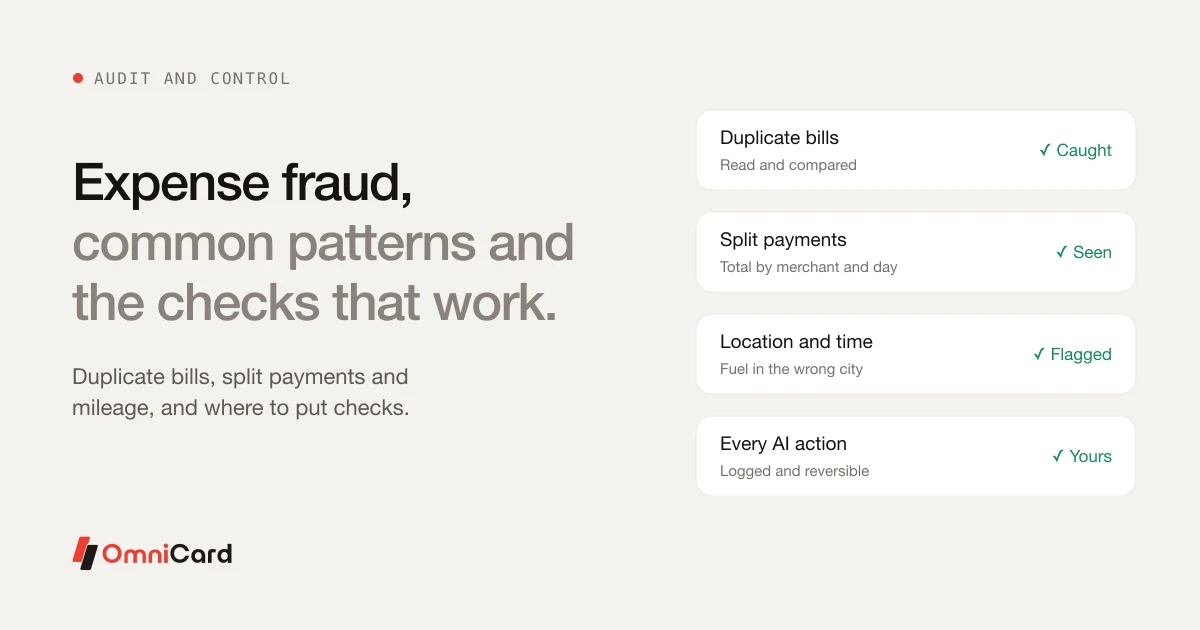
A bill is claimed through a reimbursement and again through a card, or submitted by two people. It is the most common pattern and the easiest to catch when every bill is read and compared on date, vendor and amount. Our guide on duplicate payments shows how to set the comparison.
Pattern 2: splitting a payment to stay under a limit
A purchase above a limit is split into two or three smaller payments at the same merchant on the same day. A per-payment limit never sees it. A rule that totals spend by person, merchant and day does.
Pattern 3: personal spend in business categories
Fuel, meals or travel that belong to a weekend, not a work trip. Location and time rules help: fuel in a city the person does not work in, or a purchase at midnight on a holiday, is worth a question. See geo-fencing and time limits.
Pattern 4: altered or reused bills
A changed amount on a photo, or a bill from another month. Reading the bill by OCR and comparing it with the payment makes these stand out. Our note on receipt capture with OCR explains what OCR reads well and where a person should still look.
Pattern 5: mileage that does not add up
Self-reported kilometres that are round, repeated or longer than the route. Distance recorded from the trip itself removes the guesswork. See GPS-verified field trips and mileage.
How each pattern looks in the data and where to check it
| Pattern | What shows in the data | Check that catches it | When it runs |
|---|---|---|---|
| Same bill twice | Same vendor, date and amount in two records | Duplicate and anomaly check on read bills | After payment, daily |
| Split payment | Several payments, one merchant, one day | Rule on total by person, merchant and day | At payment |
| Personal spend | Fuel or meals outside the person's city or hours | Location and time limits | At payment |
| Altered bill | Bill amount differs from payment | OCR read compared with payment | At payment |
| Inflated mileage | Round or repeated distances | Distance from the recorded trip | At claim |
Where to put each check
The earlier a check runs, the less there is to recover. Use the table above to match each pattern to a check at the right moment.
Introducing checks without a culture of suspicion
Most staff follow the rules. Tell people what the rules are before they apply, set limits just above normal use for each role, and give a way to ask for more. Treat a flag as a question, not an accusation. Checks that feel like a trap push honest people to find workarounds, and workarounds are where real misuse starts.
How OmniCard fits
OmniCard checks policy before the money moves, with limits by employee, department, cost centre, category (MCC), merchant, location and time. Its Audit agent looks for duplicates and anomalies, its Receipt/OCR agent reads each bill, and OmniCard Motion records GPS-verified trips with mileage calculated from kilometres. Every AI action is logged, explainable and reversible by the finance team. Each payment carries who paid, where, what for, the bill and the policy it was checked against, which is the record an auditor asks for. OmniCard is run by Eroute Technologies Pvt. Ltd., an RBI-authorised Prepaid Payment Instrument (PPI) issuer and a direct NPCI issuer for RuPay cards, UPI (the @omni handle) and FASTag, with no sponsor bank in between. If you are comparing platforms, see our dated comparison with Happay, which uses the other company's own published information.
Common questions
What is the most common expense fraud?
The same bill claimed twice, followed by purchases split to stay under a limit. Both are easy to detect when every bill is read and compared with the payment.
Can software stop all misuse?
No. Software makes patterns visible early and applies limits before payment, but a finance reviewer still decides what a flag means.
Should limits be strict?
Set them just above normal use for each role, with a way to ask for more. Limits set too low push people to work around them.
Where should a small business start?
With the bill and the limit: capture every bill when the payment is made, and set a limit by category for each role. Add location, time and duplicate checks next.
Related: Duplicate payments · Audit-ready expense records
Keep reading
10 Common Expense Mistakes (and How OmniCard Fixes Them)
Month-End Close and Audit-Ready Expenses: A Finance Guide
Which Indian expense platforms can guarantee measurable cost savings, not just easier workflows?
Business Expense Tracker: Business Expense Tracking for Small Business Explained
A Guide Employee Expense Reimbursements