
Spend Management Software in India: Features That Matter
Spend management software helps a company see, control and record what it spends, across employees, branches and vendors. Tools differ a lot. This guide lists the features that decide how useful one will be for an Indian business.
Expense management vs spend management
Expense management usually deals with what employees spend and claim. Spend management is wider: it also covers vendor payments, bills, fleet costs and budgets. Many Indian businesses start with expenses and grow into the rest.
Features that matter
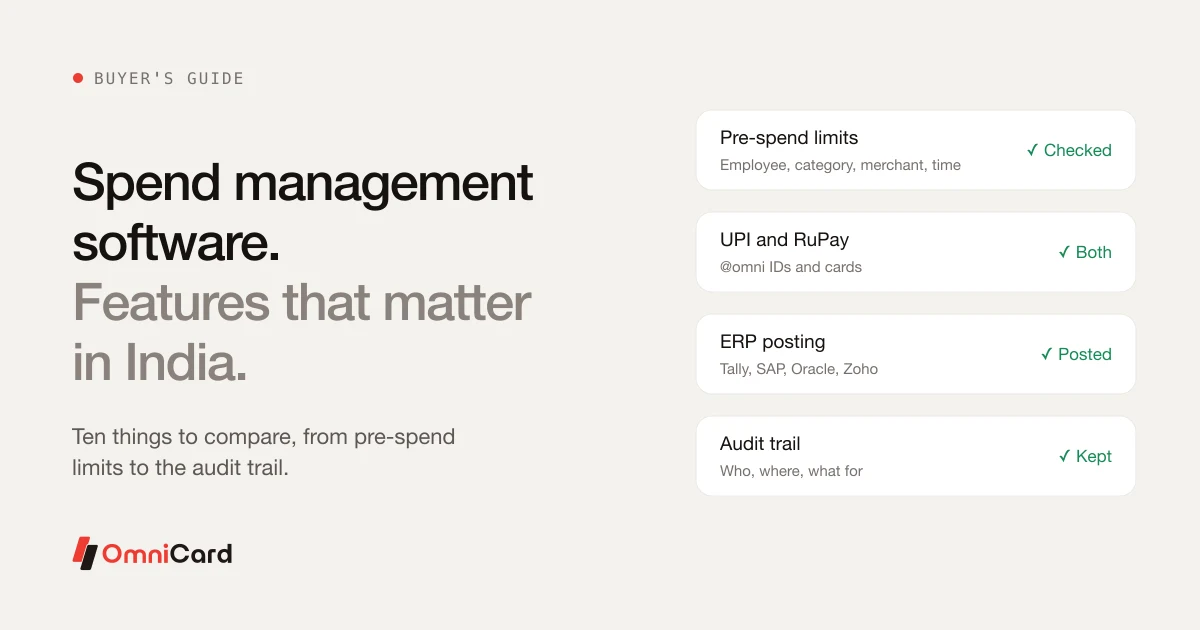
1. Control before the spend, not after. Limits by employee, department, cost centre, category (MCC), merchant, location and time, checked before the payment goes through.
2. Payments that suit India. Employees should be able to pay by UPI and by RuPay card, because that is how most small business payments happen. Employee UPI spend is offered by more than one provider, so check how the checks work.
3. Receipts tied to payments. Bill capture with OCR, linked to the payment.
4. Reimbursement without delay. Quick approvals and automatic settlement for the claims that remain.
5. Posting to your accounts. Tally, SAP, Oracle (NetSuite, Fusion), Zoho, Microsoft Dynamics and custom systems through APIs.
6. Multi-entity control. Group companies on one platform, with a master dashboard.
7. Audit trail. For each payment: who paid, where, what for, the bill and the policy it was checked against.
8. Bills, fleet and benefits. BBPS bill payments for every branch, FASTag for fleets, and employee benefits.
9. Security and compliance. Ask for ISO/IEC 27001, PCI DSS and SOC 2 Type II, and where payment data is stored.
10. Clear pricing. Whether fees are fixed or usage-based, and whether there are load, reload or inactivity charges.
Questions to ask any vendor
- Who issues the card and the UPI ID: the vendor or a partner bank?
- At what moment is a rule checked: at payment, or later?
- How long does set-up take?
- What does the audit trail show?
How OmniCard answers them
OmniCard is run by Eroute Technologies Pvt. Ltd., an RBI-authorised Prepaid Payment Instrument (PPI) issuer and a direct NPCI issuer for RuPay cards, UPI (the @omni handle) and FASTag, with no sponsor bank in between. Because it is the issuer, policy is checked at authorisation: a restricted payment is declined before money moves. Businesses can go live the same day. Pricing is a fixed fee covering all wallets or a flexible usage-based plan, with no load or reload charges on business wallets and no inactivity fee on business accounts.
More than 1,000 businesses run on OmniCard, from 700-store QSR chains to NBFCs with 5,000 branches. For a comparison with other providers using their own published information, see our comparison pages.
Keep reading
Signs Your Business Needs a Spend Management Tool (and Which of the Top 10 Fits)
Best Expense Management Software in India (2026 Guide)

Spend Management for Real Estate Developers Handling Multiple Projects
Tail Spend Management: What It Is and How To Manage It
Spend Management for Accounting Firms Managing Client Expenses