Spend Management for HR Firms Managing Recruitment Campaigns

You have just launched three urgent searches, and suddenly, unexpected invoices from LinkedIn, Indeed, and a niche developer board are hitting your desk from different directions. According to industry surveys of agency owners, this unmonitored chaos causes silent budget leaks that rapidly drain overall campaign profitability.
Navigating these costs requires understanding the difference between recording history and steering the future. Traditional accounting simply logs what happened—like realizing you overspent at the grocery store only after returning home. Conversely, proactive spend management with OmniCard acts like a detailed shopping list with a strict cash limit**.**
What to expect from this blog:

A guide to identifying and stopping "tail spend" on niche job boards using OmniCard control features.
Strategies for real-time visibility into recruitment advertising ROI.
Methods to automate approvals and reduce administrative paperwork.
A 30-day roadmap to transform your recruitment financial operations.
Key Takeaways:
Centralize Approvals: Use a "single front door" approach to vet one-off fees.
Real-Time Monitoring: Shift from monthly reviews to live OmniCard dashboards.
Consolidate Billing: Reduce "receipt hunting" by funneling multi-channel expenses.
Automate Guardrails: Set digital budget caps to prevent unexpected "surge" charges.
Audit for ROI: Conduct quarterly "zombie subscription" sweeps.
Curing the 'Tail Spend' Headache with OmniCard

The accumulation of small, unmanaged expenses—minor invoices for Rs.50 here and Rs.150 there from obscure websites—is known as tail spend. In HR, this acts like a leaky faucet on your budget. While major contracts with LinkedIn or Monster are easily monitored, effective recruitment leadership requires capturing these tiny outlays.
Left unchecked, recruiters might buy one-off resume database access without asking. This creates "rogue spending" that quietly destroys campaign profitability. To stop this leak:
Implement a Single Front Door: Everyone must seek approval before using a company card, routed through OmniCard's approval engine.
Use Smart Corporate Cards: Deploy cards with built-in limit controls to ensure niche allocations stay within budget.
Vet Before Buying: Use a quick checklist to confirm the candidate demographic can't be reached through existing platforms. The Dashboard Camera Approach
Waiting until the end of the month to review your campaign budget is like checking a map only after you have crashed. While you likely understand digital ad metrics like cost-per-click (CPC), relying on retrospective reviews leaves you blind to active spending.
You need a dashboard camera for your budget instead, showing you the financial road while you are actively driving. Utilizing a talent acquisition financial analytics dashboard shifts your workflow from retrospective reporting to active monitoring.
| Metric | Traditional Review (Monthly) | Real-Time Spend Management |
|---|---|---|
| Visibility | 30 days late | Instant/Daily |
| Ad Adjustments | Reactive (Next month) | Proactive (Mid-campaign) |
| Budget Leakage | High (Unnoticed until paid) | Low (Capped at source) |
| Admin Effort | Manual receipt chasing | Automated data sync |
Closing the Front Door on Administrative Chaos
You likely use dozens of tools to find talent, but processing invoices from every niche job board and screening service creates chaos. Instead of letting every vendor slip a bill under different doors, you need a unified entry point.
Transitioning to a model of centralized billing for multi-channel postings provides three distinct benefits:
Streamlined Invoices: Turn dozens of chaotic receipts into one predictable payment stream.
Smarter Seat Management: Easily spot and cancel duplicate recruiter licenses for major platforms.
Better Vendor Leverage: Negotiate bulk discounts by showing job boards your firm’s true aggregate spending power.
Freelancer Payouts: Simplify how you pay contractors or external headhunters by routing them through the same funnel.
Automating Approvals: Preventing the Rs.1,000 "Oops"
Waiting for email replies to authorize an urgent LinkedIn post often grinds hiring to a halt. Instead of manual sign-offs getting buried in a manager's inbox, automated expense approval workflows create a frictionless path.
This digital oversight is crucial when dynamic ads automatically adjust daily bids. Without strict limits, programmatic job advertising spend can quickly result in an unexpected Rs.1,000 weekend charge.
Set Automatic Caps: Software acts as a protective guardrail that halts spending the moment it hits your predetermined limit.
Rule-Based Approval: Standard requests pass through instantly, while only unusual or large purchases get flagged for human review.
Focus on Talent: Reducing the administrative chore of chasing down manual approvals can free up five hours of management time weekly.
The Hidden Drain: Auditing "Zombie" Subscriptions
Taking control of your budget elevates your role from a simple spender to a strategic advisor. Regular financial auditing helps uncover "zombie" subscriptions—those dormant job board accounts silently draining your funds.
Sweeping away this hidden waste instantly improves your bottom line. To maintain this strategic advantage, run a routine Recruitment Financial Health Check focusing on these pointers:
Ad Spend vs. Yield: Are you spending more on platforms that provide fewer qualified candidates?
Software Seat Audit: Are you paying for 10 licenses when only 6 recruiters are active?
Approval Latency: How much time is lost waiting for financial sign-offs?
External vs. Internal: What percentage of your budget is going to external boards versus your own talent pool?
Proving Your Strategic Value through Benchmarking
With a clean financial slate, you can measure your spending against what is normal for your industry. Comparing your expenses to average recruitment marketing budget benchmarks—typically 10% to 15% of the total cost-to-hire—shows if you are overpaying.
Sharing these insights via clear employer branding campaign financial reporting makes you an undeniable asset to the company. Instead of asking leadership for more money, you prove how efficiently their dollars attract candidates.
Optimize ROI: Identify underperforming job boards within 72 hours of launch instead of three weeks later.
Mid-Flight Adjustments: Redirect funds from high CPC sites to platforms delivering quality applicants affordably.
Total Transparency: Provide leadership with a real-time view of where every dollar is flowing while the hiring push is still live.
Your 30-Day Spend Management Roadmap
You no longer have to hope your hiring budgets balance at month's end. You now possess the tools to transform unpredictable costs into a visible, organized workflow.
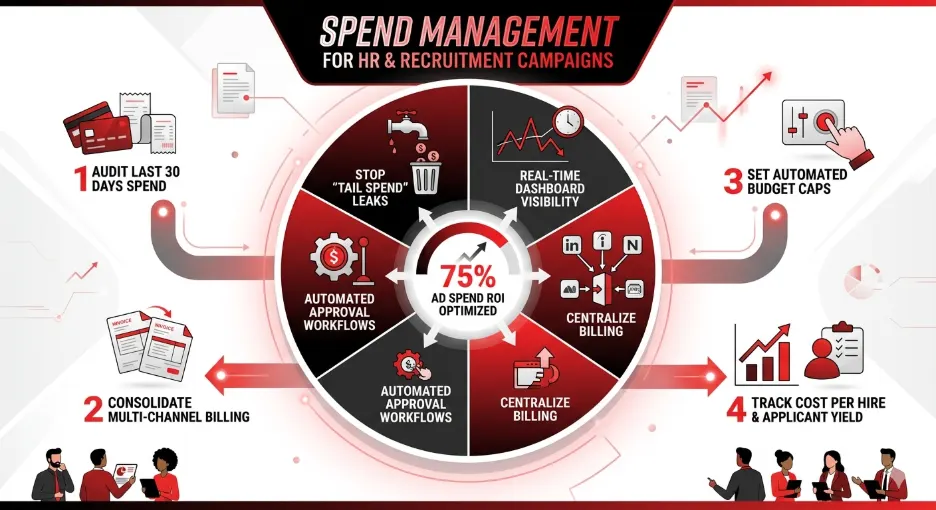
Days 1-7: Audit your company credit card spend from the last thirty days to spot hidden fees.
Days 8-15: Implement a centralized platform to handle all job board and software subscriptions.
Days 16-22: Establish automated approval workflows for your recruiting team.
Days 23-30: Generate your first real-time ROI report to share with stakeholders.
Mastering spend management elevates your role from administrative support to a strategic partner. This financial transparency protects your current hiring initiatives while driving long-term career growth.
FAQ
- What is the most common cause of budget overruns in recruitment?
The primary culprit is often "tail spend"—untracked, one-off payments to niche job boards or resume databases that bypass traditional approval workflows.
- How can I control programmatic ad spend without checking it hourly?
Implementing automated budget caps at the payment level ensures that even if an algorithm spikes your bid, the transaction will be declined or paused once your limit is reached.
- Does centralized billing slow down the hiring process?
On the contrary, it accelerates it. By removing the need for manual receipt collection and individual invoice processing, recruiters spend less time on administration and more time on candidate engagement.
Does this longer, pointer-based structure work for your SEO strategy, or should we adjust the 30-day roadmap?