Employee Expense Policy Template for India
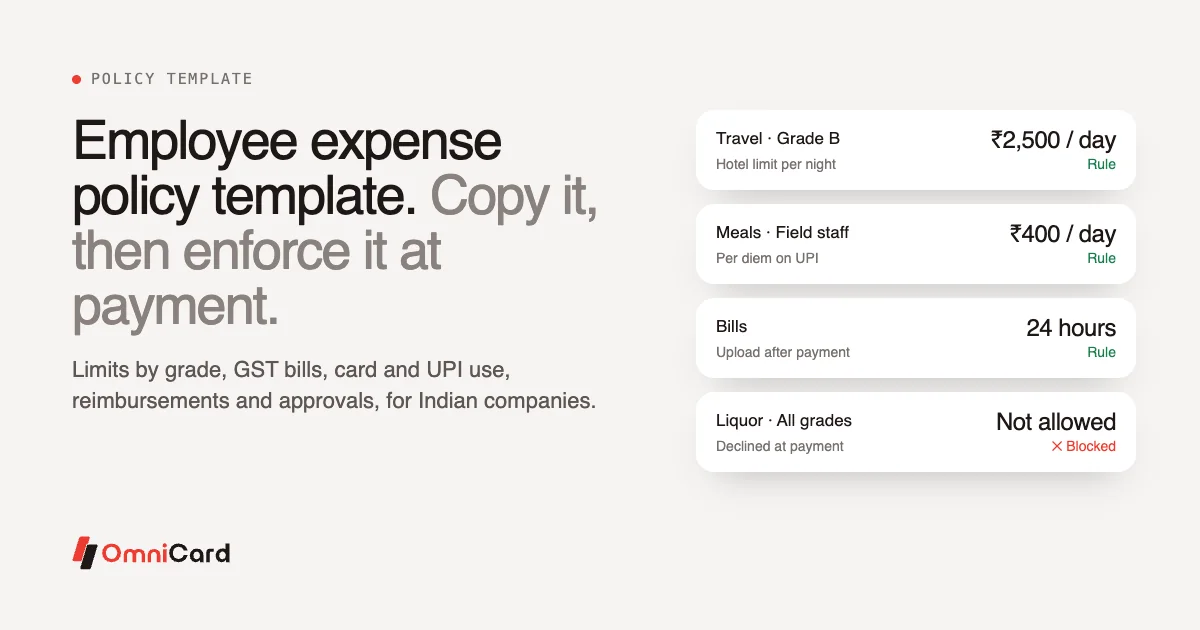
An employee expense policy sets out what staff can spend company money on, how much, who approves it, what proof is needed and how they get paid back. A good policy is short enough for employees to read and specific enough for finance to apply the same way every time.
Below is a practical employee expense policy template for India that you can copy and adapt. It covers corporate cards, UPI, reimbursements and work from home expenses. After the template, we explain how to enforce it so the rules apply before money is spent.
Before you write the policy
Answer these questions first. They decide most of the numbers you will fill in.
- Who spends? Office staff, field teams, store managers, drivers, site engineers.
- How do they pay? Company card, company UPI, petty cash, or their own money with a claim later.
- What are the high-volume categories? Fuel, local travel, meals, supplies, repairs, client meetings.
- Who approves, and at what amount? A clear approval matrix avoids most disputes. See our guide to a spend approval process.
- Which accounting system does it post to? Your categories should match your ledgers in Tally or your ERP.
The template
Copy the sections below. Replace anything in [square brackets] with your own values.
1. Purpose
This policy explains how employees of [Company Name] may spend company money on business expenses, how those expenses are approved and recorded, and how employees are reimbursed when they pay personally. It aims to keep spending fair, controlled and compliant with tax rules.
2. Scope
- This policy applies to all employees, trainees and consultants of [Company Name] who incur expenses on the company's behalf.
- It covers spend on company corporate cards, company UPI IDs, petty cash and personal funds claimed as reimbursement.
- Travel and per diem rules are set out in the [Travel Policy], which this policy refers to.
3. General principles
- Spend company money as carefully as you would your own.
- Every expense must have a clear business purpose.
- Use the company card or company UPI wherever possible. Pay personally only when neither is accepted.
- Keep a valid bill for every expense.
- Do not split one expense into smaller amounts to stay under a limit.
4. Eligible expenses
The following are eligible when incurred for business:
- Local travel: cab, auto, metro, bus, and fuel for approved vehicles.
- Meals during client meetings or approved late work, within limits in Section 6.
- Office and store supplies up to [₹ amount] per purchase.
- Repairs and maintenance at branches, stores or sites, within limits.
- Courier, printing and stationery.
- Mobile and internet charges, as set out in Section 11.
- Client entertainment with prior approval from [role].
- Training or certification approved in advance by [role].
5. Non-eligible expenses
The following will not be paid or reimbursed:
- Personal purchases of any kind.
- Alcohol, unless approved in advance for a client event by [role].
- Fines, penalties and traffic challans.
- Spend without a valid bill, except as allowed in Section 8.
- Upgrades beyond the entitled class of travel or stay.
- Gifts to government officials.
- Expenses already paid by the company or claimed before.
6. Limits by grade and category
| Category | Grade [A] | Grade [B] | Grade [C] |
|---|---|---|---|
| Local travel per day | ₹[ ] | ₹[ ] | ₹[ ] |
| Meals per day | ₹[ ] | ₹[ ] | ₹[ ] |
| Fuel per month | ₹[ ] | ₹[ ] | ₹[ ] |
| Supplies per purchase | ₹[ ] | ₹[ ] | ₹[ ] |
| Client entertainment per event | ₹[ ] | ₹[ ] | ₹[ ] |
Spend above these limits needs prior approval under Section 7.
7. Approvals
- Spend within limits on a company card or UPI does not need separate approval.
- Spend above limits needs approval from [reporting manager] before payment.
- Single expenses above [₹ amount] need approval from [department head / finance].
- Approvers may not approve their own expenses.
- Approvers are responsible for checking the business purpose as well as the amount.
8. Bills and GST invoices
- Upload a clear photo of the bill within [24 hours] of payment.
- For purchases from GST-registered suppliers above [₹ amount], ask for a tax invoice showing the company's GSTIN [GSTIN], the supplier's GSTIN, and the tax amount, so the company can claim input tax credit where eligible.
- Where no bill is available (for example, some auto fares), record the amount, place, date and purpose. Such expenses are capped at [₹ amount] per month.
- Bills with altered amounts or dates will be rejected and may lead to action under Section 13.
9. Corporate card and UPI use
- Corporate cards and company UPI IDs are for business spend only.
- Limits set on each card or UPI ID by employee, category, merchant, location and time apply automatically. A payment outside these limits may be declined.
- Do not share card details, PINs or UPI PINs with anyone.
- Report a lost card or suspicious transaction to [finance contact] immediately.
- Personal spend made by mistake must be reported and repaid within [7 days].
- Cards and UPI IDs are withdrawn on exit or change of role.
10. Reimbursements and timelines
- Submit claims within [15 days] of the expense. Claims older than [60 days] may be rejected.
- Attach the bill and business purpose to each claim.
- Approvers act on claims within [3 working days].
- Approved claims are paid to the employee's registered bank account or UPI ID within [7 working days].
- Do not claim an expense already paid on a company card or UPI.
11. Work from home expenses
- Employees on approved remote or hybrid work may claim internet charges up to ₹[ ] per month.
- Mobile charges for business use may be claimed up to ₹[ ] per month, or as a fixed allowance of ₹[ ].
- One-time home office equipment (chair, headset, monitor) up to ₹[ ] with prior approval. Equipment bought with company money remains company property.
- Electricity and rent are not reimbursed unless stated in the employee's contract.
12. Travel and per diem
Outstation travel, stay and daily allowances follow the [Travel Policy]. In brief: book through [channel], stay within entitled hotel limits, and claim per diem at the rates set for each city tier.
13. Violations
- Out-of-policy spend will be recovered from the employee.
- Repeated violations will lead to withdrawal of card or UPI access.
- False claims or altered bills will be treated as misconduct under the company's disciplinary policy.
14. Review
Finance will review this policy every [12 months], or earlier when tax rules, grades or business needs change. Questions go to [finance contact].
Notes on the tricky sections
Grades and limits. Start with your last six months of actual spend by category and grade. Set limits a little above typical spend, then tighten.
GST invoices. A tax invoice with your GSTIN is what lets you claim input tax credit on eligible purchases. Our GST guide explains the basics.
Travel. Keep travel in its own policy, since it has more rules than day-to-day spend. See our guide to travel expense management.
How to enforce the policy
A policy written in a PDF is enforced after the fact: finance reads claims, spots breaches and tries to recover money. The stronger approach is to turn the policy into rules that are checked before payment.
| Policy rule | Enforced after spend | Enforced before payment |
|---|---|---|
| Fuel limit per month by grade | Claim rejected at month-end | Payment above the limit declined at the pump |
| No alcohol or restaurants on store petty cash | Found in the bill review | Category blocked on that card or UPI ID |
| Only approved vendors for site materials | Found in audit | Payment to other merchants declined |
| Spend only in the assigned city or site | Rarely checked | Payment outside the location declined |
| No spend on weekends for certain roles | Rarely checked | Payment outside set hours declined |
On OmniCard spend management, employees pay by @omni UPI or OmniCard RuPay corporate card from company funds, and limits by employee, category (MCC), merchant, location (geo-fencing) and time are checked before the payment goes through. A restricted payment is declined at authorisation. Each payment is captured the moment it is made: who, where, what for and against which policy.
For the claims that remain, Reimburse360 handles OCR bill capture, one-tap approvals and auto-settlement. ISKCON Bengaluru cut reimbursements from 14 days to 3 with OmniCard.
Frequently asked questions
What should an employee expense policy include?
Purpose, scope, eligible and non-eligible expenses, limits by grade and category, approvals, bill and GST invoice rules, corporate card and UPI use, reimbursement timelines, work from home expenses, a pointer to the travel policy, violations and a review date.
Is an expense policy mandatory in India?
No law requires a specific format, but a written policy helps you apply rules fairly, support expenses in an audit, and claim GST input tax credit with the right invoices.
What is a corporate card policy?
It is the part of the expense policy that covers company cards: who gets one, what it can be used for, the limits on it, how bills are submitted, and what happens with misuse or loss. Section 9 of the template above covers it along with company UPI.
What should a work from home expense policy cover?
Internet and mobile charges, one-time home office equipment, and what is not covered, such as rent and electricity. Set monthly caps and say whether equipment stays company property.
How often should an expense policy be reviewed?
At least once a year, and whenever grades, tax rules or the way employees pay change.
Put the policy into practice
Copy the template, fill in your numbers, and then turn the limits into rules that apply at the point of payment. See how OmniCard spend management works, explore Reimburse360, or book a demo.