Petty Cash Entry in Tally: Ledger Group and Journal Entries
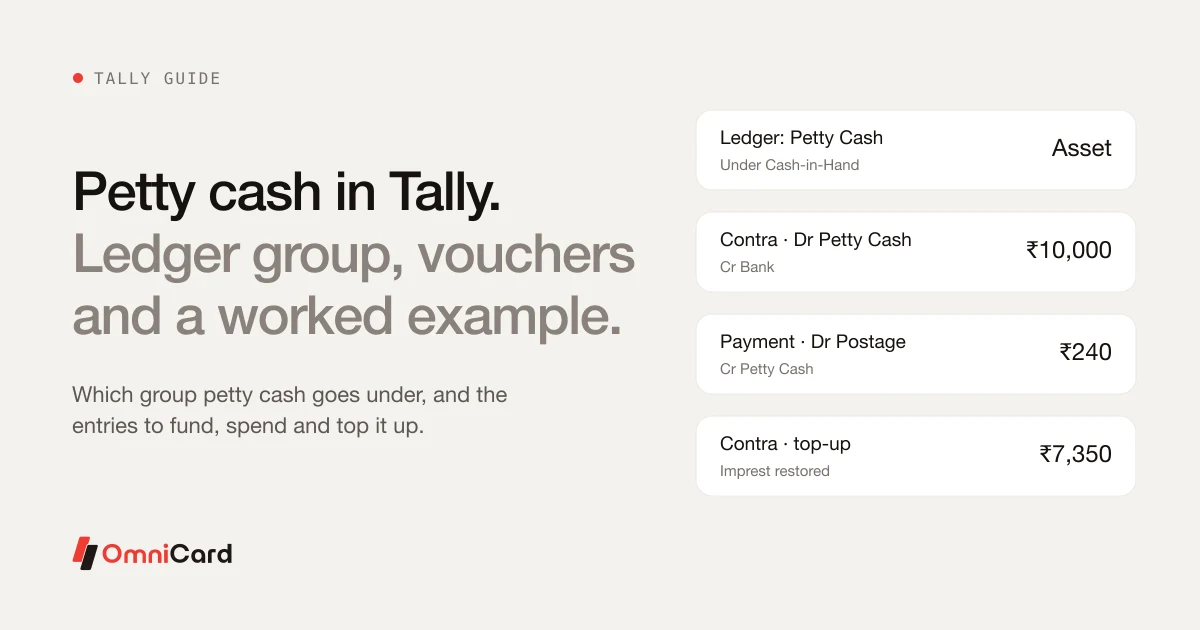
Petty cash is cash, so in Tally it belongs under Cash-in-Hand, the same group as your main cash account. Below: how to create the petty cash ledger, the three entries every petty cash fund needs (fund it, spend from it, top it up), and a worked example you can follow.
Posting petty cash by hand every month? OmniCard posts approved spend to Tally with the bill, cost centre and GST fields attached. See petty cash management →
Petty cash comes under which head in Tally?
Cash-in-Hand (a sub-group of Current Assets). Petty cash is money the business holds in cash, just kept separately for small payments, so it is an asset, not an expense. The expenses paid from it go to their own expense ledgers (Postage, Stationery, Conveyance, Staff Welfare and so on) under Indirect Expenses.
Step 1: create the petty cash ledger
- Gateway of Tally → Create → Ledger.
- Name: Petty Cash (or "Petty Cash – Andheri store" if each branch keeps its own fund).
- Under: Cash-in-Hand.
- Opening balance: the cash in the box on the day you start, if any.
- Save.
Create the expense ledgers you'll need (for example Postage and Courier, Printing and Stationery, Local Conveyance) under Indirect Expenses if they don't exist yet.
Step 2: the three entries
| What happens | Voucher type in Tally | Debit | Credit |
|---|---|---|---|
| You fund petty cash from the bank | Contra | Petty Cash | Bank |
| The cashier pays a small expense | Payment | The expense ledger (e.g. Postage) | Petty Cash |
| You top up the fund (imprest) | Contra | Petty Cash | Bank |
The same entries as journal entries, if you record them that way in your books:
1. Funding:      Petty Cash A/c        Dr   10,000
                     To Bank A/c                    10,000
2. Expense:      Postage & Courier A/c Dr      240
                     To Petty Cash A/c                 240
3. Top-up:       Petty Cash A/c        Dr    7,350
                     To Bank A/c                     7,350
Worked example (imprest system)
A store keeps a petty cash float of ₹10,000. In October the cashier pays, against petty cash vouchers:
| Expense head | Amount (₹) |
|---|---|
| Postage and courier | 1,240 |
| Printing and stationery | 2,110 |
| Local conveyance | 3,000 |
| Staff welfare (tea, water) | 1,000 |
| Total | 7,350 |
In Tally:
- Four Payment vouchers (or one with four expense lines): debit each expense ledger, credit Petty Cash, total ₹7,350.
- Petty Cash now shows ₹2,650, which should match the cash in the box.
- At month-end, one Contra voucher: debit Petty Cash ₹7,350, credit Bank. The fund is back to ₹10,000.
If the box doesn't hold ₹2,650, find the missing voucher before you top up. Don't book the difference to "Sundry".
Tips that save time at month-end
- One petty cash ledger per branch shows which store spends what.
- Cost centres (turn them on in F11 Features, then Gateway of Tally → Create → Cost Centre) let you tag each expense to a branch or department.
- Enter GST details on bills that show the supplier's GSTIN, so input tax credit isn't lost.
- Reconcile weekly, not monthly: a small gap is easier to trace than a big one.
Skip the manual entries
The work above exists because cash leaves no record of its own. With OmniCard, staff pay small expenses by an @omni UPI ID or a RuPay prepaid card from company funds, with limits by employee, category, merchant, location and time checked before the payment goes through. Bills are captured by OCR in the app, and approved spend posts to Tally (or SAP, Oracle, Zoho, Microsoft Dynamics) with the bill and cost centre attached. More: Expense management software with Tally integration · Petty cash management
FAQs
Is petty cash an asset or an expense? An asset. The money in the petty cash fund is cash the business still owns. It becomes an expense only when it's spent, and then it's booked to the right expense ledger.
Which voucher is used for a petty cash expense in Tally? A Payment voucher: debit the expense ledger, credit Petty Cash.
Which voucher is used to transfer money from the bank to petty cash? A Contra voucher, because both ledgers are cash or bank accounts.
Can I record petty cash with a journal voucher instead? You can, but Payment and Contra vouchers keep your cash and bank books cleaner and are what most auditors expect.