
The Hidden Cost of Growth: How Indian Businesses Are Losing Crores to Expense Leakage — And How to Stop It
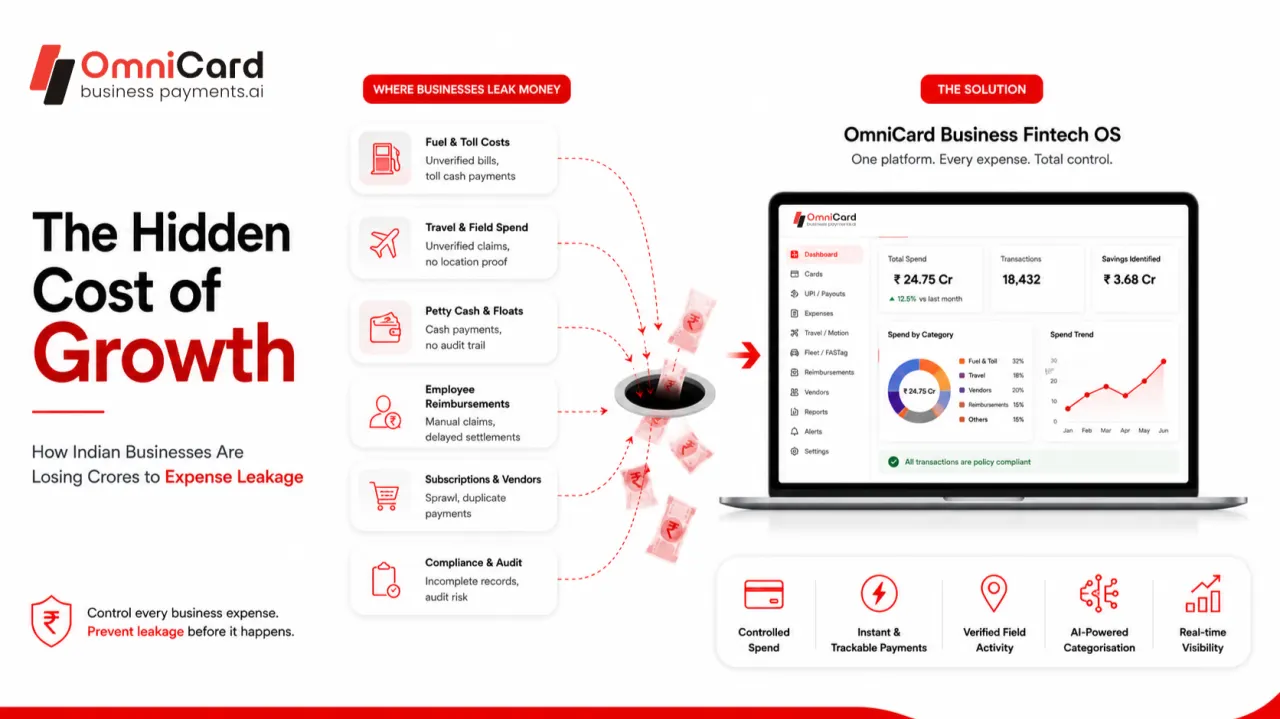
Walk into the finance office of almost any growing Indian business — a manufacturer opening its fourth plant, a hospital chain adding a new city, a logistics fleet scaling its routes, a D2C brand signing its hundredth dark store — and you'll hear a version of the same complaint: the business is growing faster than anyone can account for where the money is actually going. None of it looks like a problem on any given day. A driver rounds up a fuel bill by a few hundred rupees. A regional manager pays a local vendor in cash because the transfer "was taking too long." A field executive's travel claim goes unquestioned because nobody has the time — or the data — to check it against where he actually was. Each of these is small enough to wave through. But multiply it across dozens of branches, hundreds of employees, and thousands of transactions a month, and it stops being a rounding error. It becomes the reason finance closes every quarter later than it should, and still can't fully explain where the gap came from.
This story repeats itself in almost every growing Indian business, regardless of what it sells. A logistics company loses it in driver advances and toll cash. A retail chain loses it in store-level float. A hospital loses it in vendor procurement across locations. A services firm loses it in travel claims and subscription sprawl nobody owns. The industry changes. The pattern — growth outrunning the finance team's ability to see where the money actually goes — does not.
Why the leakage is getting worse, not better India's economy isn't just growing; it's growing faster than most finance functions were built to track. Real GDP growth for FY26 is estimated at 7.4%, with the services sector alone expanding by 9.1% — up from 7.2% the year before — and now accounting for a record 56.4% share of gross value added. That kind of growth means more branches, more field staff, more vendors, and more transactions every single quarter, and most finance teams are still running the same headcount and the same spreadsheets they had a year — or three branches — ago.
The cost of that gap isn't hypothetical. Organisations lose an estimated 5% of annual revenue to fraud and leakage every year on average, and expense reimbursement schemes alone show up in roughly 13% of all reported fraud cases globally. In Indian businesses specifically, the leakage rarely looks like one dramatic scam — it looks like a fuel bill padded by a few hundred rupees, a duplicate claim, or a WhatsApp receipt photo that's impossible to verify weeks later, repeated across hundreds of employees and thousands of transactions a month. None of it feels urgent on its own. All of it adds up to real crores by year-end.
Seven places every business — whatever it sells — is quietly leaking money
Petty cash and departmental floats.
Felt most by: branch managers, department heads, and finance controllers.
Cash floats for day-to-day purchases, staff advances, and small vendor payments are almost impossible to monitor centrally, and they're the easiest line item for an auditor to flag because there's rarely a paper trail attached to the moment the money left the till.
Field staff and travel spend.
Felt most by: sales heads, field-service teams, and the finance staff approving their claims.
Anyone who travels for work — sales reps, service engineers, consultants — submits expense claims that are genuinely difficult to verify against what actually happened on the ground, so approval becomes a matter of trust rather than evidence.
Fleet, fuel, and toll costs.
Felt most by: logistics and operations heads reconciling transport spend.
Toll receipts, fuel bills, and driver cash advances pile up across routes and vehicles, and consolidating them into one clean, per-trip cost view is a manual, error-prone exercise even for well-run fleets.
Employee reimbursements.
Felt most by: HR and finance operations teams.
Manual reimbursement queues are slow for employees and expensive for finance to process, and the gap between when money is spent and when it's claimed is exactly where inflated or duplicated bills slip through.
Subscription and vendor sprawl.
Felt most by: finance ops teams and founders in fast-scaling companies.
Software subscriptions, small recurring vendor payments, and one-off purchases multiply quietly across departments with no single owner tracking whether each one is still needed or being paid twice.
Compliance and audit trails.
Felt most by: CFOs, compliance officers, and internal auditors.
When spend isn't categorised and tagged as it happens, building an audit-ready trail becomes a year-end scramble instead of something finance can already show on demand — and that scramble is exactly where GST input-credit and compliance risk creeps in.
How to actually stop the leakage The fix isn't more approvals or more paperwork — most businesses already have too much of both, which is part of why nothing gets caught until it's too late. The fix is moving control to the point of spend instead of the point of reconciliation:
Issue controlled spend instead of reimbursing after the fact. A prepaid or corporate card with a hard limit per department, branch, or purpose stops overspending before it happens, instead of catching it in a report three weeks later.
Replace cash vendor payments with instant, trackable digital payouts. Every payment should leave a timestamped, attributable trail the moment it's made — not a receipt that has to be manually entered later.
Tie field spend to verified activity. GPS or visit-based tracking means finance is approving claims against evidence, not paperwork alone.
Automate categorisation instead of doing it at month-end. Spend that's tagged and classified automatically, transaction by transaction, turns the audit from a scramble into something finance can show on demand.
Centralise visibility across every location. One dashboard that shows every branch, plant, or outlet in real time — not a weekly stitch-together of everyone's spreadsheets — is what actually lets a CFO catch a problem while it's still small.
Why choose OmniCard This is exactly the gap OmniCard, India's AI-powered Business Fintech OS, is built to close. It's an RBI-licensed PPI issuer that has already processed ₹3,400 Cr+ in payments for 1,000+ enterprise clients across 700+ cities — spanning manufacturing, retail, healthcare, logistics, hospitality, and services — giving finance leaders in any industry a proven, enterprise-scale financial operating layer instead of a point solution bolted onto legacy banking rails.
Its product suite is built to put every category of spend on one connected, auditable rail: Corporate Cards issue department- or branch-level spend limits so cash is controlled before it's spent, not reconstructed after; B2B UPI replaces slow, cash-heavy vendor settlement with instant, fully trackable payouts; Reimburse360 automates the employee claim-to-payout cycle and cuts settlement time from weeks to days; Motion brings GPS-based field-force tracking so spend is tied to verified visits; FASTag Management and iFleet Pay bring toll and fleet costs onto a single trackable rail; and AI-powered categorisation tags and classifies every transaction automatically, giving finance a continuous, audit-ready trail instead of a year-end scramble — all visible on one real-time dashboard across every location.
Whatever industry a business is in, the math is the same: every rupee that isn't visible, controlled, and auditable in real time is a rupee a CFO has to explain later — to the board, to an auditor, or to a vendor who didn't get paid on time. OmniCard exists so that explanation is never necessary in the first place.
Sources: Economic Survey 2025-26 / PIB, IBEF, Association of Certified Fraud Examiners (ACFE)