
OmniCard Insights: Inside India's QSR & Restaurant Boom
India's food-service industry has quietly become one of the most closely watched consumption stories in the country — not because it's new, but because the shape of it is changing faster than at any point in the last two decades. Organised chains are eating into an unorganised base that has dominated for generations. Cloud kitchens are compounding at rates most other consumer categories can only envy. And a generation of investors, franchisors, and technology vendors is repositioning around a sector that used to be treated as a local, low-tech business.
Here's the landscape as it stands in 2026.
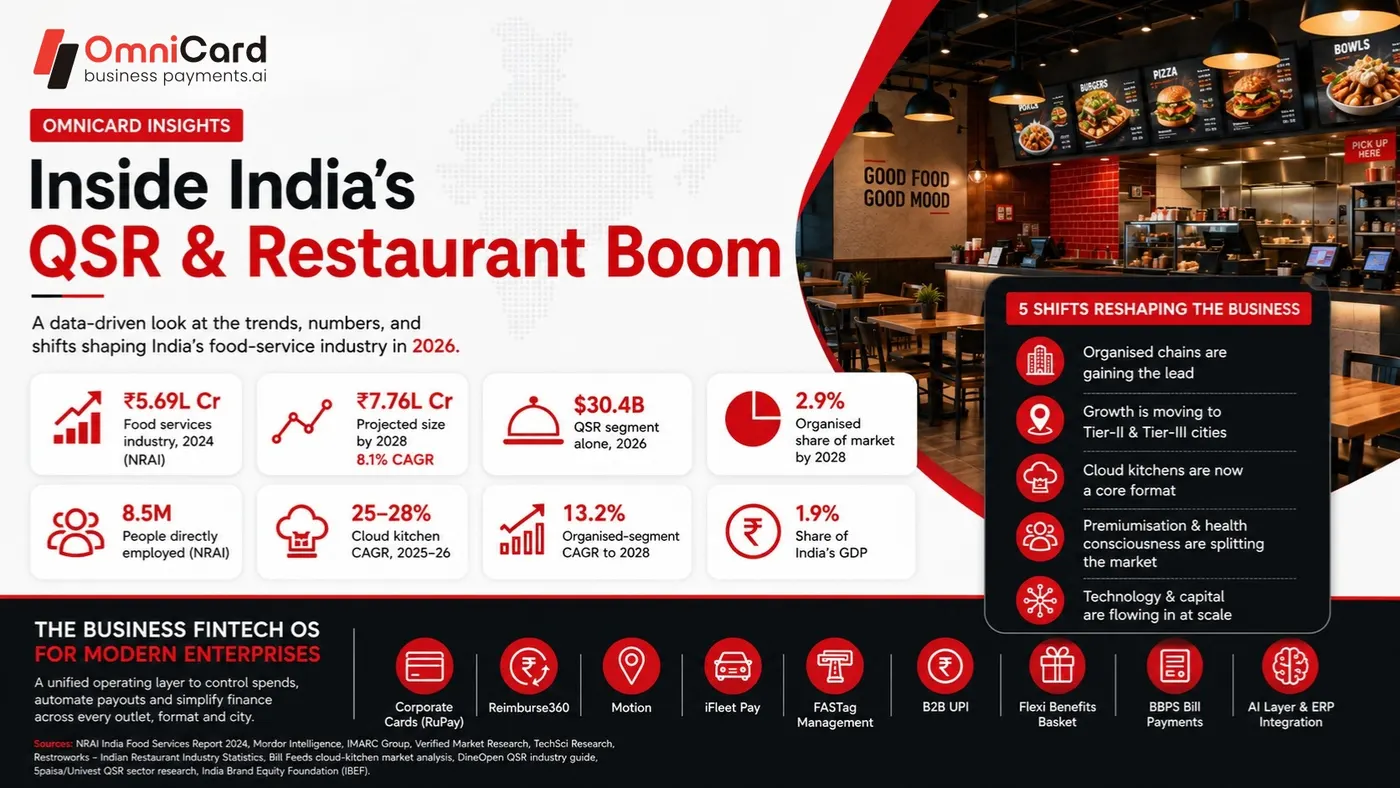
THE MARKET, BY THE NUMBERS
- ₹5.69L Cr — food services industry, 2024 (NRAI)
- ₹7.76L Cr — projected size by 2028,
- 8.1% CAGR $30.4B — QSR segment alone, 2026
- 13.2% — organised-segment CAGR to 2028 5
- 2.9% — organised share of market by 2028
- 25–28% — cloud kitchen CAGR, 2025–26
- 8.5M — people directly employed (NRAI) 1.9% — share of India's GDP
5 SHIFTS RESHAPING THE BUSINESS
- The organised-vs-unorganised balance is finally tipping. Unorganised outlets — dhabas, family-run eateries, local stalls — still account for roughly 56% of India's food-service revenue today, but that share is projected to fall to 47% by 2028 as organised chains grow at 13.2% CAGR, more than 60% faster than the unorganised segment. GST formalisation, aggregator listing requirements, and consumer trust in hygiene are all pulling spend toward registered, organised operators.
- Growth has moved to Tier-II and Tier-III cities. Metro markets remain the largest revenue pools but are also the most saturated. The incremental growth story now sits in cities like Jaipur, Lucknow, Indore, Nagpur, and Coimbatore, where middle-class households have increased annual QSR spend by over 100% in two years. Franchise models — not company-owned rollout — are the primary vehicle for that expansion.
- Cloud kitchens have gone from experiment to core format. India's cloud kitchen market crossed roughly ₹3,200 crore in 2025 and is tracking toward ₹4,000 crore in 2026, growing at 25–28% CAGR — among the fastest of any food-service format globally. Rebel Foods alone runs 450+ cloud kitchens across 70+ cities, operating 45+ brands from shared kitchen infrastructure.
- Premiumisation and health-consciousness are splitting the market. "Gourmet QSR" and "healthy fast-casual" have emerged as distinct sub-segments. Over 65% of India's population is under 35, and this cohort spends 30–40% more on eating out than older generations — creating a barbell where both value-led QSR and premium fast-casual are growing, while the middle faces the most competitive pressure.
- Technology and capital are flowing in at scale. Integrated POS, cloud-based inventory tracking, and AI-driven demand forecasting are now baseline expectations. The sector's largest players — Jubilant FoodWorks, Westlife Foodworld, Devyani International, Sapphire Foods, Restaurant Brands Asia — are all listed, and same-store-sales growth, average daily sales per store, and food-cost ratios are now tracked with the same discipline SaaS investors apply to ARR and churn.
WHERE THE PRESSURE POINTS SIT
- Cash-heavy raw-material procurement remains largely informal even inside organised chains, tying up working capital.
- Delivery-aggregator dependence is structural: Zomato and Swiggy together process over 25 lakh orders a day.
- Franchise and multi-brand models mean finance and tech stacks have to work across ownership structures that vary outlet to outlet.
- Input-cost volatility — edible oils, packaging, protein — keeps compressing margins even as topline growth stays strong.
WHERE OMNICARD'S BUSINESS FINTECH OS FITS
Every shift above lands on the same desk eventually — the CFO's or controller's — as a finance-operations problem: more outlets, more formats, more vendors, more payout rails, all needing to be controlled and reconciled without adding headcount at the same pace. That's the layer OmniCard, India's AI-powered Business Fintech OS, is built for. The full product suite maps directly onto how a QSR or restaurant chain actually spends money:
- Corporate Cards (RuPay) — outlet- and department-level cards with hard spend limits, so front-counter floats, kitchen supplies, and delivery-rider cash advances are controlled at the point of spend, not reconstructed after the fact.
- Reimburse360 — automates the claim-to-payout cycle for restaurant crew and field staff, cutting settlement from weeks to days.
- Motion — GPS-based field-force tracking for business-development, franchise-audit, and vendor-visit teams covering ground across cities.
- iFleet Pay — fuel and fleet-spend management for own-fleet delivery riders and last-mile logistics.
- FASTag Management — consolidated toll-spend tracking for supply trucks moving raw material between central kitchens and outlets.
- B2B UPI — instant, fully trackable payouts to F&B vendors and suppliers, replacing float-heavy cash cycles with same-day settlement.
- Flexi Benefits Basket — structured employee benefits (meal cards, wellness, and more) for outlet and crew staff, in a sector that competes hard for hourly talent.
- BBPS Bill Payments — consolidated utility bill payments (electricity, gas, water, telecom) across hundreds of outlets from a single dashboard instead of outlet-by-outlet bill runs.
- AI Layer — the categorisation and reconciliation intelligence tying all of the above together, and the same layer that powers OmniCard's end-to-end ERP integration with Tally, SAP, Zoho Books, and NetSuite.
Put together, it's less a single product than an operating layer — the same one a growing chain would otherwise have to stitch together out of a bank account, a card network, a POS vendor, and a finance team's spreadsheets.
THE BOTTOM LINE
India's QSR and restaurant industry isn't a single market — it's three markets growing at three different speeds: a slowly-formalising unorganised base, a fast-organising branded-chain segment, and an even faster-growing cloud-kitchen and delivery-first layer sitting on top of both. Every operator, investor, franchisor, and vendor in this space is really making a bet on which of those three layers they're building for — and the winners over the next five years will likely be the ones who can operate profitably across all three at once.
Sources: NRAI India Food Services Report 2024, Mordor Intelligence, IMARC Group, Verified Market Research, TechSci Research, Restroworks — Indian Restaurant Industry Statistics, Bill Feeds cloud-kitchen market analysis, DineOpen QSR industry guide, 5paisa/Univest QSR sector research, India Brand Equity Foundation (IBEF).