
India's Factories Are Losing Crores to Invisible Cash — And Most CFOs Don't Even Know It
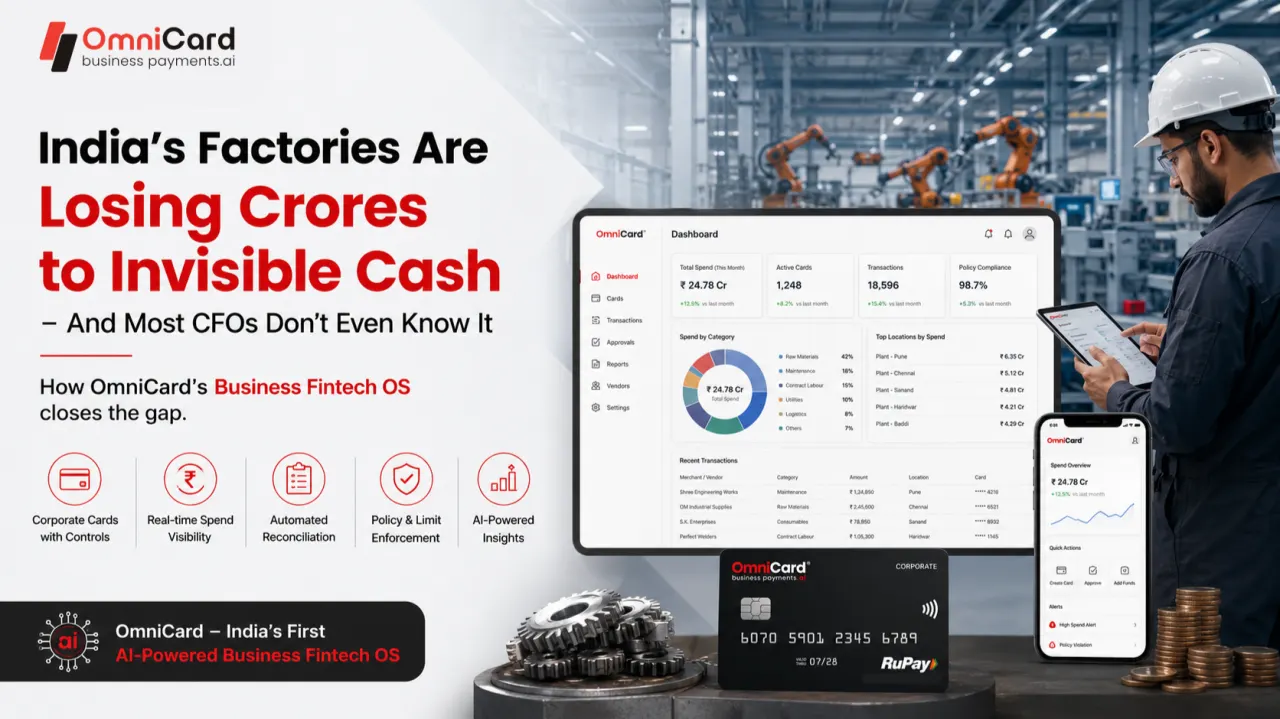
How OmniCard's Business Fintech OS closes the gap
It's the last Friday of the quarter, and the CEO of a mid-sized auto-components manufacturer is sitting across the table from his board, trying to explain why maintenance spend across six plants came in 18% over budget — again. He doesn't have a clean answer. Three plants report their numbers over WhatsApp. Two run on shared Excel sheets nobody updates on time. One plant manager is still “compiling the data.” By the time finance stitches it all together, the quarter has already closed and the number on the board slide is already three weeks stale.
This isn't a one-off. Ask any CEO or CFO running a multi-plant manufacturing operation in India, and they'll tell you a version of the same story: growth is outrunning the finance function's ability to see it, let alone control it.
India's manufacturing sector is valued at roughly $1.74 trillion in 2026 and is projected to grow at a CAGR of around 7.3% through 2031, with the government's PLI 2.0 push, a wave of “China + 1” realignment investment, and rapid MSME formalisation widening the domestic supplier base and tilting output toward electronics, batteries, and green hydrogen. Industrial production opened FY 2026-27 on a strong note, and gross value added in the sector has been growing at a healthy clip through the year.
New plants, new product lines, and new export contracts are the headline on the CEO's growth deck. But every new facility, every new supplier, every new field engineer or contract-labour crew is another point of financial exposure that finance has to track, reconcile, and defend in an audit — often with the same headcount and the same spreadsheets it had three plants ago. This is the gap OmniCard, India's AI-powered Business Fintech OS, was built to close — and it's why the platform is increasingly the finance layer of choice for plant CFOs and manufacturing controllers who are done chasing spreadsheets.
A sector CEOs are scaling faster than CFOs can control
A few numbers explain why finance teams in this sector are under so much pressure:
Manufacturing capacity is expanding across every major vertical. Automotive and auto components, electronics assembly, pharmaceuticals, specialty chemicals, and defence manufacturing are all in active capacity-addition mode, backed by PLI 2.0 outlays of roughly $26 billion and an estimated $22 billion of FDI tied to supply-chain diversification. Every new plant a CEO commissions is a new set of bank accounts, floats, and vendor relationships a CFO has to bring under control from day one.
MSME suppliers — the backbone of the supply chain — dominate the vendor base. MSMEs account for roughly 35% of India's manufacturing output and are the second-largest employer in the country after agriculture, with over 7.4 crore enterprises. As OEMs and large manufacturers deepen their MSME supplier base to meet localisation targets, CFOs inherit exactly the cash-heavy, thinly-documented financial habits that are hardest to formalise across thousands of small vendors.
Delayed payments are a structural, sector-wide drag on working capital. An estimated ₹8.1 lakh crore is currently locked up in delayed payments to MSMEs nationally, and the average small supplier now carries close to ₹3.8 crore in receivables overdue beyond a year, with the national invoice cycle stretching to roughly 73 days despite a regulatory 45-day payment mandate. For manufacturing CFOs, every day a supplier payment slips is a day of strained vendor relationships and disrupted raw-material supply.
Multi-plant and multi-site operating models are the default. Manufacturing groups run owned plants, leased facilities, job-work units, and third-party contract manufacturing side by side, each with its own procurement, payroll, and reconciliation logic — and head office is expected to see through all of it in real time to plan capacity, capex, and working capital.
For a CEO, this is a growth story. For a CFO, a plant controller, or a compliance officer, it's a scaling-risk story — and it's exactly where OmniCard's Business Fintech OS steps in.
7 financial blind spots — and who in the organisation feels each one
- Shop-floor and plant-level petty cash is untracked.
Felt most by: plant managers, maintenance heads, and finance controllers.
Machine breakdown spares, consumables, contract labour advances, and canteen or welfare cash float are notoriously hard to monitor from head office — and untracked shop-floor cash is the easiest line item for an auditor to flag. OmniCard's Corporate Cards (RuPay) let CFOs issue department-level cards with hard spend limits — maintenance, stores, HR welfare, quality — so every rupee is attributed to a cost centre before it's spent, not reconstructed after the fact.
- Multi-plant manufacturing groups lack consolidated visibility.
Felt most by: CEOs and CFOs.
When a group runs plants and warehouses across five, ten, or thirty locations, no CEO should have to wait a week for consolidated spend numbers, and no CFO should have to stitch together spreadsheets from every plant controller to get there. OmniCard's unified dashboard gives finance leadership one real-time view across every facility — the kind of visibility a growth-stage manufacturer needs to make capex and capacity calls with confidence.
- Field sales, service engineers, and dealer-visit teams travel with no verified spend-to-visit link.
Felt most by: sales and business-development heads, after-sales service teams, and the finance teams approving their claims.
Territory sales executives, after-sales service engineers, and dealer-network managers cover enormous ground visiting clients, dealers, and job sites, and reconciling their expense claims against actual visits is a chronic weak spot. OmniCard's Motion brings GPS-based field-force tracking, so finance professionals are approving spend against verified visit data, not paperwork alone.
- Raw-material and component vendor payouts are cash-heavy, slow, and chronically delayed.
Felt most by: CFOs managing working capital and procurement leads managing supplier relationships.
With an estimated ₹8.1 lakh crore locked in delayed MSME payments nationally and invoice cycles stretching to around 73 days against a 45-day mandate, slow vendor settlement is one of the biggest working-capital and supply-continuity risks a manufacturing CFO carries. OmniCard's B2B UPI enables instant, fully trackable payouts to raw-material, component, and packaging suppliers — replacing float-heavy cash and cheque cycles with same-day, auditable settlement that protects supplier relationships and keeps production lines running.
- Inbound and outbound logistics spend — freight, tolls, and fleet fuel — is fragmented across carriers.
Felt most by: supply chain and logistics heads, and finance teams reconciling freight costs.
Raw material inbound and finished-goods outbound movement runs on a mix of owned fleets, third-party transporters, and last-mile carriers, each generating its own toll receipts, fuel bills, and driver cash advances that are painful to consolidate. OmniCard's FASTag Management and iFleet Pay bring toll and fleet spend onto a single trackable rail, giving logistics and finance heads one clean view of per-trip and per-route cost instead of a pile of disconnected receipts.
- Shop-floor staff and contract-labour reimbursements are manual and delayed.
Felt most by: HR leaders and finance operations teams.
Manual reimbursement queues for travel, safety gear, and contract-labour advances are a genuine retention issue in a sector already competing hard for skilled shop-floor talent — and they consume disproportionate finance-team bandwidth. Reimburse360 automates the claim-to-payout cycle, cutting settlement time from weeks to days.
- Compliance and audit trails are weak on capex, machinery, and job-work vendor spend.
Felt most by: CFOs, compliance officers, and internal auditors.
Manufacturing is a capex-intensive sector with GST input-credit implications riding on every machinery, spares, and job-work vendor payment, making these categories some of the hardest to defend during an audit. OmniCard's AI-powered categorisation tags and classifies every transaction automatically, giving compliance officers a continuous, audit-ready trail instead of a year-end scramble.
What this means if you sit in the CEO's or CFO's chair
If you're a CEO, the calculus is simple: every plant you commission or every product line you add should come with financial visibility on day one, not six months into onboarding a new finance hire. If you're a CFO, controller, or compliance officer, the calculus is even more direct — you're the one who has to answer for every untracked rupee and every delayed supplier payment when the auditors, or the vendors, come calling.
OmniCard is built for exactly this seat. It's an RBI-licensed PPI issuer that has already processed ₹3,400 Cr+ in payments for 1,000+ enterprise clients across 700+ cities, giving manufacturing CEOs and finance professionals a proven, enterprise-scale financial operating layer, not a point solution bolted onto legacy banking rails.
As India's manufacturing base keeps expanding under PLI-driven capacity addition and supply-chain realignment, the CEOs and CFOs who win won't just be the ones with the most plants or the widest supplier network. They'll be the ones whose finance teams can see, control, and audit every rupee — and pay every vendor on time — in real time. That's what a Business Fintech OS is for.
Sources: Mordor Intelligence, Market.us, Market Research Future, Verified Market Research, India Briefing, Business Standard (Economic Survey), Recordent Indian SME Receivables Report 2026, KNN India, Maier + Vidorno.