Miscellaneous Expenses: Meaning, List and Examples
Miscellaneous expenses are small, irregular business costs that do not fit any of your regular expense heads, such as a one-off courier, a minor repair or a bank charge. In accounting they are usually grouped under "miscellaneous expenses" or "other expenses" in the profit and loss account and treated as indirect expenses. Each one is small, but together they can add up, so they still need bills, a budget and regular review.
What are miscellaneous expenses?
Miscellaneous expenses are costs that do not belong to the main categories of business expenditure, such as salaries, rent, raw materials or marketing. They come up as part of normal operations but are too small or too infrequent to deserve their own account. That is why they are easy to overlook in financial management, and why they can quietly push spending over budget.
In short, miscellaneous expenses are:
- Small in value compared with your main cost heads.
- Irregular, with no fixed monthly pattern.
- Hard to classify under any existing expense account.
- Indirect, meaning they are not tied to producing goods or services.

List of miscellaneous expenses with examples
| Type of expense | Examples |
|---|---|
| Office supplies and incidentals | Pens, paper, ink cartridges, a replacement mouse or cable |
| Minor repairs and maintenance | Fixing a fan, lock, door or small appliance |
| Postage and courier | Sending documents, samples or small parcels |
| Local travel | Auto, taxi or metro fares for a short work trip; parking fees |
| Refreshments | Tea, coffee or snacks for a client meeting |
| One-off advertising | A single social media boost, a print advertisement, a small event stall |
| One-off legal and professional fees | A single consultation, a notary charge or a filing fee outside any retainer |
| Bank charges | Transaction fees, cheque book charges, account maintenance fees |
| Small subscriptions and memberships | A trade association fee, a one-time online tool purchase |
| Printing and stationery | Visiting cards, letterheads, one-off printouts |
| Cleaning and pantry supplies | Cleaning materials, drinking water, pantry items |
| Small gifts | Festive sweets or small gifts for clients and staff |
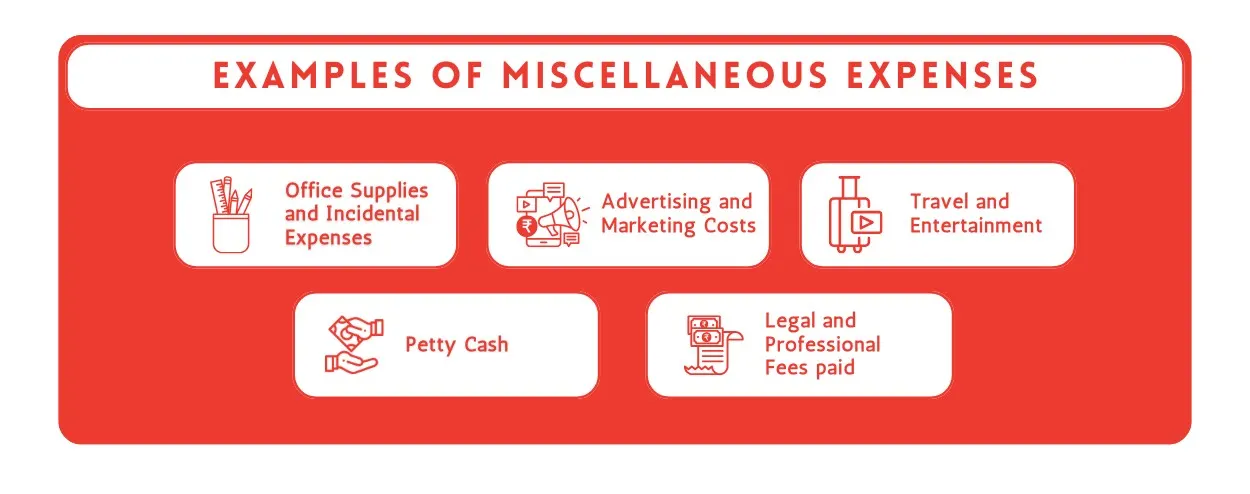
Office supplies and incidental expenses
Pens, paper, ink and other small office items are needed every day but are often too small to justify their own budget line. Incidental expenses, such as an unexpected repair or a minor upgrade to office equipment, fall in the same bucket.
One-off advertising and marketing costs
Most businesses have a marketing budget, but a single social media ad, a print advertisement or a small sponsorship outside the plan is often booked as a miscellaneous expense.
Travel and entertainment
Small costs from business travel or client meetings, such as a last-minute cab or an unplanned meal with a client, often land here when they are not part of a formal trip budget.
Petty cash payments
Parking fees, tea for a meeting and local transport are usually paid from petty cash. They still need to be tracked so that the fund is not overspent.
Legal and professional fees
An occasional consultation with a lawyer or consultant that is not part of a standing retainer, or a single legal filing fee, may be recorded as a miscellaneous expense.
What should not go under miscellaneous expenses
Keep the miscellaneous head for genuinely small, irregular items. Book these under their own accounts instead:
- Recurring costs such as rent, salaries, electricity or monthly software subscriptions.
- Large one-off purchases, especially assets such as laptops or furniture, which may need to be capitalised.
- Personal expenses of owners or employees.
A miscellaneous account that grows every month is a sign that some items need their own category.
Miscellaneous expenses in accounting
Where they appear. Miscellaneous expenses are indirect expenses. They are shown in the profit and loss account, usually within "other expenses" or as a separate "miscellaneous expenses" line.
Journal entry. When you pay a miscellaneous expense in cash or from the bank:
| Account | Debit | Credit |
|---|---|---|
| Miscellaneous Expenses A/c | Amount | |
| To Cash / Bank A/c | Amount |
Recording rules.
- Record each expense as soon as it is incurred, with the bill attached. Late entries lead to lost bills and wrong classification.
- Use a separate miscellaneous expense account so the main accounts, such as payroll or inventory, stay clean.
- Review the account every month and move any repeating item to its own head.
- For companies, Schedule III of the Companies Act, 2013 requires significant items within other expenses to be disclosed separately, so a large miscellaneous balance may need to be broken down in the financial statements.
Why tracking miscellaneous business expenses matters
Budget control and financial accuracy
Because they are unpredictable, miscellaneous expenses can create surprise cash flow gaps. Tracking them against a budget line keeps small costs from adding up unnoticed and gives you better data to plan future spending.
Tax benefits of deductible miscellaneous expenses
Many miscellaneous business expenses can reduce taxable profit, but only if they are properly recorded and supported by bills. Categorising them correctly makes tax filing and audits simpler.

Finding cost savings
Detailed tracking shows small, repeating costs that can be cut. If office supply spend keeps rising, for example, you can switch vendors or buy in bulk.

Are miscellaneous expenses tax-deductible in India?
Generally, yes, if they are business expenses. Under Indian income-tax law, an expense is usually allowed as a deduction when it is incurred wholly and exclusively for the business and is neither capital nor personal in nature. Keep in mind:
- Keep the evidence. Save bills, invoices and bank or UPI records for every item, however small.
- Personal costs are not deductible. Meals, travel or gifts that are not for the business cannot be claimed.
- Capital items are treated differently. Assets are generally depreciated over time rather than expensed in one go.
- GST input tax credit needs a tax invoice. To claim GST paid on a business purchase, you need a valid tax invoice showing your GSTIN, and some items, such as food and beverages in most cases, are blocked credits.
Common deductible miscellaneous expenses include office supplies, bank charges, business use of a vehicle, local business travel, professional fees, one-off advertising, business insurance premiums and equipment repairs. Tax rules and their section numbers change over time, so confirm the treatment of specific items with your tax adviser.
Keeping these records is easier with accounting software or an expense management tool than with spreadsheets.
How to manage miscellaneous expenses
Budget for them
Set aside a fixed portion of your budget for miscellaneous costs and review it every quarter. This gives room for the unexpected while keeping spending in check.
Track and categorise every expense
Record every bill, however small. Even small office purchases matter for accurate accounting and tax reporting. Digital expense management systems can categorise transactions, generate reports and show spending trends automatically.
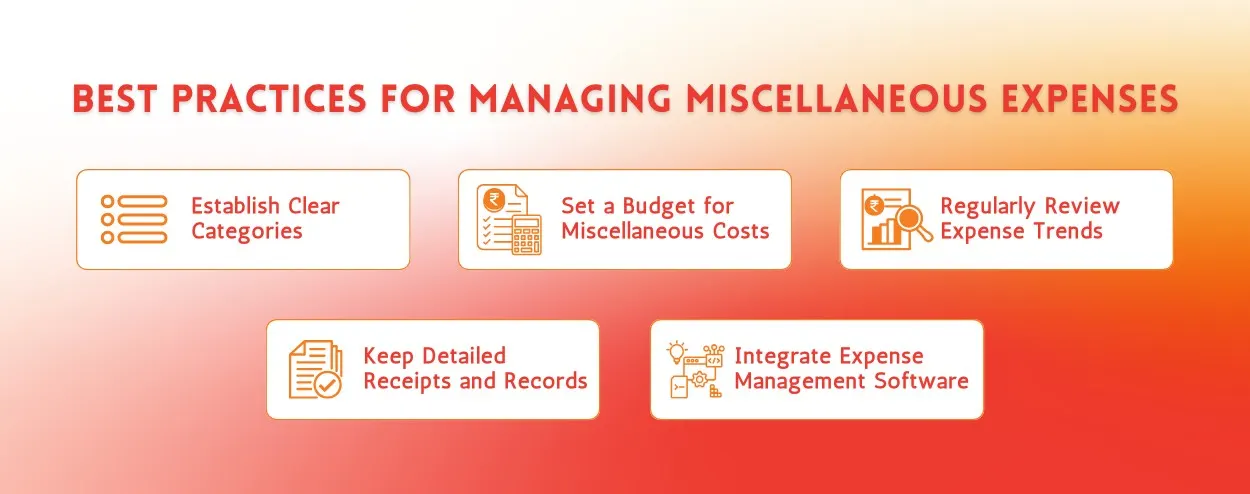
Best practices
- Set clear sub-categories, such as office supplies, one-off advertising and client entertainment, so the miscellaneous account is easy to analyse.
- Set a budget and review it against actual spend each month.
- Watch the trends to catch overspending early.
- Keep every bill, for tax deductions and audits.
- Use expense management software so tracking, categorising and reporting happen as you spend.
Expense management and miscellaneous costs
Expense management is the process of tracking, controlling and optimising what a business spends, from payroll and inventory to office supplies and marketing. Miscellaneous expenses, such as small repairs, travel expenses or last-minute purchases, are the hardest part to control because they are irregular.
Digital expense management tools help by capturing every payment and bill as it happens, which reduces errors and keeps a business's finances up to date.
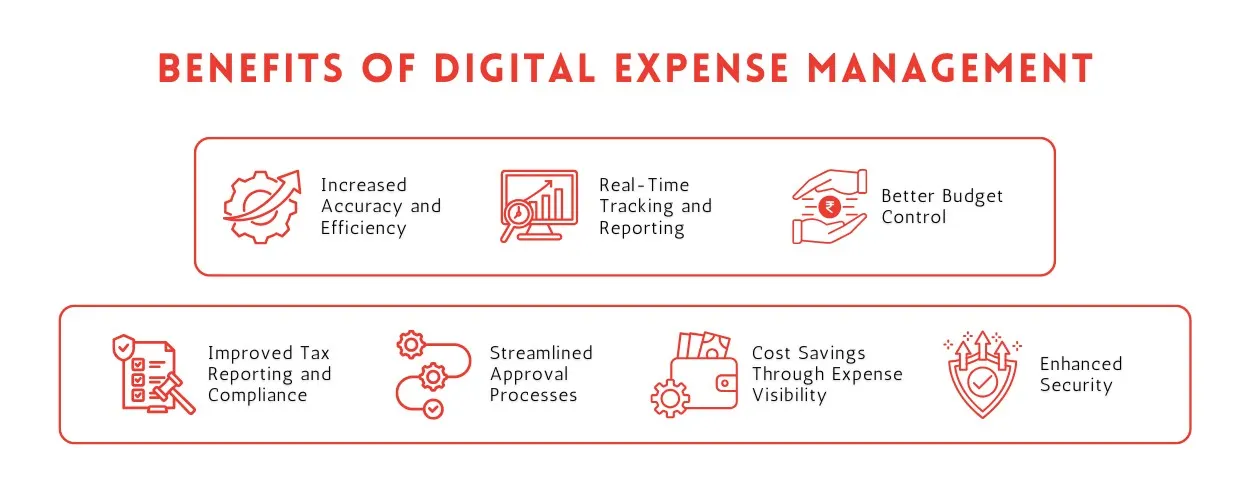
Benefits of digital expense management
- Accuracy: bills are captured when the expense happens and categorised automatically, so fewer receipts go missing.
- Real-time tracking: owners and finance teams see spend as it happens instead of waiting for month-end reports.
- Budget control: limits and alerts flag spending before it goes over budget.
- Tax records: bills and documents are stored digitally and are ready for filing and audit.
- Faster approvals: managers approve or reject expenses from anywhere, and everyone can see the status of each request.
- Cost visibility: spend data over time shows where to renegotiate or switch vendors.
- Security: fewer paper documents to lose, and access limited to authorised users.
Managing miscellaneous expenses with OmniCard
With OmniCard, employees pay for small business expenses by an @omni UPI ID or an OmniCard RuPay prepaid card from company funds, instead of paying personally and claiming later. Limits by employee, category, merchant, location and time are checked before the payment goes through. The bill is captured by receipt OCR, and entries post to ERP and accounting systems such as Tally, SAP, Oracle, Zoho and Microsoft Dynamics. See spend management, or Reimburse360 for out-of-pocket claims.
Frequently asked questions
What is the meaning of miscellaneous expenses?
Miscellaneous expenses are small, irregular business costs that do not fit any regular expense category, such as a one-off courier, a minor repair or a bank charge. They are grouped together under one head in the accounts.
Are miscellaneous expenses direct or indirect?
They are indirect expenses, because they are not directly linked to producing goods or services. They are shown in the profit and loss account, usually within other expenses.
What is the journal entry for miscellaneous expenses?
Debit the Miscellaneous Expenses account and credit Cash or Bank, depending on how the expense was paid.
Is miscellaneous expenditure the same as miscellaneous expenses?
Not always. Miscellaneous expenses are day-to-day costs charged to the profit and loss account. The older term "miscellaneous expenditure (to the extent not written off)" referred to costs such as preliminary expenses carried on the balance sheet under the old Schedule VI, a heading that the current Schedule III no longer includes.
Are miscellaneous expenses tax-deductible?
Generally yes, if they are incurred wholly and exclusively for the business, are not capital or personal in nature, and are supported by bills. Confirm specific items with your tax adviser.
How can a business control miscellaneous expenses?
Set a budget line for them, require a bill for every item, review the account monthly and move repeating items to their own head. Expense management software with spending limits makes this easier.
Conclusion
Miscellaneous expenses look trivial one at a time, but together they affect cash flow, tax and budgets. Budget for them, record every bill as it happens and review the account regularly. That keeps small costs under control and gives you cleaner books.