One Swipe, One Ledger: How Expense Management and ERP Actually Work Together
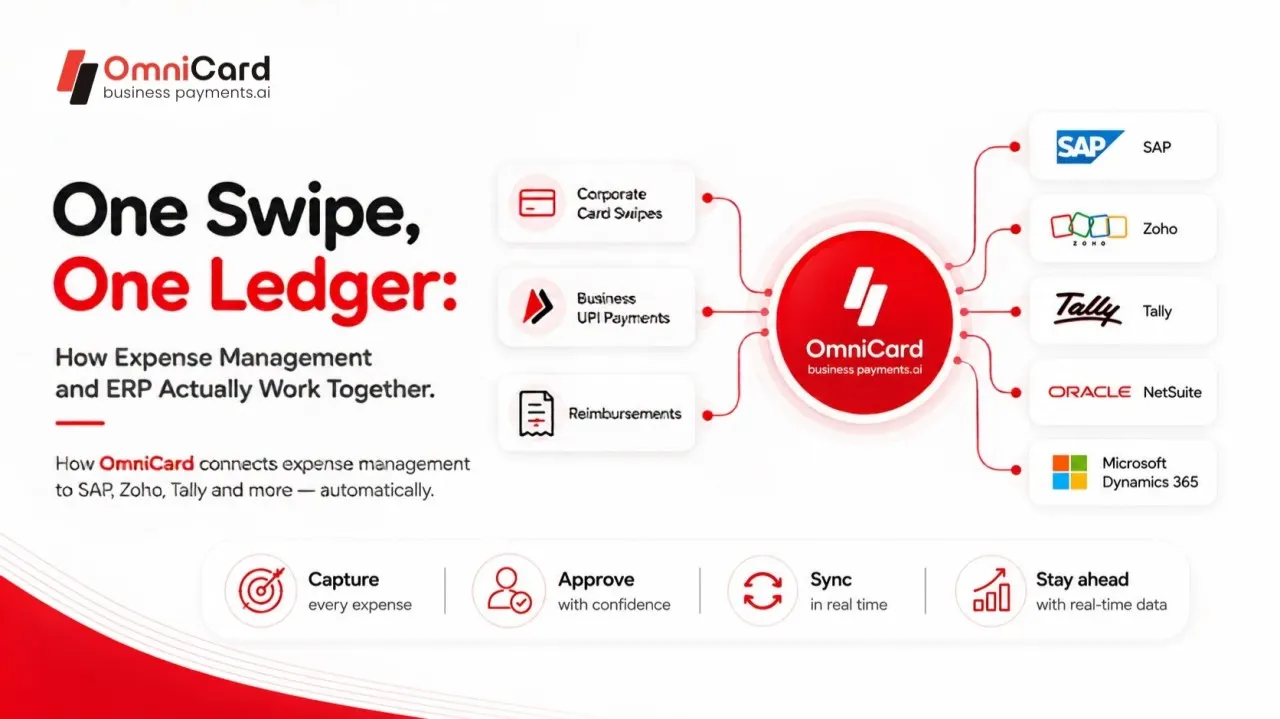
How OmniCard connects expense management to SAP, Zoho, Tally, and more — automatically
Over 2 million Indian businesses run their books on Tally. Thousands more run SAP, Zoho, Oracle NetSuite, or Microsoft Dynamics 365 — and a growing number of them have quietly solved something most finance teams once assumed was just how things worked: getting every swipe, payment, and reimbursement to land straight in the ledger, without anyone retyping it.
Picture a field sales team that spends ₹40,000 on fuel and hotels over a week. The manager approves it from a phone. The transaction already carries the right GST invoice and cost centre. By the time the trip wraps up, it's sitting in the ERP — no receipt photo, no manual entry, no piecing together which trip it belonged to.
That's the shift underway across Indian businesses right now: expense management and ERP software, once treated as two separate categories, are finally being wired together — and the businesses making that connection are moving faster because of it.
India's ERP software market is valued at roughly $5.7 billion in 2025 and is projected to cross $7 billion in 2026, growing at a compound rate of over 15% a year, as more businesses invest in the systems that will run their next phase of growth. Tally powers an estimated 2 million+ Indian businesses and remains the backbone of SMB-level GST filing; SAP anchors most BSE/NSE-listed conglomerates and large enterprises; and a fast-growing mid-market runs on Zoho Books, Oracle NetSuite, Microsoft Dynamics 365, and sector-specific platforms like Marg ERP in pharma and FMCG distribution. And with GST e-invoicing now standard for every business above ₹5 crore turnover, the businesses that connect spend data to their ERP in real time are turning compliance into a non-event instead of a monthly scramble.
The good news: every major ERP today ships with an open API, which means this connection is well within reach — it just needs the right layer sitting in between. That's exactly where OmniCard, India's AI-powered Business Fintech OS, fits in — integrating directly with SAP, Zoho, Tally, and more, so every corporate card swipe, UPI payment, and reimbursement claim lands in the ERP the moment it happens.
How expense management and ERP work best together
A few trends explain why more finance teams are making this connection now.
India's ERP ecosystem gives every business a natural home. Tally leads at SMB scale, SAP anchors large enterprises and listed conglomerates, and the mid-market runs on Zoho, Oracle NetSuite, Microsoft Dynamics 365, and sector-specific platforms like Marg ERP. The right integration layer works across all of them, whichever a business has already invested in.
GST e-invoicing has pushed real-time compliance into the mainstream. Businesses above ₹5 crore turnover now generate an IRN via the government's Invoice Registration Portal for every invoice. Businesses that build this into their expense flow turn it into a routine step, not a periodic scramble.
Automated reconciliation is freeing up finance teams for higher-value work. When spend syncs automatically with the ledger, finance teams spend less time matching receipts line by line and more time on planning, forecasting, and the decisions that actually grow the business.
Multi-entity groups are learning to run on one connected view. A subsidiary on Tally, an HQ on SAP, and a new digital arm on Zoho or NetSuite no longer has to mean four separate reports — group CFOs are increasingly pulling all of it into a single, real-time number.
For a CEO, this means growth and financial visibility can finally move at the same speed. For a CFO, it means the systems already in place — the ERP, the cards, the UPI rails — start working as one connected system instead of three disconnected ones. That's exactly where OmniCard's Business Fintech OS steps in.
7 ways OmniCard connects expense management directly to your ERP
1. Every expense is captured — and categorised — the moment it happens.
Matters most to: Finance executives and accountants.
Card swipes, UPI payments, and reimbursement claims are captured with the right category and GST invoice attached instantly, so there's nothing left to retype into Tally, Zoho, or SAP later.
2. Transactions sync directly into the ledger, live.
Matters most to: Accountants and finance controllers closing monthly books.
OmniCard's native integrations push every transaction directly into Tally, Zoho, or SAP the moment it's categorised, turning monthly reconciliation into a real-time, always-current view.
3. Approvals and ERP entries move together, not apart.
Matters most to: Approving managers and department heads.
OmniCard's approval workflow sits inside the same platform as the spend itself, so an approved transaction posts straight to the ledger the instant it clears.
4. GST invoices travel with the transaction, automatically.
Matters most to: Compliance and tax teams.
OmniCard auto-tags GST invoices to every transaction at the point of spend, keeping input tax credit and e-invoicing compliance current rather than something to catch up on.
5. Every ERP in a group comes together in one dashboard.
Matters most to: Group CFOs managing multi-entity businesses.
OmniCard's API-based connectors normalise spend data across Tally, SAP, Zoho, and NetSuite into one live view, so group CFOs see a single number instead of stitching several together.
6. Vendor payments and reimbursements post themselves.
Matters most to: Accounts payable and payroll finance teams.
OmniCard's B2B UPI and Reimburse360 record every payout the moment it's made and push it straight into the ERP's payables or reimbursement ledger.
7. Audits become a formality, not a scramble.
Matters most to: CFOs and auditors.
OmniCard's AI-powered categorisation keeps one continuous, audit-ready trail synced to the ERP at all times, so year-end simply confirms what was already accurate.
What this means for growing businesses
For a CEO, it means every rupee spent across the business is already visible where it matters — in the ERP — without waiting on a finance cycle to catch up. For a CFO or controller, it means the tools already in place finally talk to each other, turning three separate systems into one connected source of truth.
OmniCard is built to make this connection effortless. It's an RBI-licensed PPI issuer that has already processed ₹3,400 Cr+ in payments for 1,000+ enterprise clients across 700+ cities, and it connects natively with SAP, Zoho, Tally, and more — so adopting a modern expense layer means getting more out of the ERP a business has already invested in, not replacing it.
As more Indian businesses move to cloud ERPs and real-time compliance becomes the norm, the finance teams pulling ahead are the ones whose spend data flows into the ERP automatically, accurately, and the moment it happens. That's what a Business Fintech OS makes possible.
Sources: Market Research Future, NextMSC, Grand View Research, Ken Research, Zendikt, 6Wresearch, Quantumrun/Statista, OmniCard.