Why Corporate Cards Alone Don’t Solve Spending Chaos

Why Corporate Cards Alone Don’t Solve Spending Chaos
In the evolving landscape of business finance, corporate cards have become a powerful symbol of modernization. They simplify payments, offer transparency, and eliminate many of the hassles of traditional reimbursement cycles. Yet, even with all their advantages, organizations are realizing a hard truth — corporate cards alone can’t fix the chaos in spending.
Spending chaos is deeper than scattered payments or lost receipts; it’s a systemic problem rooted in the absence of control, visibility, and structured processes. It’s not about the method of payment, but how organizations track, analyze, and govern those payments in real time. Let’s explore why corporate cards, while valuable, are only part of the solution and how the real fix lies in pairing them with a comprehensive expense management ecosystem.
Understanding Spending Chaos
What Spending Chaos Really Means: Spending chaos refers to the disorder in how an organization manages its money outflow — from untracked transactions to policy violations, duplicated expenses, delayed approvals, and fragmented visibility. It’s when multiple departments spend simultaneously without oversight, when receipts go missing, or when reports are filed weeks late. The result is not just inefficiency, but financial blind spots that erode trust, profitability, and control. Spending chaos thrives in environments where processes depend on manual effort and reactive management rather than structured systems.
The Root Causes of Spending Chaos: The problem often begins with disconnected financial tools and siloed workflows. Expenses made on cards, reimbursements, or petty cash are managed separately, with little central visibility. A lack of automated controls and real-time reporting turns simple spends into financial uncertainties. When organizations grow, these inefficiencies multiply — and that’s when chaos becomes costly. At its core, spending chaos isn’t a payment issue. It’s a visibility and governance problem, one that requires more than a payment instrument to solve.
The Corporate Card Advantage
Streamlining Payments: Corporate cards are designed to simplify how organizations spend. They reduce dependency on cash, make reconciliation easier, and bring uniformity to business payments. Employees can make purchases directly without going through lengthy reimbursement cycles, ensuring smooth operations. They also centralize transactions, which helps finance teams trace payments, categorize spends, and analyze patterns creating a structured digital record of financial activity.
Building Spend Visibility: Corporate cards provide an important layer of transparency. Unlike traditional methods where receipts pile up, cards automatically log each expense, allowing finance teams to track usage across departments or employees. This real-time visibility improves oversight, helping businesses detect anomalies or unauthorized spends faster. It’s the first step toward financial control but still just the first.
Policy and Limit Controls: Modern corporate cards allow predefined spend limits, merchant restrictions, and category controls. This ensures that employees spend within policy without needing constant supervision. These built-in features create guardrails that reduce overspending and misuse. However, without integration into an intelligent expense management system, these controls remain surface-level and reactive, not strategic.
Why Corporate Cards Alone Aren’t Enough
Data Without Context: While corporate cards capture what was spent and where, they don’t explain why the expense was made, who approved it, or how it aligns with policy. A transaction log alone doesn’t give finance leaders the context needed to analyze spending behavior or policy compliance. Without this context, even well-documented spending can lead to chaos — just in a digital form.
Limited Workflow Integration: Corporate cards operate well as payment instruments but rarely integrate seamlessly with approval workflows, reimbursement systems, or policy engines. This leads to disconnected financial data scattered across tools and spreadsheets. The result? Finance teams still spend hours reconciling, verifying, and matching card statements with reports — defeating the purpose of digitization.
Reactive Oversight: Most organizations use corporate cards to monitor spends after they happen, not before. This post-transaction oversight doesn’t prevent errors; it only identifies them later. To truly eliminate chaos, finance oversight must be real-time and preventive, where anomalies are detected and flagged as they occur — something corporate cards alone can’t achieve.
Lack of Expense Categorization: Corporate card systems often record spending without automatic categorization. Without intelligent tagging, businesses lose clarity on which department, project, or cost center is responsible for an expense. This lack of granularity can lead to poor budgeting and limited insight into spending trends, leaving finance leaders without actionable intelligence.
The Real Solution: Integrating Cards with Expense Management
The Power of Integration: When corporate cards are paired with automated expense management platforms, they become part of a controlled financial ecosystem. Integration ensures every card transaction is automatically logged, categorized, verified, and approved based on pre-set rules — eliminating manual tracking, delays, and policy violations. It transforms card spending from being just recorded to being actively managed.
End-to-End Spend Visibility: Integrated systems offer a single source of truth for all business spending. Whether an employee pays via card, UPI, or prepaid solutions, all expenses are tracked in one unified dashboard. Finance leaders gain real-time visibility into every transaction, allowing them to identify leakages, control cash flow, and make informed decisions instantly.
Automated Workflows and Approvals: Automation ensures that every expense follows a defined approval path. Expenses that exceed limits are flagged instantly, while compliant transactions are approved automatically. This workflow automation not only reduces errors and delays but also boosts productivity, freeing finance teams from repetitive verification tasks.
AI and Analytics for Smarter Control: Modern expense platforms powered by AI and analytics can detect anomalies, flag duplicate spends, and predict potential policy breaches before they happen. By combining corporate card data with AI insights, CFOs can move from reactive monitoring to predictive governance, ensuring financial discipline at scale.
Building an Effective Expense Management System
Centralization Is Key: A robust expense management setup centralizes all spending channels — cards, reimbursements, and payments— into one system. This consolidation eliminates fragmented oversight and provides a clear picture of organizational spending at any given time.
Custom Policy Controls: Integrating policies directly into the system ensures automatic adherence. When employees spend, the system checks compliance in real time, creating a culture of proactive accountability rather than reactive correction.
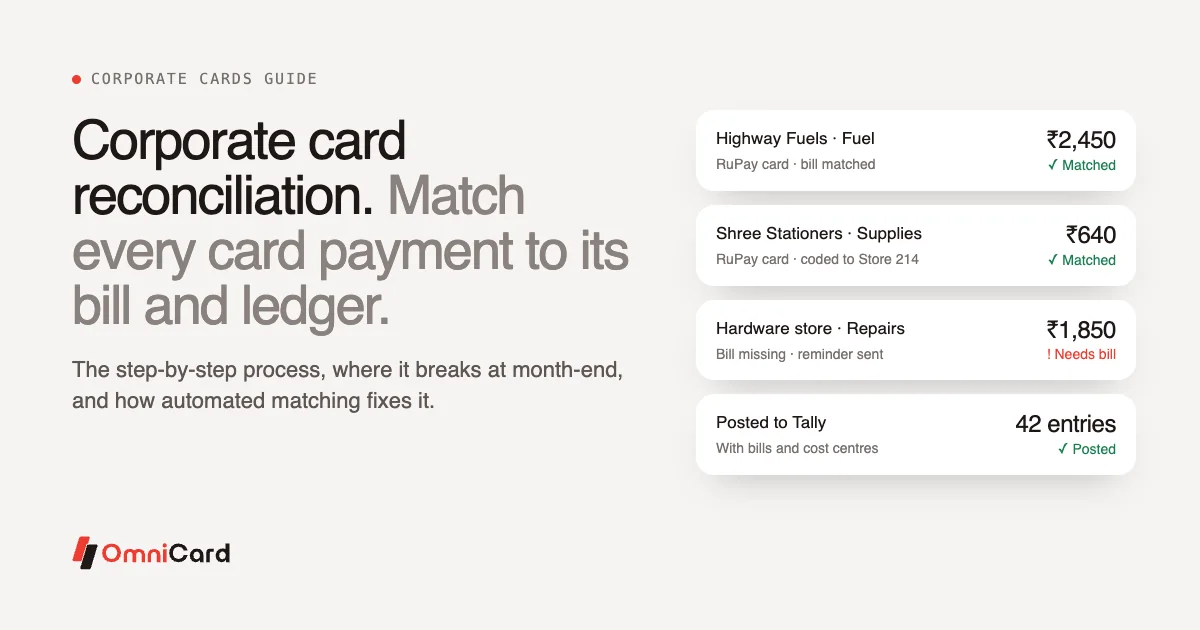
Continuous Monitoring and Reconciliation: Real-time reconciliation ensures that every transaction, whether via card or digital payment, is instantly matched with receipts and policy parameters. This continuous monitoring reduces financial discrepancies and ensures the company’s books stay accurate and up to date without manual intervention.
Empowering Finance Teams: When repetitive processes are automated, finance teams can shift focus from administrative work to strategic analysis and planning. This shift transforms finance from a back-office function to a decision-making powerhouse, driving efficiency and financial intelligence.
A Hawk-Eye Conclusion
Corporate cards are an essential step in modernizing business spending, but they’re only one piece of a larger puzzle. While they simplify payments and offer visibility, they don’t inherently control chaos — because chaos doesn’t come from spending itself, but from how that spending is managed, approved, and analyzed. True financial order comes when corporate cards are integrated within a digital expense management ecosystem, enriched with automation, AI, and real-time policy controls.
The organizations that will lead the financial transformation of 2026 won’t just issue corporate cards; they’ll build intelligent, unified, and self-regulating systems where every rupee spent is tracked, verified, and optimized for value. Corporate cards may open the door to digital finance, but it’s intelligent expense management that keeps it from descending into chaos.