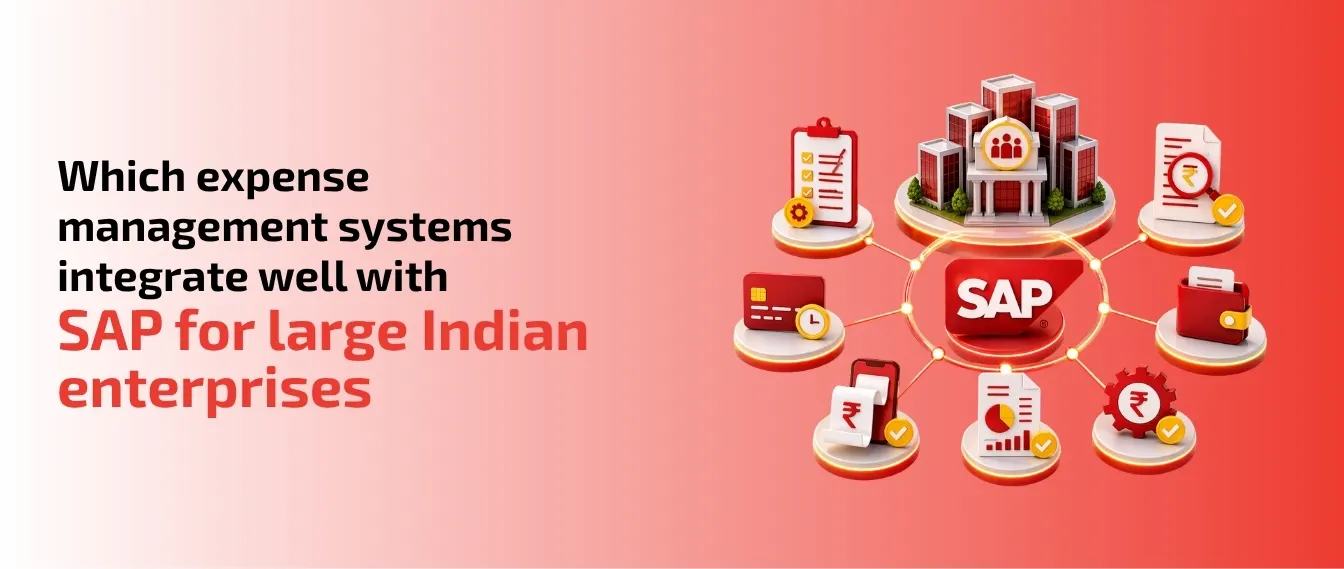
Which expense management systems integrate well with SAP for large Indian enterprises
Your sales rep in Mumbai collects crumpled GST receipts, while your Pune finance manager manually types those same numbers into accounting software. Industry data reveals these manual reimbursement cycles cost companies hundreds of hours in lost productivity monthly. Your SAP system is your business's powerful engine, but daily expense tracking is the fuel line feeding it.
Building a digital bridge between these tools, known as ERP integration, clears the blockage. Modern sap expense management grants leaders complete spend visibility, showing exactly where company money goes without human intervention. Securing guaranteed GST compliance, zero manual entry, and faster payouts requires selecting the right expense management system to integrate seamlessly with SAP for large Indian enterprises.
What to Expect From This Blog?
The Architecture of Integration: Understanding how APIs replace manual spreadsheet uploads.
Compliance Automation: How to solve the GST Input Tax Credit (ITC) puzzle for Indian businesses.
A Comparative Review: Analyzing native vs. best-of-breed expense management systems for sap.
The ROI of Automation: Why real-time reconciliation saves hundreds of finance hours.
Implementation Strategy: A 3-step roadmap to transition from manual chaos to a Business FinTech OS.
Bridging the Gap: What 'SAP-Integrated' Actually Means for Your Daily Workflow
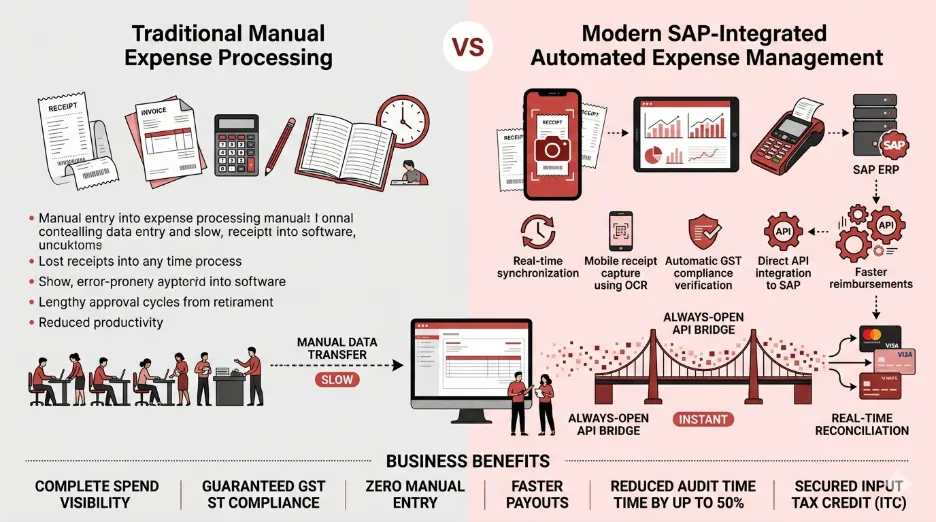
Figuring out how to sync expense data with SAP ERP usually reveals two choices. The old method relies on manually downloading spreadsheets from an expense app and uploading them into SAP. A modern setup uses an Application Programming Interface (API).
Think of an API as an invisible, always-open bridge between the two platforms. Expense data travels across this bridge instantly without human help, replacing those clunky manual file uploads. Because of this continuous connection, your "Master Data"—essential details like employee IDs and department budgets—stays perfectly synced across both systems.
How Integration Transforms Your Team’s Workflow:
Legacy Approach: Hoarding paper receipts and waiting weeks for finance to manually verify them before posting to SAP.
Modern Integration: Using real-time API integration to instantly link a hotel swipe in Pune to the correct SAP cost center.
Master Data Sync: Employee records, GL codes, and profit centers update automatically from SAP to your expense tool.
Real-Time Reconciliation: This instant matching catches missing information immediately rather than at month-end, often reducing audit time by up to 50 percent.
Platforms like OmniCard operate as a Business FinTech OS, ensuring that the "fuel" entering your SAP engine is pre-validated, categorized, and ready for high-speed processing.
Solving the GST Puzzle: Automating Tax Credits Within Your SAP System
Losing tax refunds to a coffee-stained hotel bill is a frustrating reality for many Indian businesses. By using an app equipped with Optical Character Recognition (OCR)—technology that "reads" text from images—this problem disappears.
The Power of OCR and GST Validation:
Intelligent Extraction: Even with a crumpled dinner receipt from Hyderabad, enterprise-grade OCR for Indian bill processing instantly extracts the vendor's name, date, and tax amounts.
Frictionless Submission: Employees simply snap a quick photo on their phones instead of manually typing numbers into a digital form.
GSTIN Verification: Proper GST-compliant travel and expense automation automatically verifies if the 15-digit GSTIN on that receipt is legitimate.
Securing ITC: If valid, the system secures your Input Tax Credit (ITC)—the tax money the government allows you to claim back. Catching fake or expired GSTINs before they reach your finance team prevents costly errors.
Automating Indirect Tax Compliance:
Automatic Categorization: True indirect tax compliance in sap expense management means software automatically categorizes tax codes.
TDS Calculation: The system calculates vendor deductions, like TDS for travel agencies, without human intervention.
Error Reduction: Pushing pre-audited and perfectly formatted data directly into SAP eliminates the final hurdle of manual tax filing.
Audit Readiness: Generating accurate return reports becomes effortless because every expense is linked to a verified digital invoice.
Maximizing Efficiency: Why SAP Cost Management Requires Granular Visibility
Effective cost management with expense management software is about more than just recording spend; it’s about controlling it before it happens. Large Indian enterprises often struggle with "leaky" budgets where small, unrecorded expenses snowball into significant losses.
Strategies for Better Cost Control:
Policy Enforcement: Embed your company’s travel and expense policy directly into the integration. If an employee tries to book a flight above the Rs. 10,000 limit, the system flags it before the spend occurs.
Departmental Visibility: Finance heads can see real-time spend against budgets for specific projects or regions like Karnataka or Maharashtra.
Eliminating Duplication: API-driven systems check for duplicate invoices, ensuring you don't pay for the same Mumbai-Delhi flight twice.
Spend Analysis: Use SAP’s analytics combined with clean expense data to negotiate better rates with preferred Indian vendors and hotel chains.
By using a unified platform like OmniCard, businesses can issue cards with pre-set limits, ensuring that sap cost management starts at the point of swipe, not at the end of the month.
The Cultural Shift: Improving Employee Experience Across India
In the competitive Indian talent market, the "reimbursement experience" matters. Employees in cities like Bengaluru, Delhi, and Chennai expect digital-first solutions. Forcing them to manually track Rs. 500 auto-rickshaw receipts laeds to frustration and decreased morale.
Benefits for the Modern Indian Workforce:
Faster Payouts: Automation reduces the reimbursement cycle from 30 days to under 5 days, putting money back in employees' pockets faster.
Mobile Accessibility: Whether they are in a remote site in Odisha or a boardroom in Gurgaon, employees can manage expenses via smartphone.
Reduced Friction: Eliminating the need to visit the office physically to submit paper stacks is a major win for hybrid work models.
Transparency: Employees can track the status of their claims in real-time, reducing the "Where is my money?" emails to HR.
From Chaos to Control: Your 3-Step Plan for a Connected Finance System
Employee reimbursements no longer has to be a manual chore of crumpled receipts and GST errors. Streamlining employee reimbursement cycles via SAP connectors turns this daily frustration into a smooth, automated process.
The Implementation Checklist:
Perform a 'Data Audit': Review your current manual expense process. Spot where the delays are—is it receipt collection in Mumbai or approval delays in Bangalore?
Prepare an IT Checklist: Run an SAP compatibility check. Consult your IT team about whether your version (ECC or S/4HANA) supports modern API data bridges.
Set Realistic Expectations: Plan for a 4-week rollout. Focus on training a "pilot" department first to ensure comfortable adoption before scaling company-wide.
Implementing SAP-integrated expense workflows shifts the organizational mindset from chasing paper to empowering the workforce. Once connected, the biggest victory isn't just the software—it’s the massive hours saved per week, transforming an administrative burden into a strategic advantage.
Key Takeaways:
Seamless Sync: API-based integration is the gold standard for connecting expense management systems for sap, replacing manual uploads.
GST Protection: Automated GSTIN verification is essential for Indian enterprises to claim Input Tax Credits accurately and avoid audit red flags.
Cost Visibility: Real-time data flow enables superior sap cost management and departmental budget tracking.
User Adoption: Tools like OmniCard bridge the gap between complex ERPs and the need for simple, conversational employee interfaces.
Efficiency Gains: Automation can reduce audit and reconciliation time by up to 50 percent, allowing finance teams to focus on strategy.
FAQs:
Q: Can I integrate my expense system if my company still uses SAP ECC instead of S/4HANA?
A: Yes. While S/4HANA offers native benefits, many best-of-breed expense management systems for sap offer robust connectors designed specifically for SAP ECC to ensure smooth data flow.
Q: How does the system handle different GST rates across Indian states?
A: Modern sap expense management tools use OCR to identify the state of supply and automatically apply the correct CGST, SGST, or IGST codes based on your SAP tax configuration.
Q: What happens if an employee loses a physical receipt?
A: Most systems encourage "snap-as-you-go." However, for missing receipts, platforms can trigger an affidavit workflow or use the verified corporate card transaction as secondary proof, depending on your internal audit policy.
Q: Does this integration require a complete overhaul of our SAP setup?
A: No. Integration typically works via a "connector" or API that sits on top of your existing SAP environment, meaning your core accounting processes remain intact while your data entry becomes automated.
Q: How does sap cost management improve with these tools?
A: By providing real-time visibility. Instead of waiting for month-end reports, finance managers can see "pending" expenses and actual spends against budgets instantly, allowing for proactive adjustments.