What’s the typical pricing model for SaaS-based spend management tools in India, and which ones offer the best value for money?
In today’s fast-paced business environment, controlling corporate expenditures is no longer just about balancing the books; it is a strategic imperative. As companies scale, tracking every rupee becomes complex, leading many organizations to invest in robust spend analysis software. If your business is looking to upgrade its procurement processes, you are likely wondering about the costs and the return on investment.
What to Expect From This Blog?

In this comprehensive guide, we will break down the financial and operational aspects of modern spend tracking. You will learn:
The fundamental differences between spend management and procurement analytics.
A step-by-step breakdown of how spend analysis software processes your data.
The typical SaaS spend management tools pricing India businesses can expect.
Strategic ways to use platforms like OmniCard to maximize ROI and plug revenue leakages.
How to choose the right tool that offers the best value for money in the Indian market.
Decoding the Tech: Spend Management vs. Procurement Analytics

Before evaluating pricing, it is essential to understand exactly what you are paying for. A common point of confusion is the difference between spend management vs procurement analytics.
Spend Management Software: This refers to the overarching platform used to control, track, and process purchasing activities. It handles the "doing"—issuing purchase orders, managing employee corporate cards like those provided by OmniCard, and paying vendors.
Procurement Analytics: This is the analytical engine that crunches the data generated by those activities. It focuses on the "insight"—identifying patterns and saving opportunities.
The Integrated Approach: The best platforms seamlessly combine both. By integrating analytics into your daily operations, your finance team gains real-time visibility into indirect spend—such as office supplies, software subscriptions, and travel expenses—which often go unnoticed.
Furthermore, it becomes significantly easier to prevent revenue leakage by identifying maverick spending in accounts payable, ensuring that all purchases comply with negotiated contracts and company policies.
The Core Framework: What Are the Five Steps of Spend Analysis?
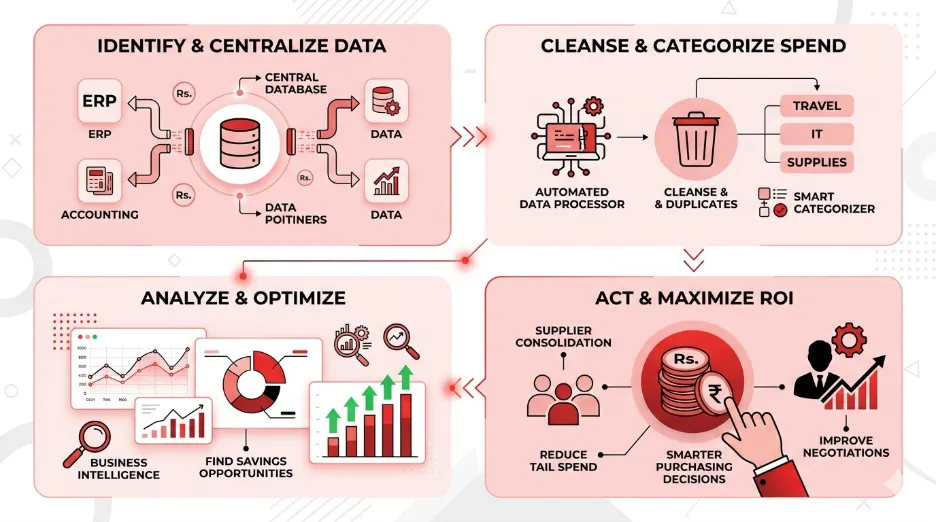
To truly appreciate the value of these tools, it helps to know how they process your data. Modern spend analysis software automates these five critical steps:
Identify Data Sources: a)The system locates all internal sources of spend data across departments. b)This includes ERPs, accounting software, and digital payment logs from platforms like OmniCard.
Extract and Centralize: a)The software pulls this data into a single repository. b)Top-tier tools utilize seamless ERP integration for financial transparency, ensuring no data is left behind.
Cleanse the Data: a)Raw data is often messy (e.g., "Amazon India" vs "Amazon.in"). b)Modern tools excel at automating procurement data classification, instantly correcting errors and removing duplicates.
Categorize Expenditures: a)The system groups purchases into logical categories (Travel, IT, Stationery). b)Using automated spend taxonomy mapping, the software aligns your localized spending data with global standards like UNSPSC.
Analyze and Act: a)The final step involves generating actionable insights. b)This is where you spot that you are overspending on recurring SaaS subscriptions or identifies vendors who aren't honoring contract rates.
SaaS Spend Management Tools Pricing India: What to Expect
When evaluating the market, understanding the typical SaaS spend management tools pricing India has to offer is crucial for budgeting. Unlike legacy on-premise software, SaaS platforms offer flexible, subscription-based models tailored to the Indian MSME and Enterprise landscape.
- User-Based Licensing
How it works: You pay a fixed monthly or annual fee per user or "seat."
Target Audience: Ideal for mid-sized companies with a small, dedicated procurement or finance team.
Estimated Cost: In India, prices typically range from Rs. 1,500 to Rs. 5,000 per user, per month.
Benefit: Predictable monthly costs that scale linearly as your team grows.
- Spend Volume-Based Pricing
How it works: Some top-rated procurement intelligence tools charge based on the total annual spend volume they analyze (e.g., a percentage of the total Rs. value processed).
Target Audience: Highly favored by large enterprises with massive transaction volumes.
Benefit: Aligns the cost of the software with the scale of the business operations.
- Modular & Platform Pricing
How it works: Many providers offer a base platform with add-on modules.
The Mix: You might pay a base fee for standard spend management software and an additional premium for advanced analytics, automated sourcing, or specialized card integration features.
The OmniCard Edge: Some modern Indian fintech solutions provide spend management features bundled with corporate cards, often significantly reducing the software-only cost by integrating the payment and tracking layers.
Which Ones Offer the Best Value for Money?
The tools that offer the best value are not necessarily the cheapest; they are the ones that deliver the highest ROI through efficiency and cost savings.
AI-Driven Efficiency: Look for solutions that feature artificial intelligence. Instead of a human manually sorting thousands of invoices, AI does it in seconds with higher accuracy.
Data Visualization: Platforms that enable strategic sourcing through data visualization allow procurement managers to see spending trends on intuitive dashboards.
Tail Spend Management: High-value tools excel at reducing "tail spend" with automation—capturing those small, unmanaged purchases that typically make up 20% of a company's spend but 80% of its transactions.
Localized Compliance: In the Indian context, ensure the tool handles GST compliance and Indian tax structures seamlessly. Platforms like OmniCard help simplify this by capturing digital receipts and GST details at the point of purchase.
Actionable Strategies to Maximize Your ROI
Once you have implemented your chosen spend management software, here is how to ensure it pays for itself:
- Consolidate Your Vendor Base
Use your software’s reporting features to identify supplier overlap.
If your data reveals you are buying IT hardware from fifteen different vendors, consolidating that spend to just two or three preferred suppliers will instantly unlock volume discounts.
This lowers administrative costs as your accounts payable team has fewer invoices to process.
- Uncover Hidden Savings
Proactively look for cost reduction opportunities.
With everything tracked centrally via your spend analysis software, you can easily spot overlapping software licenses or premium freight charges that could be avoided.
Identify seasonal price spikes that can be mitigated through early or bulk purchasing.
- Elevate Supply Chain Visibility
Treat your software as more than just a financial tool.
By utilizing business intelligence for supply chain management, you can assess supplier performance and monitor delivery lead times.
Mitigate risks before they impact your production lines by tracking which vendors consistently underperform.
- Run Regular Audits
If you have ever wondered how to conduct a spend audit without spending weeks in spreadsheets, your new software is the answer.
Set up automated quarterly reports to verify that invoice prices match contract prices.
Ensure that all approval workflows—from the initial request to the final OmniCard payment—are being strictly followed.
The Role of Integrated Payment Solutions
A major trend in the Indian market is the move toward "Spend Management + Payments." Traditional software often waits for an invoice to be uploaded to "see" the spend. However, when you use a solution like OmniCard, the spend is captured the moment the card is swiped or the online payment is made.
Real-time Visibility: You don't have to wait for the end of the month to see budget leaks.
Empowerment with Control: Give employees the freedom to make necessary business purchases while maintaining strict limits and category controls.
Simplified Reimbursements: Eliminate the "reimbursement culture" that plagues Indian HR and Finance departments, saving hundreds of man-hours.
The Bottom Line
Investing in spend analysis software is one of the most effective ways to protect your company's profit margins. While the SaaS spend management tools pricing India offers varies widely, the true measure of a tool’s worth lies in its ability to bring order to chaos.
By prioritizing platforms that offer AI capabilities, robust ERP integrations, and deep analytical insights, you empower your procurement teams to move away from tactical paper-pushing and toward highly strategic financial management. Ultimately, the right tool—supported by a robust payment ecosystem like OmniCard—will not just track your spending; it will transform the way your entire organization does business.
Key Takeaways
Spend Management vs. Analytics: One controls the process; the other provides insights. You need both for total control.
Automation is King: Modern spend analysis software automates data cleansing and categorization, reducing human error.
Pricing Models: Indian SaaS pricing usually follows per-user or spend-volume models, typically ranging from Rs. 1,500 to Rs. 5,000 per user/month.
ROI Drivers: Focus on vendor consolidation, tail spend reduction, and AI-driven categorization to see the fastest return on investment.
Integrated Payments: Using tools like OmniCard allows for real-time tracking, making spend management proactive rather than reactive.
FAQs
Q1: Is spend management software suitable for small Indian startups?
Yes. Many SaaS providers offer "Starter" tiers. Small businesses can actually benefit more from these tools early on to establish financial discipline and prevent "leaks" before they scale.
Q2: How does GST factor into spend management tools?
Top-rated SaaS spend management tools pricing India packages often include GST reconciliation. This ensures that the GST paid on corporate expenses can be claimed as Input Tax Credit (ITC) accurately.
Q3: Can these tools integrate with my existing Tally or Zoho Books?
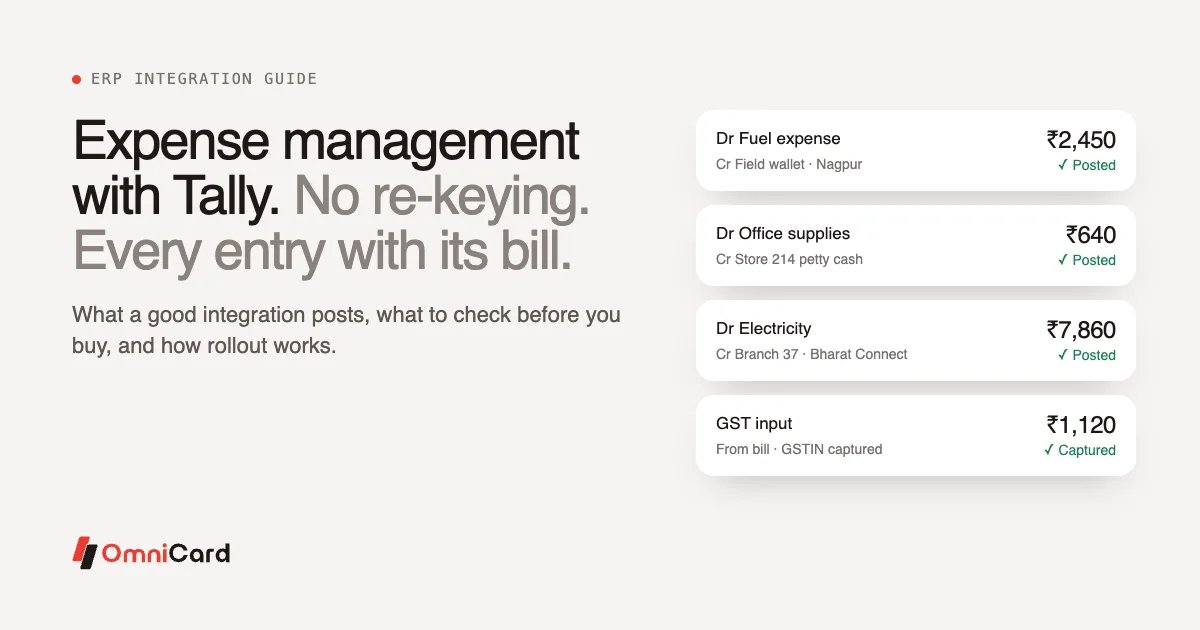
Most modern spend management software offers API integrations or CSV exports specifically formatted for popular Indian accounting software like Tally, Zoho Books, and SAP.
Q4: What is "Maverick Spend"?
Maverick spend occurs when employees purchase goods or services outside of the company’s established procurement policy or from non-preferred vendors. Spend analysis identifies these instances so they can be corrected.
Q5: How long does it take to implement spend analysis software?
For SaaS-based platforms, basic setup can take as little as a few days. However, full integration with your ERP and historical data cleansing usually takes 4 to 8 weeks.