What tools can help Indian logistics firms replace cash advances to drivers with digital cards or wallets?
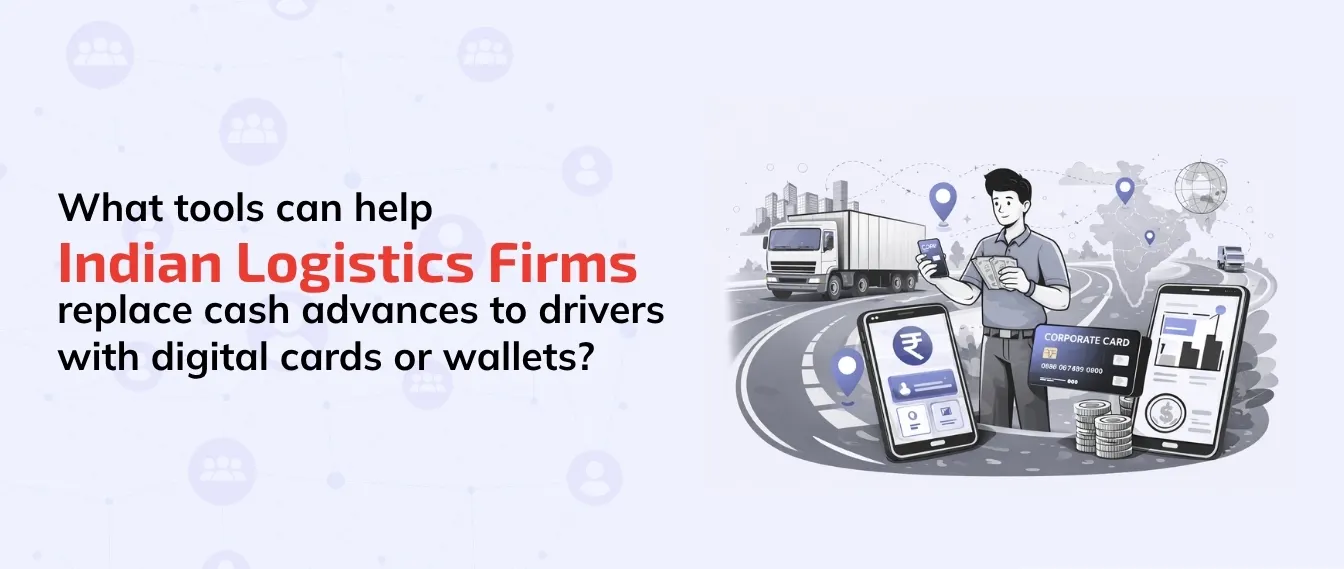
Every morning, across thousands of logistics hubs, transport yards, and last-mile delivery branches in India, a ritual plays out that has remained unchanged for decades. A driver walks up to a supervisor. The supervisor opens a drawer, counts a few thousand rupees, and hands over cash - for fuel, tolls, meals, repairs, and "miscellaneous." A scribbled entry is made in a register. The driver leaves. And with that exchange, visibility ends.
No one knows exactly how that cash gets spent. No one knows if the fuel receipt is real. No one knows if the toll amount was right. By the time the trip closes and accounts are settled, if they are, the numbers rarely add up cleanly. The gap between what was disbursed and what was actually spent becomes just another item under "operational loss."
This is the cash advance problem at the heart of Indian logistics finance and it is costing the industry far more than most CFOs want to admit What to Expect from This Blog?

This blog is written for founders, finance heads, and operations leaders in Indian logistics and every one who manages fleets, field teams, or distributed driver workforces. Here is what you will walk away with:
A clear-eyed breakdown of why cash advances are a structural problem, not just an operational inconvenience
An understanding of what a modern digital spend ecosystem looks like; beyond just "giving drivers a card"
A deep dive into the capabilities: approvals, policy engines, UPI rails, ERP integrations, AI audits, GST compliance, and more, which define a truly enterprise-grade fleet spend platform
The business impact: how moving to digital translates into real savings, faster closures, and airtight compliance
Practical guidance on what to look for when evaluating tools for your logistics business
Whether you run a 50-truck fleet or a 5,000-vehicle network, this blog will give you the framework to make the shift from cash-heavy chaos to a structured, digital-first spend management ecosystem.
The Real Cost of Cash in Indian Logistics

India's logistics sector is one of the most operationally demanding in the world. With over 230M registered vehicles on the road, a sprawling network of highways, state borders, toll plazas, fuel stations, delivery hubs and a workforce that is largely cash-dependent, managing field spend is structurally complex.
But complexity is not the core problem. The core problem is opacity.
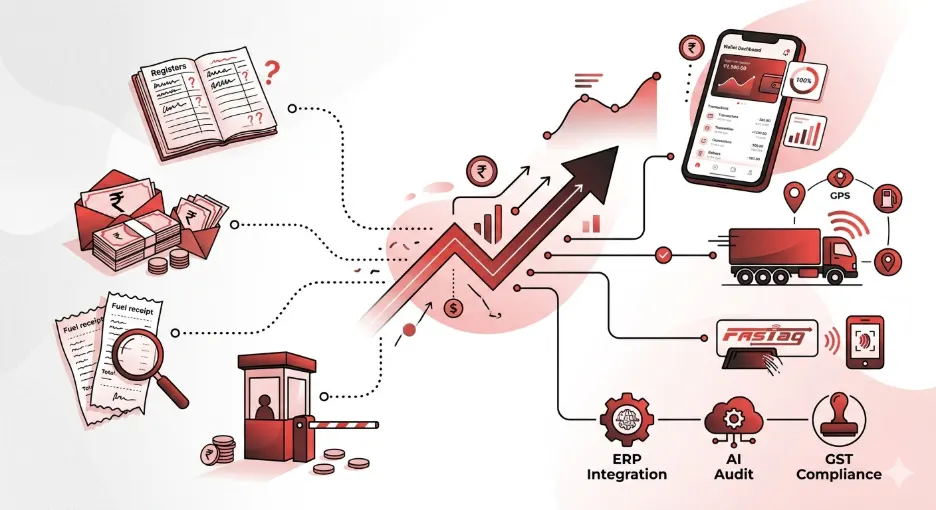
When a driver receives ₹5,000 in cash before a trip, that money enters a black box. The spend that comes out the other end which are receipts crumpled in a pocket, WhatsApp photos of petrol pump bills, verbal accounts of breakdown costs, is almost always incomplete, often inaccurate, and nearly impossible to reconcile at scale.
The downstream effects compound quickly. Finance teams spend disproportionate hours chasing settlement paperwork. Duplicate reimbursements slip through. Inflated fuel claims go undetected. Petty cash floats balloon across branches. Month-end closures get delayed. GST input tax credits are lost because receipts are not GST-compliant or go missing entirely. And perhaps most critically, no one has a real-time view of what the company is actually spending on the road.
Indian truck drivers often rely on a manual, offline system that leads to cash payments which are delayed, disputed, or less than agreed upon — creating financial instability and an erosion of trust across the supply chain. This is not a fringe issue. It is the operating reality for most Indian fleet businesses today.
The question is no longer whether to digitise driver payments. The question is: what does a truly capable digital spend system look like and which tools can get you there?
The Shift Is Already Happening But Patchwork Solutions Are Not Enough
UPI now accounts for over 80% of overall retail digital payments in India and is expected to grow to 91% of total retail digital payments by FY 2028–29. The infrastructure for cashless payments has never been more mature or more widely accessible, including drivers on highways in Tier 2 and Tier 3 cities.
At the same time, the India fuel card market is expected to grow from approximately USD 935 M in 2024 to USD 2,075M by 2035, driven largely by the increasing adoption of digital payment solutions and a growing focus on efficiency in fleet management.
Forward-thinking logistics firms are already moving. But many are making the mistake of treating this shift as a point solution replacing cash with a prepaid card here, enabling UPI payments there, setting up a WhatsApp group for receipt submissions. The result is a fragmented patchwork of tools that reduces some friction but does not solve the structural problem.
What is actually required is a unified, policy-driven, digitally-native spend management ecosystem built specifically for the realities of Indian logistics operations. Let us break down exactly what that means.
What a Modern Fleet Spend Platform Must Do: Capability by Capability
1. Multi-Level Approvals and Policy Engines
The most fundamental shift from cash to digital is not the payment instrument, it is the control layer that sits above it. In a cash-based system, money flows with minimal governance. In a digital system, every rupee should flow through a defined policy before it moves.
A robust policy engine allows finance and operations teams to configure spend rules at multiple levels: per driver, per vehicle, per trip, per expense category, and per vendor. A driver on a short-haul run should not have the same fuel limit as one on a cross-country trip. Repairs above a certain threshold should require manager sign-off before payment, not after. Toll spends should be restricted to FASTag channels. Meal allowances should have daily caps.
Equally important is the approval workflow. Multi-level approval structures allow organisations to define who can authorise what — a field supervisor for routine spends, a regional finance manager for exceptions, a CFO for anything above a defined threshold. Approvals happen digitally, in real time, via mobile and not through phone calls, WhatsApp messages, or verbal sign-offs that leave no audit trail.
This combination of policy rules and approval hierarchies transforms spend governance from a reactive exercise (finding out what went wrong after the month closes) to a proactive one (preventing non-compliant spends from happening in the first place).
★ iFleet Pay by OmniCard is built with exactly this philosophy — enabling policy-first controls with limits configurable by driver, vehicle, category, vendor, and time, combined with dynamic multi-level approval workflows that work across distributed fleet operations.
2. Unified Multi-Rail Payment Stack
One of the most persistent inefficiencies in fleet spend is fragmentation across payment instruments. A driver may use cash for fuel, a company credit card for repairs, a personal UPI account for toll recharges, and FASTag for highway toll plazas with each channel generating different data in different formats, or no data at all.
A modern fleet spend platform consolidates all of this onto a single stack. UPI, RuPay-enabled prepaid cards and FASTag should all operate under one policy layer, one ledger, and one dashboard. This is not merely a convenience, but a structural requirement for real-time visibility and clean reconciliation.
★ OmniCard's iFleet Pay brings together UPI, prepaid cards, and FASTag in one unified stack: single ledger, single policy, designed to eliminate the chaos of fragmented payment channels across fleet operations.
When all payment rails flow through one system, finance teams can see every rupee on the road, in real time — not at the end of the month when settlement headaches begin.
3. Instant Reimbursements and Payout Speed
Not every fleet spend can be pre-loaded or pre-approved. Breakdowns happen. Emergency repairs come up. A driver stranded at 2 AM on a national highway cannot wait 48 hours for finance to process an advance.
This is where instant payout capability becomes a critical differentiator. A modern fleet spend platform should allow operations or finance teams to release emergency funds to a driver's wallet, UPI handle, or prepaid card within seconds, not hours. This removes the operational dependency on physical cash reserves at branch locations, eliminates the "running to the ATM" problem, and ensures that drivers are never forced to use their personal money for business expenses.
Speed here is not just a convenience feature. It directly impacts driver trust, retention, and operational continuity — particularly for long-haul transport companies where delayed reimbursements have historically been a significant driver of attrition.
4. UPI-First Field Spend Enablement
India's field workforce which includes delivery agents, truck drivers, loading supervisors, service technicians lives on UPI. It is the payment language they already speak. Any solution that asks them to learn a new app, carry a new card, or go through a lengthy onboarding process will face adoption resistance.
A UPI-first approach meets drivers and field staff where they already are. Spend wallets that work via UPI QR codes at fuel stations, dhabas, spare parts shops, and toll booths require zero behavioural change from the driver. The compliance burden which is staying within limits, spending only at approved merchants is enforced by the platform invisibly, not by asking drivers to police themselves.
This is particularly powerful for last-mile delivery fleets, where the workforce is large, distributed, and often has limited familiarity with corporate payment tools. UPI-enabled digital vouchers and wallets are interoperable, instantly accessible, and work even on basic smartphones, making them the right instrument for India's logistics ground reality.
5. Business Finance OS and Unified Spend Platform
The vision beyond just fleet payments is more ambitious: a Business Finance Operating System that unifies every category of company spend, field operations, employee benefits, petty cash, reimbursements, incentives, under one platform and one set of policies.
For logistics firms that have historically managed spend across a tangle of branch cash registers, shared credit cards, Excel sheets, and WhatsApp groups, this is a genuine transformation. A unified spend platform means that the finance team has one source of truth for all expenditure, not only fleet-related, but across the company.
This kind of consolidation has compounding benefits. It eliminates duplicate tools and their associated costs. It gives CFOs and founders a single dashboard view of spend health. It enables consistent policy enforcement across business functions. And it dramatically reduces the time and effort required to close books at month end.
OmniCard positions itself as exactly this — a Business Fintech OS for Indian enterprises — with iFleet Pay being the fleet-specific expression of that broader platform, seamlessly connected to the same policy engine, approval workflows, and finance dashboard that governs the rest of the organisation's spend.
6. Deep ERP and Accounting Integrations
A digital spend platform that does not integrate with a company's accounting or ERP system is a half-measure. Finance teams still end up manually exporting data, reformatting it, and re-entering it which defeats much of the purpose of going digital.
Enterprise-grade fleet spend platforms must offer native or near-native integrations with the tools Indian finance teams actually use: Tally, Zoho Books, SAP, Oracle, and increasingly, custom ERPs built by mid-sized logistics firms. Integration should be bidirectional: expense data flows into the accounting system automatically, and budget or policy updates from the ERP can inform spend limits on the platform.
This level of integration transforms the month-end close from a scramble into a near-automated process. Trip-linked expenses are automatically matched against budget heads. GL coding happens programmatically. Variance reports are generated without manual intervention. Finance teams are freed from reconciliation drudgery and redirected to analysis and decision-making.
7. Transparent Pricing and Low-Fee Economics
A common hesitation among logistics CFOs considering digital fleet spend tools is the fee structure — particularly for companies operating at scale, where even small per-transaction charges add up significantly across thousands of trips per month.
The right platform should offer transparent, predictable pricing with no hidden charges. MDR (Merchant Discount Rate) economics, FASTag transaction fees, UPI processing charges, all of these should be clearly disclosed and, ideally, structured to reward volume. Platforms that charge opaque monthly fees bundled with per-transaction levies make it difficult for finance teams to model the true cost of adoption.
Transparent pricing also builds trust. When finance heads can see exactly what they are paying for and audit that against the value delivered in terms of leakage prevention and reconciliation savings, the ROI case for digital spend management becomes self-evident.
8. AI-Driven Audit and Anomaly Detection
Manual audits of field expense data are slow, error-prone, and largely impractical. A finance team cannot realistically review thousands of fuel receipts, toll records, and repair invoices every month with meaningful scrutiny.
AI-driven audit capabilities change this equation entirely. Machine learning models trained on transactional data can flag anomalies in real time: a driver who is consistently fuelling 20% more than route distance would justify; a toll claim that does not match the designated route; a repair expense at a vendor not on the approved list; a pattern of weekend spends that does not align with any active trip.
These flags are surfaced to finance and operations managers as actionable alerts — not buried in reports that no one reads. Over time, AI audit layers also build a baseline of "normal" spend patterns for each driver, vehicle, and route, making anomaly detection increasingly precise. This is the shift from reactive auditing to proactive fraud prevention — and it is only possible at scale when spend data is digital, structured, and flowing through a single platform.
9. Proactive Budgeting and Spend Analytics
Visibility without intelligence is just data. The real value of a digital fleet spend platform lies in what it enables finance and operations leaders to do with the data and the best platforms are moving from descriptive analytics (what happened) to prescriptive ones (what to do next).
Trip-based budgeting allows companies to set precise spend envelopes for each route — accounting for fuel consumption norms, standard toll charges, driver allowances, and a buffer for variable costs. As actual spends flow in, the platform compares them to budget in real time, flagging overruns before they become month-end surprises.
At the fleet level, spend analytics across driver cohorts, vehicle types, routes, and time periods reveal patterns that are invisible in a cash-based system. Which routes consistently over-spend on fuel? Which drivers have the cleanest expense records? Which vendors are being used most — and are they on the approved list? These insights drive procurement decisions, route optimisation, driver performance management, and ultimately, margin improvement.
10. Multi-Wallet Employee Benefit Management
Driver welfare is increasingly recognised as a strategic priority in Indian logistics — both because it impacts operational continuity and because regulatory scrutiny around labour compliance is increasing. A modern fleet spend platform should support structured benefit disbursement: meal allowances, night-halt allowances, vehicle maintenance budgets, and incentive payouts — all managed through dedicated wallets with their own policy rules.
Multi-wallet architecture allows a single driver to carry separate balances for fuel, meals, tolls, repairs, and incentives, each governed by its own spend limits and merchant restrictions. This structure is not just operationally clean; it is also compliant with RBI prepaid instrument guidelines, and tax treatment norms for different categories of employee benefits.
For operations leaders, multi-wallet management simplifies allowance administration dramatically. No more manual calculation of per-trip entitlements, no more cash distribution at branch level, and no more disputes over what was paid and when.
11. GST-Compliant Automation and ITC Recovery
For most logistics companies, GST compliance around field spends is a significant and underappreciated pain point. When drivers pay for fuel, repairs, or services using cash and collect paper receipts, or no receipts at all, the GST data required for Input Tax Credit (ITC) recovery is lost entirely.
At scale, this represents a material financial leakage. A company running 500 vehicles and spending ₹10 crore per month on fuel, tolls, and maintenance could be losing lakhs in unclaimed ITC every month simply because the expense documentation does not meet GST requirements.
A digital spend platform addresses this at the source. When every transaction is executed digitally via card, UPI, or FASTag, the GST data (vendor GSTIN, invoice amount, tax breakup) is captured automatically. Platforms with GST-compliant automation reconcile this data against GSTR returns, flag mismatches, and generate ITC-ready reports without manual intervention.
This single capability, automated ITC recovery, can often justify the entire cost of a fleet spend platform on its own.
The Business Impact: What Changes When You Go Digital
The shift from cash advances to digital fleet spend management is not merely a technology upgrade. It is an operational transformation with compounding financial and strategic benefits.
Cash leakage drops sharply. Policy engines and real-time controls prevent non-compliant spends before they happen. AI audit layers catch anomalies before they become patterns. Trip-linked budgets ensure that every rupee disbursed is tied to a specific business purpose.
Reconciliation accelerates dramatically. What used to take a finance team days of manual effort by matching fuel receipts to trips, verifying toll claims, cross-referencing repair invoices, now happens automatically. Month-end close cycles shrink from weeks to days.
Compliance becomes continuous, not periodic. GST data is captured at the point of transaction. Approval records are digital and timestamped. Audit trails are complete. Regulatory exposure from GST assessments to labour compliance audits is reduced significantly.
Driver experience improves. Instant payouts, clear allowance structures, and the elimination of personal-money-first reimbursement cycles improve driver satisfaction and reduce attrition. For an industry with persistent driver shortage challenges, this is not a soft benefit.
Finance and operations teams get their time back. With reconciliation automated, budgets tracked in real time, and anomalies surfaced proactively, finance teams can shift from transactional processing to strategic analysis. Operations leaders get the visibility they need to make informed decisions about routes, vendors, and fleet allocation.
Making the Move: What to Look for in a Fleet Spend Platform
Not all digital fleet spend tools are built equally. As you evaluate options, here is the framework:
Coverage across the payment stack: Does the platform support UPI, prepaid cards, and FASTag under one policy and one ledger? Single-rail solutions create new fragmentation problems.
Policy depth and approval configurability: Can you set limits at the driver level, vehicle level, category level, and vendor level? Can approval workflows be configured for your organisational hierarchy?
ERP and accounting integration: Does it connect to Tally, Zoho, SAP, or your existing system? Is the integration bidirectional and automated?
AI and analytics maturity: Is anomaly detection rule-based (basic) or machine-learning-driven (intelligent)? Are spend analytics actionable or just descriptive?
GST compliance: Does the platform capture and reconcile GST data automatically? Does it generate ITC-ready reports?
Adoption-readiness for drivers: Does the solution require drivers to change their payment behaviour significantly, or does it work with UPI interfaces they already use?
Pricing transparency: Are all fees, per transaction, MDR, platform subscription clearly disclosed and predictable?
★ For Indian logistics firms looking for a platform purpose-built across all these dimensions, iFleet Pay by OmniCard — available at omnicard.in/fleet — is designed exactly for this use case. From trip-based budgeting and geo-fenced spend controls to instant driver payouts, FASTag integration, and ERP-ready reconciliation, it represents what a modern fleet finance operating system looks like for India's logistics reality.
Key Takeaways
Cash advances are a structural problem, not just an operational inconvenience — they create leakage, opacity, and compliance risk at scale that compounds with every trip.
The right digital solution is not a single card or wallet — it is a unified, policy-driven ecosystem covering UPI, prepaid cards, FASTag, approvals, analytics, and ERP integration under one roof.
Multi-level approvals and policy engines are the control layer that makes digital spend meaningful — without them, you have digital cash, not digital governance.
UPI-first design is non-negotiable for Indian logistics — any tool that does not meet drivers where they already are will fail at adoption.
AI-driven audit and anomaly detection transform digital spend data into proactive fraud prevention — moving finance teams from reactive damage control to real-time governance.
GST compliance and ITC recovery are among the most tangible and financially significant benefits of going digital — often large enough to justify the platform cost independently.
The business impact is compounding — lower leakage, faster reconciliation, better compliance, improved driver experience, and stronger strategic visibility all reinforce each other over time.
iFleet Pay by OmniCard is a purpose-built fleet spend platform for Indian logistics — combining all the capabilities above in a single, integrated solution.
FAQs
Q1: Can digital fleet cards and wallets work in areas with poor internet connectivity?
Yes. UPI works on basic smartphones across Tier 2, Tier 3, and rural geographies, and prepaid cards with offline fallback add further resilience — making digital fleet spend viable even on remote highway corridors.
Q2: How do digital platforms handle driver emergencies like a highway breakdown at night?
Finance or operations managers can release funds instantly to a driver's UPI handle or wallet from a mobile app — no branch office, no waiting. The driver gets access within seconds.
Q3: How much ITC can a logistics company realistically recover by switching to digital payments?
For a fleet spending ₹5–10 crore monthly, unclaimed ITC from missing cash receipts can run into several lakhs per month. Digital platforms capture GST data at the point of transaction automatically, enabling systematic recovery that often covers the platform cost entirely.
Q4: How quickly can a mid-sized fleet go live on a digital spend platform?
Driver-side setup typically takes a few days. Full deployment including ERP integration and policy configuration usually completes within four to six weeks for fleets of 50–500 vehicles.
Ready to move your fleet from cash envelopes to digital control? Explore iFleet Pay at omnicard.in/fleet