How OmniCard’s AI-Driven Smart Spend Platform Detects Anomalies Before Finance Teams Do
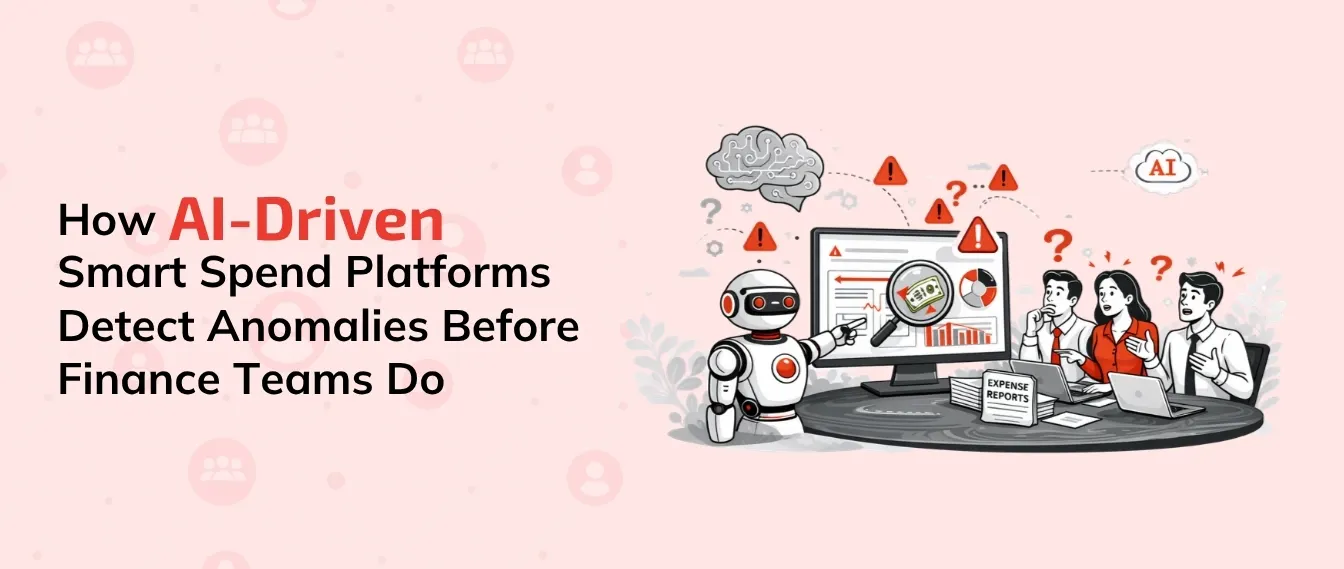
Have you ever looked at your personal bank statement and felt a sudden spike of adrenaline over a charge you didn't recognize? Corporate finance teams dread that exact feeling, except their mystery expenses happen on a scale of millions of dollars. Finance teams often miss billing errors due to the sheer volume of modern business, creating a massive "data haystack" where spotting a single duplicate subscription is exhausting for a human relying on a calculator.
What to expect from this blog?
This guide explores how moving from manual "spot-checking" to automated oversight can safeguard your company's bottom line. We will dive into the mechanics of machine learning baselines, how to eliminate departmental silos that cause double payments, and the steps to transition your finance team from data checkers to strategic advisors.
Key Takeaways
OmniCard is an AI-powered Business FinTech OS designed to act as an untiring digital security guard for corporate spending.
Unlike traditional tools that rely on manual end-of-month audits, this system utilizes continuous monitoring to flag risks the millisecond they occur.
Enables real-time control by automatically pausing suspicious transactions and enforcing company policies at the point of sale.
The 'Data Haystack' Problem: Why Human Eyes Miss Costly Billing Errors
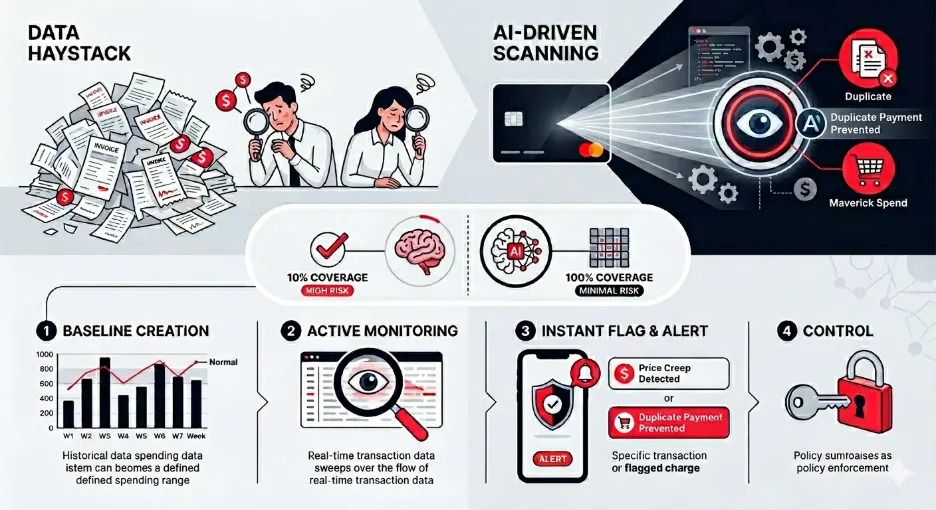
Staring at a budget spreadsheet too long often makes the numbers blur. Imagine being a finance manager reviewing ten thousand receipts every month. Because human teams cannot read every single line, they rely on "spot-checking"—reviewing a random 10% and hoping the other 90% is error-free. This sheer volume creates a hidden danger: audit fatigue. When people process an endless sea of invoices, their brains naturally tire, leading them to miss tiny but expensive glitches, like paying twice for the same software subscription.
Modern spend analysis software acts as an unblinking security guard for the company checkbook. Comparing traditional manual methods to the automated oversight found in a platform like OmniCard reveals a massive upgrade:
| Feature | Traditional Spot-Checking | OmniCard AI Oversight |
|---|---|---|
| Review Speed | Minutes per receipt | Milliseconds per transaction |
| Audit Coverage | 10% of spending | 100% of transactions |
| Consistency | Drops with fatigue/distraction | Never tires or loses focus |
| Financial Impact | Leaks money via manual errors | Catches costly typos instantly |
| Feedback Loop | Monthly or Quarterly | Real-time / Instant |
How Machine Learning 'Learns' Your Business Norms
Older computer programs operated on rigid, "rules-based" instructions. They functioned like stubborn bouncers; if a rule flagged any dinner over $50, it would alert you even if that meal fed a team of five people. Today’s technology operates differently because it has a memory.
Machine learning doesn't blindly follow static rules; it looks at your historical data to understand your actual habits. By constantly observing past purchases, the system teaches itself exactly what a typical Tuesday looks like for your specific business. This process creates a baseline, which is simply a customized picture of your normal behavior.
Through modern AI spend management, the software knows a thousand-dollar software charge is perfectly routine for your IT director. Yet, if that exact same charge suddenly appears on a marketing intern's corporate card, the system instantly spots the mismatch. Understanding context dramatically reduces frustrating false alarms. Advanced pattern recognition allows the system to realize that higher travel costs during your annual conference are expected, not suspicious.
Stopping the 'Double-Dip' and Departmental Silos: How AI Catches Duplicate Invoices Across Different Departments
Imagine two employees in different departments buying the same software subscription on the same day. Often, these workers belong to separate groups that rarely communicate, creating "departmental silos"—invisible walls keeping teams apart. Because these teams do not share information, the business frequently pays for the same thing twice.
Human reviewers naturally miss these double payments when drowning in paperwork. Most duplicate billing errors occur for three simple reasons:
Scanning mistakes: A single receipt accidentally gets processed twice.
Departmental silos: Isolated teams independently purchase the exact same tool.
Spelling differences: One person writes "Microsoft," while another types "MSFT."
OmniCard uses fuzzy matching to recognize that "Zoom.us" and "Zoom Video" are the same vendor, triggering a stop-payment workflow immediately. By automatically pausing these suspicious transactions, businesses reduce unnecessary leakage and keep cash where it belongs: in the company account.
Spotting 'Maverick Spend' Before it Breaks the Budget
Employees sometimes purchase items themselves because official approval takes too long. This shortcut is what finance teams call "maverick spend"—any purchase made outside of normal company rules. Whether an employee upgrades to first-class travel or buys an unauthorized standing desk, these rogue expenses quietly drain the budget.
Traditionally, accounting departments only discovered these purchases weeks later when reviewing expense reports. By then, the money was already gone, turning accountants into detectives trying to track down why the cash disappeared. Today, the focus is shifting from cleaning up old messes to stopping them before they happen.
Using smart corporate card policy enforcement, businesses can now block unauthorized purchases the exact moment an employee swipes their card. If someone tries to buy a new tablet but only has approval for office supplies, the platform can instantly decline the transaction based on pre-set guardrails. This makes budget protection effortless and ensures employees avoid accidentally breaking the rules.
Beyond Simple Errors: Detecting Unusual Vendor Behavior and Fraud
Even when employees follow the rules, budgets can still leak through subtle vendor changes. Think about a service subscription that quietly goes up by 5% every few months. Human eyes rarely catch this "price creep" when looking at a single invoice. However, AI performs trend analysis, comparing today's bill against years of past data to spot slow, creeping costs that remain invisible in isolated views.
A smart system also flags more serious external and internal risks:
Sudden cost spikes: A regular supplier drastically increasing their standard rates without notice.
Suspicious banking updates: A long-time vendor abruptly changing their payment routing numbers, which could signal a compromised account.
Shell vendors: A fake, newly registered supplier whose mailing address mysteriously matches a current employee's home.
Reimbursement fraud: If someone submits the same hotel receipt in March and again in July, the system excels at preventing double-claiming before the second check is ever written.
Transitioning from Traditional ERPs to Smart Spend Platforms
Most companies rely on standard accounting software, but these systems often act like digital filing cabinets holding "static data" that just sits there waiting for review. The real difference between a traditional ERP and a smart spend platform like OmniCard is action.
AI platforms run on "active data," meaning they constantly analyze and question every invoice the second it arrives. Connecting these modern watchdogs to your current setup is surprisingly simple. Think of it like pairing a new smartwatch to your phone via a secure digital bridge (API integration). Because of this design, implementing AI for spend visibility doesn't require replacing your old software or forcing your team to learn complex coding skills.
Your 30-Day Action Plan for Smarter Spend Oversight
AI spend management is not about replacing human jobs; it is about eliminating exhausting grunt work. By handing over the tedious task of hunting for hidden errors, your finance team can finally shift from being data checkers to valuable strategic advisors who focus on growth rather than receipts.
To begin, organizations can follow this 4-step checklist:
Audit: Conduct a "Leakage Audit" to see exactly how much money your current manual processes are missing.
Pilot: Select one high-volume category—like employee travel or digital ads—to test the new system.
Integrate: Connect predictive analytics into your team's daily routines to automate the heavy lifting.
Scale: Expand the tool to cover all company expenses once you feel confident in the real-time risk mitigation.
Continuous monitoring provides the assurance that financial discrepancies are caught and addressed before funds ever leave the bank.
Frequently Asked Questions (FAQs)
- How does the system handle an RBI PPI license for compliance?
Smart spend platforms operating in India ensure that all corporate card issuances and wallet transactions strictly adhere to the latest RBI PPI (Prepaid Payment Instrument) guidelines. This ensures that every rupee spent is tracked within a secure, regulated framework, providing both transparency and legal peace of mind.
- Does this replace our existing ERP software?
No. It acts as an intelligence layer on top of your existing ERP. While your ERP functions as a system of record (the "filing cabinet"), OmniCard functions as a system of action. It integrates via API to catch errors before they are recorded in your main books, keeping your primary ledger clean.
- Will it flag every small fluctuation as a suspicious charge?
No. Because the system uses machine learning to create a baseline of "normal" behavior, it understands context. It recognizes that higher travel costs during an annual conference or seasonal spikes in utility bills are expected, significantly reducing the number of frustrating false alarms.