How Much Can You Actually Save with an Expense Management Platform

Think about the last time you tracked down a crumpled paper receipt from three weeks ago just to get Rs. 500 back. Multiply that frustration by your entire team, and you are no longer just dealing with a headache—you are watching money disappear. According to industry data, missing receipts and manual data entry create invisible business leaks that quietly drain thousands from your bottom line annually.
What to Expect From This Blog?

In this deep dive into modern corporate finance, we break down the tangible and intangible returns of moving away from paper-based systems. You will learn:
The hidden administrative costs that make manual reimbursements surprisingly expensive.
How digital guardrails and automated policy enforcement prevent direct financial leakage.
Strategies for reclaiming up to 75% of your finance team’s time using OCR technology.
Methods to leverage spend visibility for better vendor negotiations and bulk discounts.
A simple formula to calculate the ROI of automation for your specific business size.

Many business owners hesitate to add another monthly subscription, confusing the upfront software price with the true process cost. Yet, comparing manual vs automated expense tracking costs reveals that paying employees to chase paper is far more expensive. An expense platform acts like a digital assistant, handling the tedious work of reading receipts and gently enforcing budgets before inappropriate purchases happen.
By integrating a solution like Omnicard, businesses can transition from reactive accounting to proactive spend management. Unlocking real expense management savings means looking beyond the monthly fee. Applying modern expense tracking tips helps you capture three distinct pillars of savings: direct cuts to wasteful spending, indirect returns of your team's wasted hours, and strategic insights to negotiate better vendor deals.
The Rs. 2,200 Secret: Why Every Paper Receipt Costs More Than You Think
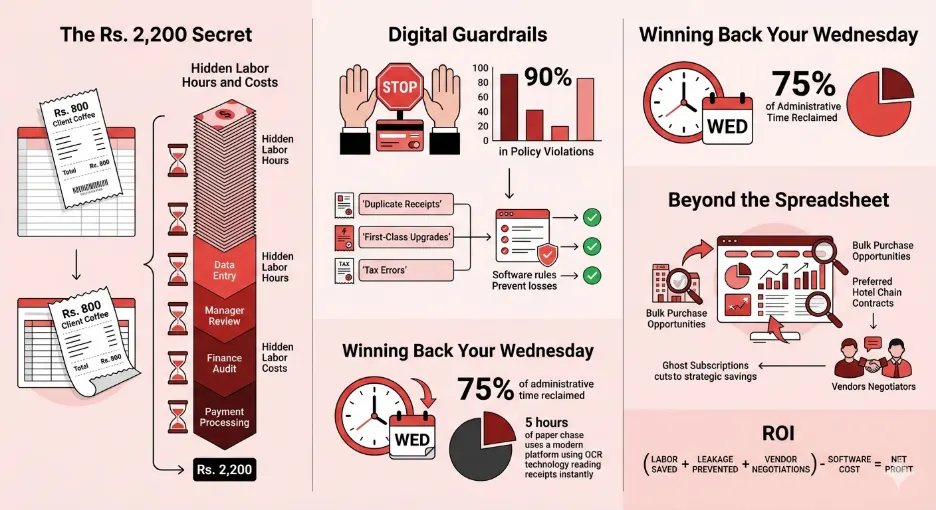
Consider a typical Rs. 800 receipt for a client coffee. Reimbursing that small amount actually costs the average business a staggering Rs. 2,200 in total processing time. That number surprises most managers because they only look at the coffee's price, completely ignoring the invisible labor required to process the paperwork.
This invisible labor is known as administrative overhead—the soft cost of the time your team spends managing tasks instead of doing their actual jobs. To see these hidden costs of manual bookkeeping in action, just look at the standard four-step reimbursement cycle:
Manual Data Entry: The employee spends 15–20 minutes wrestling with a spreadsheet, trying to remember the purpose of the expense.
Managerial Review: You spend your afternoon chasing down missing paper receipts or clarifying vague entries.
Finance Department Audit: An accountant must manually verify that the numbers aren't duplicated and comply with GST norms.
Payment Processing: The final cash transfer is manually scheduled, recorded in the ledger, and reconciled against bank statements.
Calculating Your True Baseline
Finding your own baseline is surprisingly simple. Try calculating the cost per expense report by taking the hourly wage of everyone involved in those four steps and multiplying it by the time spent on each form.
If a manager earning Rs. 1,000 per hour spends 30 minutes reviewing reports, that’s Rs. 500 gone.
If an employee earning Rs. 500 per hour spends an hour on data entry, that’s another Rs. 500 lost.
The cumulative effect quickly outpaces the cost of the actual item purchased.
Suddenly, that quick coffee run drains real productivity from your week, making manual tracking far more expensive than a monthly software fee. Once you realize how much time bleeds out through paperwork, the need for a smoother system like Omnicard becomes obvious. But wasted hours are only half the problem; direct financial losses from human error and overspending also take a heavy toll.
Digital Guardrails: Cutting Direct Losses from Human Error and Overspending
Let’s face it: nobody enjoys telling a team member they cannot be reimbursed for an extravagant client dinner that already happened. Relying on managers to play the "bad guy" is a highly stressful way of mitigating unauthorized business spending.
Instead of waiting weeks to retroactively reject an expense, modern platforms use digital guardrails—automated rules that gently decline unapproved purchases right at the point of submission. When your team uses Omnicard corporate cards, these rules are baked into the card itself, ensuring the expense management cost savings begin before the swipe even occurs.
Top Leaks Stopped by Automation
This proactive oversight constantly reviews every transaction, effectively preventing common financial drains:
Duplicate Receipts: Systems catch identical amounts and dates submitted by accident across different months.
Out-of-Policy Upgrades: Automated blocks on specific categories (like 5-star hotels when the policy allows 3-star) prevent "budget creep."
Tax Errors: Software identifies when GST is incorrectly calculated, saving hours of reconciliation during tax season.
Unapproved Vendors: Restrict spending to specific verified suppliers to ensure every Rupee stays within your approved ecosystem.
Shifting this enforcement responsibility from humans to software fundamentally improves office dynamics. Managers avoid awkward rejection conversations, while the system quietly works in the background, improving expense policy compliance rates by up to 90%. With direct financial losses finally plugged and your budget protected, you can turn your attention toward reclaiming massive amounts of administrative time.
Winning Back Your Wednesday: Reclaiming 75% of Your Admin Time
While blocking accidental duplicate payments keeps cash in your bank, the most profound savings are actually invisible on a balance sheet. A manager spending hours matching coffee shop receipts to a spreadsheet incurs a massive hidden cost. Modern expense platforms eliminate this busywork using Optical Character Recognition (OCR), technology that reads the receipt for you.
The Power of Automated Extraction
Instant Scanning: An employee snaps a photo of their bill via the app.
Data Accuracy: The software instantly extracts the date, vendor, amount, and even the tax breakdown.
Automatic Categorization: Expenses are tagged to specific projects or departments without manual input.
Searchable Archives: All receipts are stored digitally, making "lost paperwork" a thing of the past.
Removing this manual typing is the secret to reducing administrative overhead with fintech tools. Instead of chasing down missing paperwork at month-end, small business teams typically reclaim 15 to 20 hours of lost productivity every single month. This automated workflow drastically shrinks the waiting game, reducing employee reimbursement turnaround time from several frustrating weeks to just a few days.
Furthermore, having perfectly legible, searchable records helps you maximize digital receipt management tax benefits without digging through messy shoeboxes during an audit. This allows your finance team to provide better financial planning advice to the leadership team rather than acting as data entry clerks.

Beyond the Spreadsheet: Using Spend Visibility to Negotiate Better Vendor Deals
When every purchase lives in a unified dashboard rather than scattered across dozens of spreadsheets, you finally get real-time visibility into company spend. This isn't just about making your accountant happy; it’s about transforming raw data into serious negotiating power. Knowing exactly where your money goes allows you to forecast monthly budgets with 95% more accuracy, proving the true ROI of expense management automation.
Turning Data Into Leverage
Using a platform like Omnicard allows you to spot trends that were previously hidden:
Vendor Consolidation: If five employees buy office supplies from five different stores, you can see the total volume and negotiate a bulk discount with a single supplier.
Corporate Travel Rates: Streamline your hotel stays into one preferred chain to unlock "corporate partner" pricing.
Subscription Cleanup: Spot redundant software or "ghost" subscriptions that no one actually uses but are still billing your company.
Departmental Benchmarking: Compare spending across teams to identify which departments have the most efficient expense tracking tips in practice.
Suddenly, your business is treating vendors like true partners rather than just checkout counters. By funneling your purchases through fewer, carefully selected suppliers, you unlock enterprise-level discounts that drop straight to your bottom line. As your company expands, keeping these financial guardrails in place ensures your team can grow without administrative strain.
Scaling Without Stress: Why Automation is the Secret to Growing Your Team
Imagine doubling your sales team next quarter. While more revenue is exciting, it means twice as many client dinners and travel receipts to process. If your current setup relies on manually reviewing every coffee purchase, knowing how to scale expense processes becomes an urgent hurdle.
Zero Marginal Labor: With an automated system, processing 100 receipts takes almost the same amount of effort as processing 10.
Remote Readiness: New hires across India can be issued virtual Omnicard accounts instantly, with spending limits pre-configured.
Proactive Control: Digital guardrails automatically stop out-of-policy spending before the transaction even happens, regardless of where the employee is located.
You shouldn't have to hire a full-time administrator just to babysit a growing stack of paper forms. This proactive control offers some of the best financial planning advice for growing companies: build systems that run themselves to future-proof your daily operations. Unlocking these expense management cost savings ensures your growth won't be choked by administrative bottlenecks.
The Net Gain: Is the Subscription Actually Worth It?
You no longer have to view expense tracking as a frustrating, invisible drain on your business. By applying a clear cost-benefit analysis of expense platforms, you now know that replacing manual data entry with digital tools transforms lost hours into measurable profit.
The average expense management savings from automated software go far beyond catching duplicate receipts—they fundamentally change how your team spends their week. To calculate your break-even point and start your transition away from spreadsheets, use this quick ROI math checklist:
Total Labor Saved: (Total hours saved by all employees � their average hourly wages)
Leakage Prevented: (Estimate of caught errors + blocked out-of-policy spending)
Vendor Savings: (Projected discounts from consolidated purchasing)
The Formula: (Total Labor + Leakage + Vendor Savings) - (Software Subscription Fee) = Your Net Profit
This simple math reveals the true ROI of expense management automation, empowering you to translate saved administrative time directly into business growth time. Your next practical step is to review your last three months of spreadsheets and calculate the exact hours your team spent managing them. That number is your starting line for a more profitable operational process.
Key Takeaways:
Manual Processing is a Hidden Tax: Processing a single receipt can cost up to Rs. 2,200 in labor time.
Proactive over Reactive: Digital guardrails on Omnicard stop unapproved spending before it happens, not weeks later.
Time is Money: Automation reclaims nearly 20 hours per month for the average small-to-medium business.
Data Drives Discounts: Visibility into total company spend allows for powerful vendor negotiations and bulk pricing.
Scalability: Automated systems allow your team to grow without increasing the headcount of your finance department.
FAQs:
- How does an expense management platform actually create expense management savings?
Savings are created by eliminating "soft costs" (employee time spent on data entry), preventing "hard costs" (duplicate payments or fraudulent claims), and providing the data needed to negotiate better rates with vendors.
- Can these platforms help with GST compliance in India?
Yes. Modern platforms like Omnicard help capture GST-compliant receipts digitally, ensuring you can claim Input Tax Credit (ITC) accurately and avoid penalties during audits.
- Is my business too small for an expense platform?
If you have more than three employees spending company money, the time lost to manual tracking usually exceeds the cost of a platform. Small businesses often see the highest proportional expense management cost savings because their teams need to stay lean.
- What are the best expense tracking tips for a growing team?
The best tip is to issue corporate cards with pre-set limits. This eliminates the "reimbursement cycle" entirely, as the money spent is already approved and categorized the moment the card is swiped.
- How long does it take to see the ROI of expense management automation?
Most businesses see a return on their investment within the first two months of implementation, primarily through the immediate reduction in administrative hours and the discovery of unused software subscriptions.