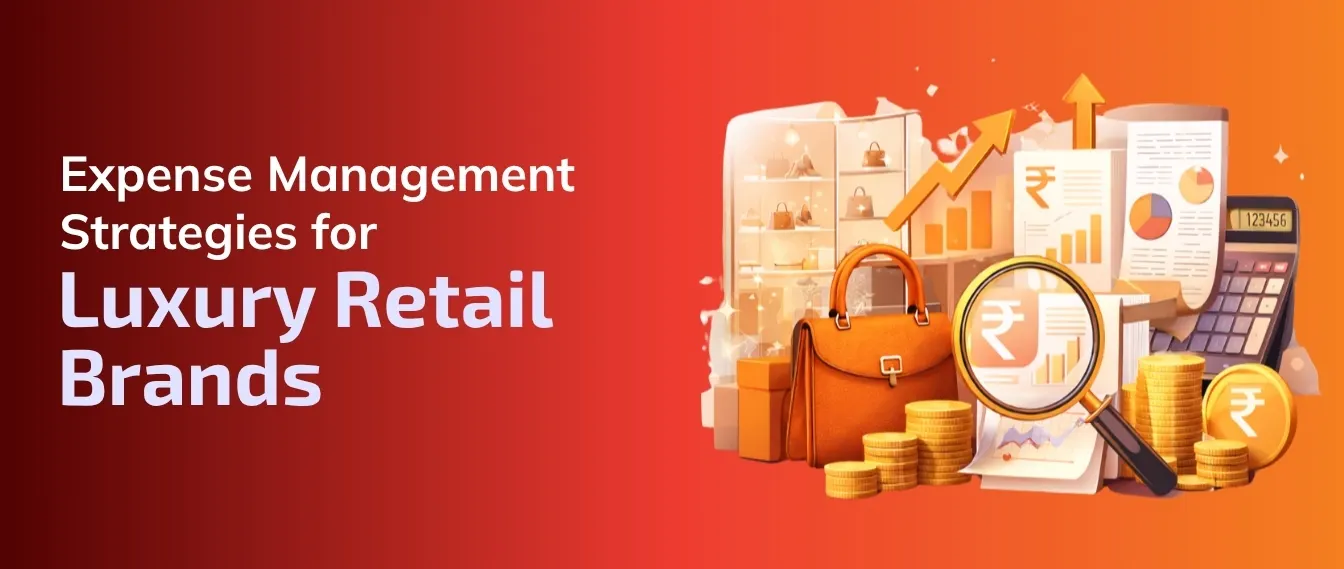
Expense Management Strategies for Luxury Retail Brands
Running finances for a luxury brand is not the same as running finances for any other business. When your company's value proposition is built on craftsmanship, exclusivity, and experience, every rupee spent must reflect that standard — from the vendor you choose for an event activation to the hotel your regional director books for a client meeting. And yet, most expense management frameworks are built for operational efficiency above all else, with cost-cutting as the north star. That creates a structural mismatch that quietly erodes the brand, employee experience, and supplier relationships that luxury organisations depend upon.
What to expect from this blog?

Why standard expense management frameworks fall short for premium and luxury brands
The core pillars of a luxury-aligned spend management strategy
How to balance cost discipline with brand integrity across supplier and employee spending
Practical guidance on policy design, compliance, and the role of smart spend tools
Key takeaways and answers to the most frequently asked questions on the topic
The Fundamental Challenge: When Frugality Conflicts With Brand Equity

Luxury brands operate in paradox. Externally, they project abundance — rare materials, first-class service, aspirational pricing. Internally, however, many of these organisations apply the same cost-management orthodoxy used by mass-market retailers: reduce, consolidate, negotiate down. The result is a disconnect. A brand manager pitching a fragrance campaign to a high-net-worth clientele is simultaneously submitting receipts for a ₹2,000 cap on client entertainment. The finance team flags it. The brand manager is frustrated. The relationship suffers.
Effective expense management for luxury brands requires reframing the fundamental question. Instead of "How do we reduce spend?", the question becomes "How do we ensure every rupee spent actively supports the brand we are trying to be?" This is not a license for unchecked spending — it is an argument for intelligent, contextual spend governance.
"Luxury is the art of knowing what you want, finding it, and refusing to compromise on either the experience or the numbers behind it."
Rethinking Spend Categories Through a Brand Lens
Client entertainment and hospitality
In a luxury business, client entertainment is not a discretionary line item — it is part of the product. A private view at a gallery, a tailored dining experience before a trunk show, a suite upgrade for a visiting collector: these are brand interactions, not perks. Spend management policies need to distinguish between transactional expenses (flights, stationery, office supplies) and brand-aligned expenses (client hospitality, event activations, press gifting). Each category deserves its own policy logic, approval thresholds, and reporting structure.
Supplier and vendor relationships
Luxury brands do not buy from commodity vendors. The ateliers, florists, photographers, caterers, and production houses that luxury companies work with are often relationship-driven, boutique, and premium-priced — for good reason. A spend management framework that automatically flags a ₹40,000 floral invoice as "over limit" because it exceeds a generic procurement threshold will consistently create friction where none should exist. Vendor tiering and category-specific spend rules are non-negotiable in a luxury context.
Travel and executive mobility
For an industry built on in-person relationships and physical experiences, travel is a high-stakes spend category. Business class for a creative director flying to a couture presentation in Paris is a policy decision, not an exception. Flat travel policies applied uniformly across all roles and all contexts inevitably create resentment, off-policy workarounds, and shadow spending. Intelligent travel policies in luxury organisations are role-aware, occasion-aware, and destination-aware.
Marketing and experiential spend
Few industries spend more on experience creation than luxury. Pop-up installations, brand collaborations, high-net-worth client events, and editorial partnerships generate expenses that rarely fit standard procurement workflows. These spends are often time-sensitive, relationship-driven, and require flexible approval structures. A rigid, sequential PO-based process is structurally incompatible with how luxury marketing actually operates on the ground.
Building a Spend Management Framework Fit for Luxury
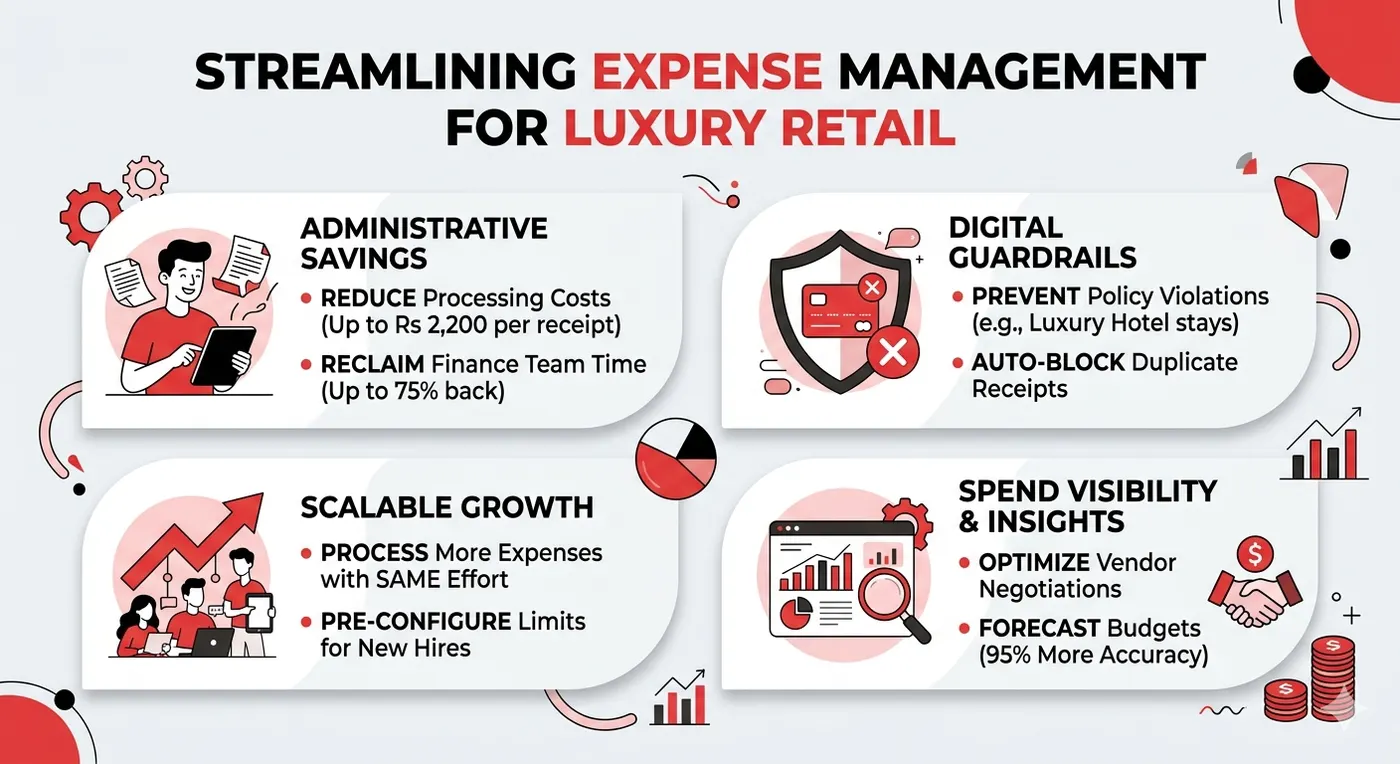
Good spend management in a luxury context does not mean laissez-faire budgeting. It means building a framework rigorous enough to ensure financial control while flexible enough not to get in the way of the brand. Here is what that framework requires.
Segmented spend policies by role and category
A single universal expense policy cannot serve a luxury organisation well. Finance teams should invest in building segmented policies: a creative director, a boutique manager, and an operations analyst have fundamentally different spend profiles. Role-based policies — with clear, pre-approved limits and approved vendor lists for specific categories — eliminate constant exception-handling while ensuring governance.
Real-time visibility, not retrospective auditing
Most legacy expense management systems are designed around the month-end audit: employees spend, submit receipts, finance reviews. For luxury brands managing complex, fast-moving events and campaigns, this is too slow. Real-time spend visibility — knowing what is being spent, by whom, against which budget, at the moment it happens — allows finance teams to course-correct proactively rather than clean up reactively. Platforms like OmniCard that issue smart corporate cards with built-in spend controls, real-time dashboards, and instant receipt capture bring exactly this kind of visibility to organisations that have historically relied on spreadsheets and delayed reimbursements.
Approved vendor frameworks and pre-negotiated rates
Luxury brands should invest in curating an approved vendor ecosystem that is itself premium. Working with a shortlist of pre-vetted, brand-aligned vendors for high-frequency categories — travel, hospitality, print, production — reduces friction at the point of spend while ensuring quality standards are maintained. This also gives finance teams better negotiating leverage and category-level reporting.
Digital-first, receipt-light workflows
The irony of expense management in luxury companies is that highly paid creative and commercial talent routinely spends hours a month chasing receipts, filling PDF forms, and waiting for reimbursements. This is a productivity drain and a cultural signal that does not align with the premium experience the brand promises externally. Modern spend management tools — particularly corporate card programmes with automated receipt matching and policy-embedded approval flows — dramatically reduce administrative burden. When employees at every level can see their spend limits, submit expenses in seconds, and receive reimbursements without bureaucratic delays, the organisation runs better and brand professionals can stay focused on the work that actually matters.
Compliance Without Cultural Damage
The compliance question in luxury expense management is a delicate one. Overly aggressive policing of spend creates a culture of mistrust, drives off-policy behaviour underground, and signals to senior creative and commercial talent that the organisation does not trust its people. Under-policing creates financial risk, audit exposure, and budget overruns that eventually force painful corrections.
The resolution lies in preventive controls rather than punitive ones. When spend policies are embedded at the point of the transaction — a corporate card that simply will not approve a spend outside its predefined category or limit — compliance is structural, not cultural. Employees do not feel policed; they just have a card that works within the agreed framework. Finance has real-time visibility. Audits become formalities. Tools designed with this philosophy, like OmniCard's spend control capabilities, allow luxury brands to set nuanced, role-specific parameters that run silently in the background — catching policy drift before it becomes a financial or reputational problem.
The Reporting Imperative: Spend Data as Brand Intelligence
For most companies, expense data is a finance artefact — it lives in accounting software and is reviewed quarterly. For luxury brands, spend data can be a source of genuine commercial intelligence. Which client entertainment categories drive the highest repeat purchase? Which regional teams consistently over-spend on production and what does that tell you about resource planning? Which vendor relationships are costing you more than alternatives of equal quality?
When spend management infrastructure produces clean, categorised, real-time data, finance and commercial leadership can have conversations that go far beyond variance analysis. They can connect spend patterns to brand performance, client retention, and competitive positioning. This is the long-term case for investing in modern expense management for luxury brands — not just control, but insight.
Key Takeaways
- Standard cost-cutting expense frameworks create brand-value misalignment in luxury organisations — the goal should be intelligent spend governance, not blanket reduction.
- Expense categories in luxury — client hospitality, premium travel, experiential marketing — need their own policy logic, approval thresholds, and vendor frameworks rather than one-size-fits-all rules.
- Real-time spend visibility is significantly more valuable than retrospective auditing, especially for fast-moving events, campaigns, and client activations.
- Preventive, embedded spend controls — such as smart corporate card limits — enforce compliance structurally without creating a culture of mistrust or excessive policing.
- Role-aware, segmented spend policies eliminate the constant exception-handling that drains finance team time in most luxury organisations.
- Modern spend management tools like OmniCard offer luxury brands the combination of real-time dashboards, automated receipt capture, and granular card controls needed to run a sophisticated, brand-aligned expense program.
- Clean spend data is a commercial intelligence asset — it connects expense patterns to brand performance, client retention, and vendor quality decisions.
FAQs:
1. How is expense management for luxury brands different from standard expense management?
Luxury brands must balance financial rigour with brand integrity. Standard frameworks prioritise cost reduction; luxury expense management prioritises ensuring that every spend decision actively reinforces the brand's quality, relationships, and experience standards. This requires segmented policies, premium vendor frameworks, and role-aware spend limits rather than uniform rules applied across the organisation.
- How do luxury brands enforce expense policy compliance without damaging employee culture?
The most effective approach is structural compliance through preventive controls — embedding policy limits into payment tools (like corporate cards with pre-set category limits) so that policy is enforced at the point of transaction rather than through retrospective audits or manual approval chains. This removes the feeling of being policed and reduces friction while maintaining financial governance.
- Is there expense management software designed specifically for luxury or premium businesses? While there is no single platform exclusively built for luxury brands, solutions like OmniCard that offer highly configurable spend controls, smart corporate cards, real-time dashboards, and granular category-level management are well-suited to luxury organisations. The key criteria to look for are: flexibility in policy configuration, real-time visibility, clean data exports for reporting, and a user experience that does not create administrative friction for senior creative and commercial staff.