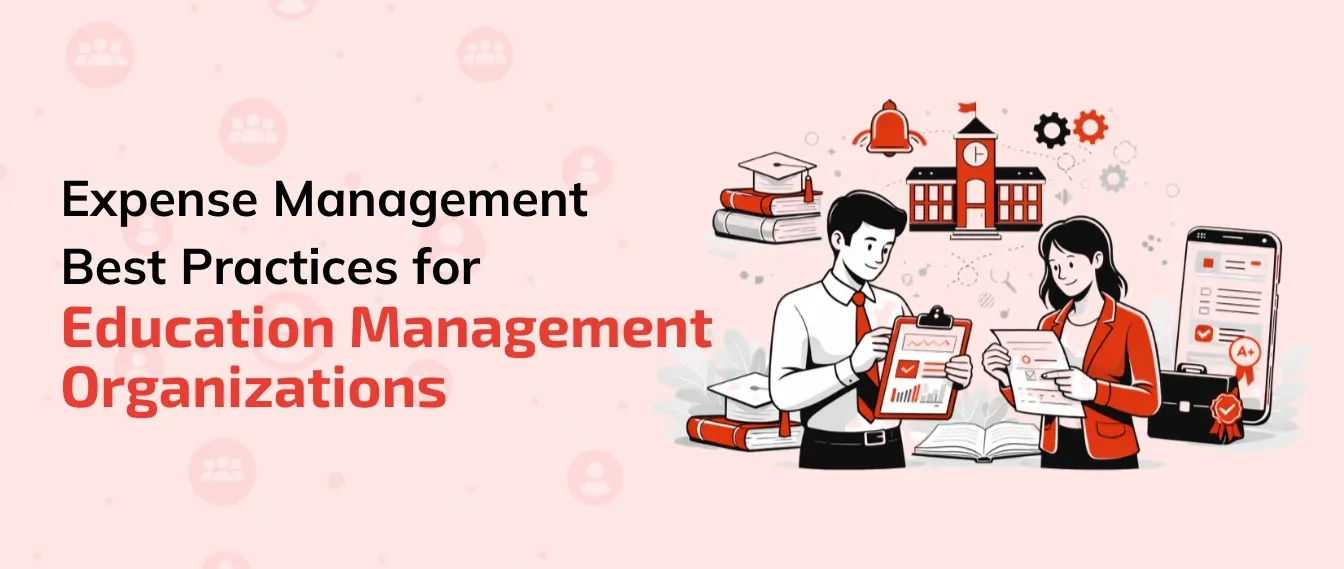
Expense Management Best Practices for Education Management Organizations
Expense management is crucial for education management organizations (EMOs). It ensures financial resources are used wisely and effectively to drive student success. Educational institutions face unique financial challenges, including fluctuating funding cycles, diverse spending needs across multiple campuses, and stringent regulatory requirements.
Implementing best practices in expense management can help address these challenges, leading to better budgeting and long-term financial stability. Technology—specifically advanced platforms like OmniCard—plays a vital role in streamlining these processes. Automated systems and data analytics offer significant advantages in maintaining a lean, efficient institution.
This guide explores effective strategies for managing expenses in educational settings. It aims to enhance financial operations, support educational goals, and provide a roadmap for digital transformation.

What to Expect from This Blog?
Learn how to align institutional spending with academic priorities to ensure every rupee supports student success.
Discover how integrating OmniCard eliminates manual errors and replaces slow reimbursement cycles with real-time tracking.
Master proactive techniques like merchant-specific restrictions and automated budget sub-wallets to prevent overspending.
Understand how to build a digital paper trail that simplifies financial compliance and builds stakeholder trust.
Insights into fostering a cost-conscious culture and conducting data-driven reviews for long-term stability.

Understanding Expense Management in Education
Expense management involves monitoring and controlling organizational spending. In education, it is essential for ensuring financial health and sustainability. Educational institutions must juggle multiple financial responsibilities, ranging from payroll to facility maintenance and student extracurriculars. Effective expense management helps in prioritizing these needs.
Key aspects of expense management in education include:
Tracking expenditures to maintain budget compliance.
Analyzing spending patterns to identify cost-saving opportunities.
Allocating resources to meet educational goals efficiently.
Expense management requires a strategic approach. It aligns resources with institutional priorities. By understanding these fundamentals and utilizing tools like OmniCard’s centralized dashboard, education management organizations can achieve unprecedented financial efficiency.
Setting Clear Financial Goals and Priorities
Establishing financial goals is crucial for educational organizations. Clear objectives guide budgeting and spending decisions, ensuring that every rupee spent contributes to the institution’s mission. Prioritizing spending supports strategic goals and ensures that limited resources are used effectively.
To set clear financial goals, organizations should:
Conduct a thorough financial needs assessment.
Align financial objectives with academic priorities.
Involve key stakeholders in the planning process.
By setting and prioritizing financial goals, education organizations can direct funds where they are most needed. This practice promotes financial stability and supports academic excellence.
Leveraging Technology for Efficient Expense Management
Technology plays a vital role in optimizing expense management. Digital tools help streamline financial processes and reduce manual errors while offering real-time insights into spending patterns. Organizations can benefit significantly from adopting advanced technologies like OmniCard’s corporate spending solution, which replaces slow, manual reimbursement cycles with instant digital tracking.
Consider the following ways to integrate technology:
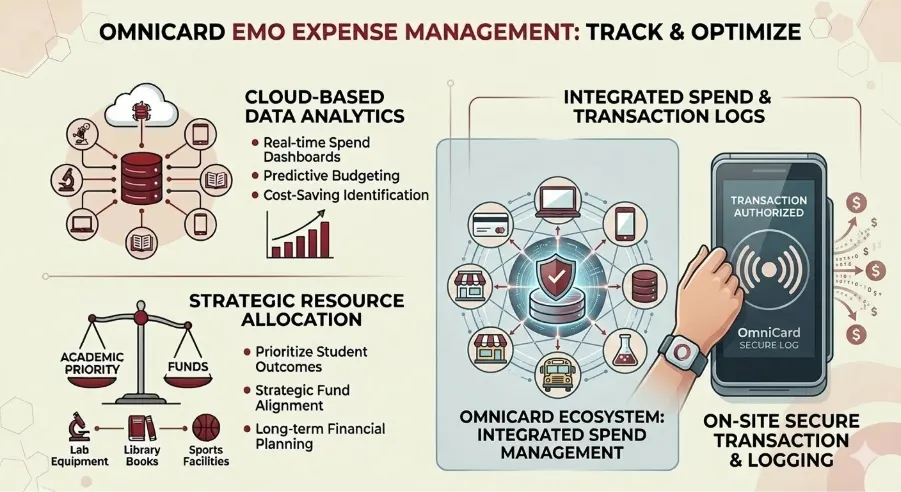
Implement cloud-based accounting systems that sync with your spending data.
Utilize data analytics for detailed expenditure reports.
Adopt mobile apps for on-the-go financial tracking for field staff and administrators.
By leveraging these technological solutions, educational organizations can manage expenses more effectively. This strategic approach not only saves time but also enhances accountability and transparency.
Implementing Automated Expense Tracking Systems
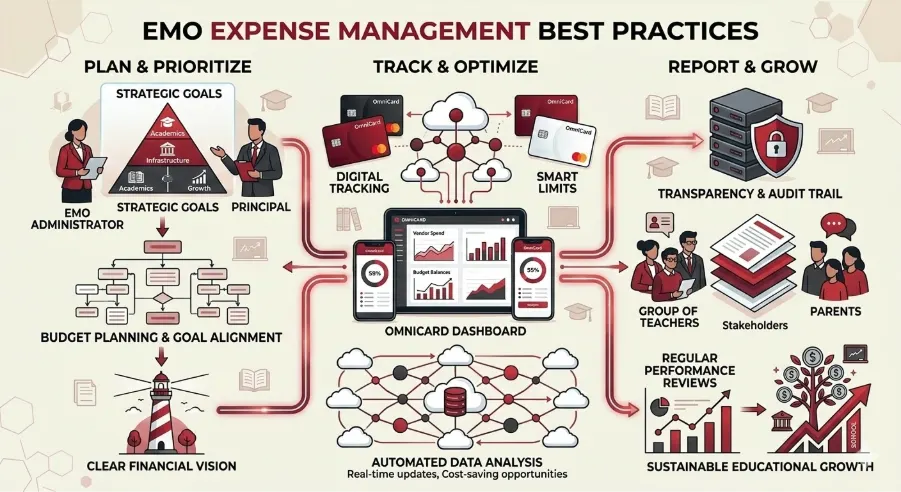
Automated expense tracking systems have revolutionized financial management. These systems offer precise tracking and reporting, significantly reducing the administrative burden on staff. When an EMO uses OmniCard, the automation begins the moment a transaction occurs.
Incorporating automated solutions brings various benefits:
Minimized human errors in data entry and reconciliation.
Real-time updates on spending status across different departments or campuses.
Simplified compliance with financial policies through pre-set spending limits.
Educational organizations achieve greater efficiency by utilizing automated systems. They provide instant access to financial data, facilitating better oversight and control. This not only enhances financial accuracy but also saves time, allowing educators to focus on their primary mission—education.
Best Practices for Budgeting in Educational Organizations
Effective budgeting ensures that resources align with institutional goals. By prioritizing expenses, organizations can optimize their financial health. Educational leaders should develop detailed and realistic budget plans and involve key stakeholders in the process.
Collaboration is key to successful budgeting. Engaging educators and administrators enhances ownership and accountability. Moreover, this collaborative approach helps in identifying the needs and allocating funds where they are most impactful. OmniCard’s sub-wallet feature allows EMOs to allocate specific budgets to different departments or projects, ensuring that no one overspends their designated limit.
Regular monitoring and adjusting budgets ensure that educational goals are met. Flexibility in budgeting allows institutions to adapt to changes, providing a cushion against unexpected financial challenges.
Enhancing Spend Management and Cost Control
Spend management is vital for education organizations to maintain financial discipline and reduce wasteful expenditures. Organizations can adopt strategies such as conducting thorough spend analysis and implementing cost-control measures.
OmniCard empowers EMOs to control costs proactively rather than retroactively. By setting merchant-specific restrictions and daily limits on corporate cards, organizations can prevent unauthorized spending before it happens.
Creating a cost-conscious culture within the organization is essential. Encouraging staff to be mindful about expenses fosters responsibility. Monitoring expenses regularly ensures adherence to financial plans, leading to better financial outcomes and sustainability.
Promoting Financial Accountability and Transparency
Financial accountability is crucial in maintaining stakeholder trust. It involves clear reporting and open communication about financial activities. Transparency helps in building confidence among investors, staff, and the community.
To foster accountability and transparency, EMOs should:
Establish clear financial policies and communicate them effectively.
Conduct regular and detailed financial reporting.
Digitize the audit trail using platforms like OmniCard, where every transaction is recorded with date, time, and category automatically.
Implementing these practices ensures that all stakeholders are informed and engaged. It creates an environment where financial decisions are made collaboratively, strengthening the organization’s reputation.
Training and Engaging Staff in Financial Processes
Effective financial management requires well-informed staff. Training ensures that employees understand and follow financial policies. Engagement in financial processes promotes a culture of responsibility.
To enhance staff involvement:
Offer regular financial training sessions on new tools.
Encourage feedback on financial procedures.
Empower staff with controlled spending power through OmniCard, reducing their need to use personal funds for institutional needs.
By investing in staff training and providing them with the right tools, organizations can improve financial efficiency and encourage innovative ideas for financial improvement.
Regular Audits, Reviews, and Continuous Improvement
Regular audits are crucial for financial integrity in education. They help identify issues before they escalate. Conducting periodic reviews provides insights into financial performance, and with OmniCard’s instant reporting, these reviews can happen weekly or monthly rather than just annually.
These insights drive continuous improvement, ensuring financial strategies remain effective and relevant. This process builds a foundation for long-term financial stability.
Conclusion: Building a Sustainable Financial Future
Adopting best practices in expense management fortifies educational organizations against financial challenges. These practices ensure optimal resource use and align financial strategies with educational goals.
With a robust framework and a reliable partner like OmniCard, education organizations can confidently face the future. By fostering financial accountability and leveraging technology, they build a sustainable financial environment. This approach not only supports educational excellence but also enhances stakeholder trust.