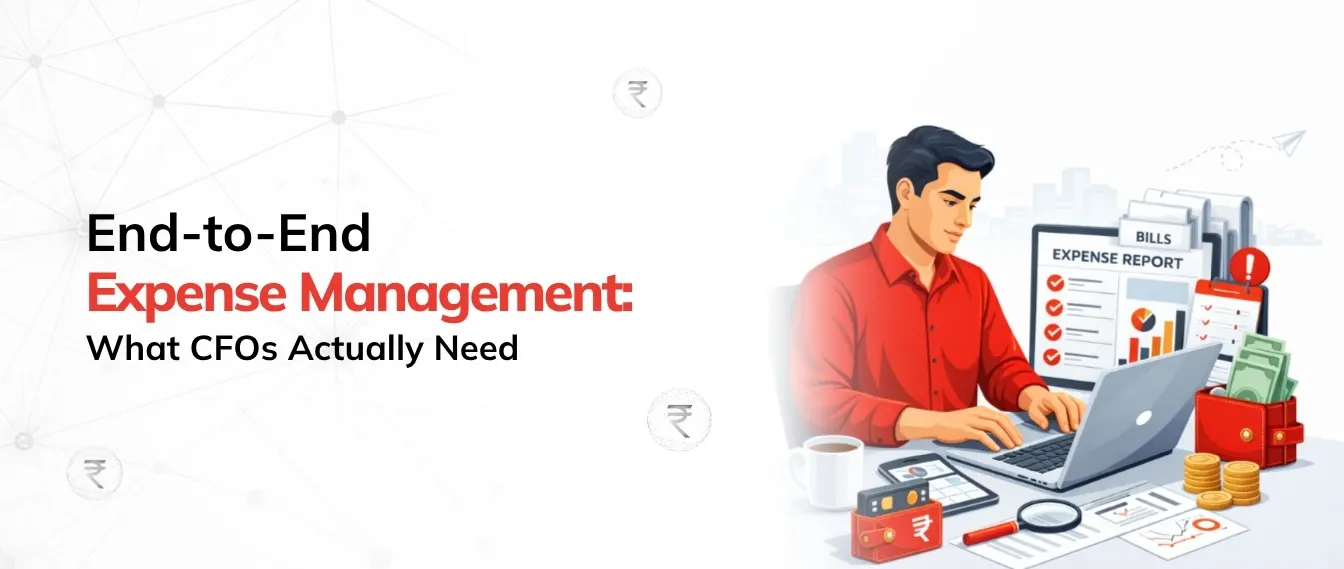
End-to-End Expense Management: What CFOs Actually Need
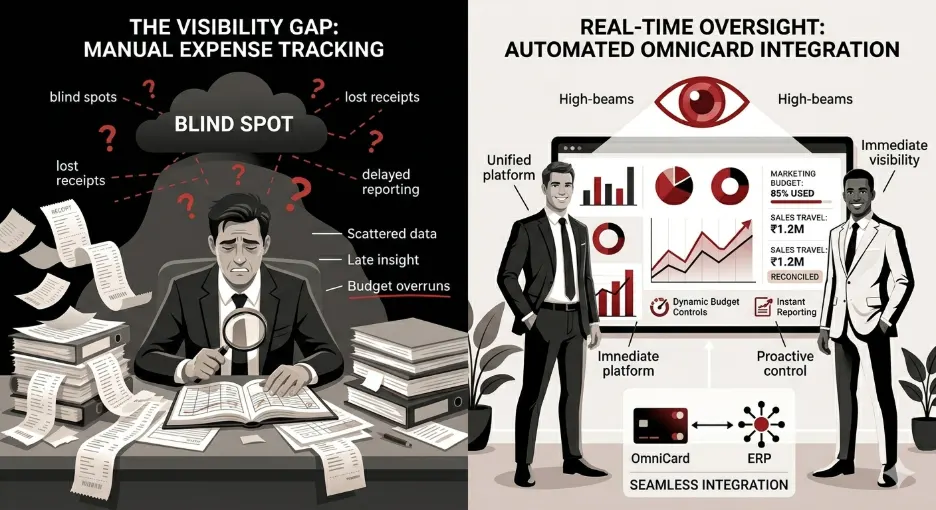
Staring at a crumpled receipt from a business lunch, you might just see an administrative hassle. Yet, for a CFO, that paper is a vital data point in the lifecycle of a rupee. According to industry data, manual tracking creates a dangerous "Visibility Gap"—a blind spot where money is spent but remains unrecorded. Just as you want household budget clarity before a bill arrives, businesses need immediate insight.
Automation is about strategic speed, not mere convenience. In practice, streamlining accounts payable automation for finance teams closes this visibility gap entirely. It establishes real-time financial visibility and spend controls, ensuring every daily purchase instantly informs the company's future planning.

What to expect from this blog?
A deep dive into the hidden "labor tax" of manual expense reports.
A technical breakdown of how OCR and AI eliminate data entry.
Comparison of corporate cards vs. traditional reimbursement.
How to leverage real-time dashboards for proactive budget management.
A 30-day roadmap for transforming your financial operations.

How Can Automation Kill the "₹1,500 Manual Processing Tax"?
We all know the routine of saving paper receipts to get paid back, but few realize how expensive that routine is for a company. Every time a finance team manually reviews, types, and files a paper claim, the business pays a hidden labor cost.
The Hidden Cost of Labor: Industry studies show that manual processing costs can average around ₹1,500 per report. This includes the employee's time spent filling out forms, the manager's time for review, and the finance team’s time for data entry and reconciliation.
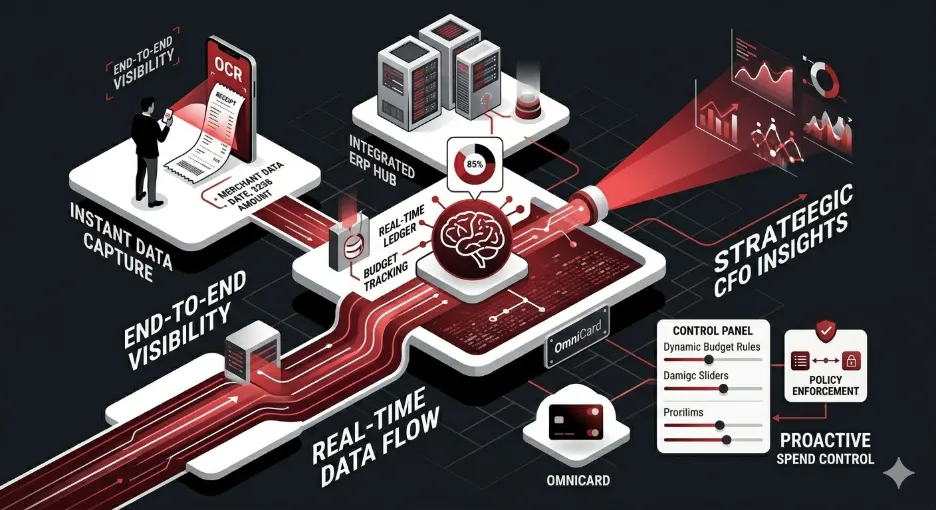
The OCR Solution: Optical Character Recognition (OCR) acts as a digital translator. It reads a photo of a receipt and instantly extracts the date, amount, and merchant name, converting a physical scrap of paper into structured data.
The Modern Journey with OmniCard: When a company adopts an end-to-end platform, the entire transaction journey is compressed:
Receipt Capture: Employees snap a photo on their phone the moment they spend, eliminating "lost receipt" excuses.
Approval Route: The system automatically pings managers for a digital thumbs-up, ending the hunt for physical signatures or email threads.
Data Entry: Technology replaces hours of manual spreadsheet work, feeding data directly into the accounting software.
Payout: Funds move directly to the employee's bank account in days, not weeks, significantly boosting employee morale.
How Do Real-Time Dashboards Stop Overruns?
Imagine driving down a dark highway using only a rearview mirror. For decades, companies managed finances this way, relying on historical reporting that only showed what was spent weeks after the cash was already gone.
The Historical Reporting Trap: Traditional accounting often leaves leadership in the dark until the month-end "closing of books." By then, a budget overrun is a problem of the past that cannot be corrected.
Switching on the High-Beams: Modern software turns on the "high-beams." It provides instant oversight, allowing a CFO to see spend as it happens across different departments, projects, or geographic locations.
Proactive Navigation: Leadership shifts from being historical record-keepers to proactive navigators. You can identify trends—like a sudden spike in travel costs—and adjust strategy in real-time.
Digital Guardrails: Dynamic budget tracking acts like a digital bouncer. If a marketing team has ₹20,000 left in their quarterly budget and tries to book a ₹30,000 venue, the system can block the purchase at the point of sale.
Scaling Without Friction: For mid-market companies, centralized spend management allows a workforce to grow without needing an army of accountants to police every receipt. The software handles the scale, while your team focuses on growth.
Why Is Connecting Corporate Cards to Your ERP Non-Negotiable?
When comparing corporate credit cards vs. employee reimbursement systems, the difference is night and day. Reimbursements rely on scattered paper; corporate cards plug directly into the "central brain"—the ERP (Enterprise Resource Planning) system.
The ERP Integration Advantage: Your ERP is the single source of truth for your business. When corporate cards aren't integrated, you have a massive data silo that requires manual "bridging."
Direct Synchronization: Integrating platforms like OmniCard with your ERP ensures every rupee is tracked on a single foundation without human intervention.
Three Key Advantages of Integrated Cards:
Built-in Spending Limits: You can set strict budget rules and merchant category restrictions before a card is even swiped.
Instant Digital Records: The system captures exact merchant data and timestamps the second a purchase occurs.
Automated Reconciliation: The software matches the transaction to the correct general ledger (GL) code automatically, replacing manual math and reducing audit risks.
Invisible Security Guard: Every approved purchase leaves a permanent, traceable digital footprint. This setup acts as a deterrent for expense fraud, flagging personal purchases or duplicate claims immediately rather than discovering them months later in a spreadsheet.
How Automation Boosts Employee Retention
While we focus on the CFO’s needs, we cannot ignore the "end user"—your employees. A broken expense process is a major point of friction that affects culture.
Reclaiming Productive Hours: Your sales and marketing teams should be focused on bringing in revenue, not spending their Sunday nights matching receipts to bank statements.
Eliminating Out-of-Pocket Stress: Expecting employees to float company expenses on their personal cards is a burden. Providing corporate cards shows trust and improves the employee experience.
Transparency and Trust: When the rules are coded into the system (e.g., "Lunch limit is ₹500"), there are no awkward conversations about rejected claims. Everyone knows the boundaries from the start.
The Strategic Shift: From Gatekeeper to Growth Partner
The modern CFO is no longer just the "No" person. They are strategic partners who use data to drive the company forward.
Data-Driven Decision Making: With all spend centralized, you can negotiate better deals with vendors. If you see the company spends ₹5,00,000 a month with a specific airline, you have the leverage to ask for a corporate discount.
Optimizing Cash Flow: Real-time visibility means you know exactly how much cash is committed at any given moment, allowing for more precise treasury management.
Audit Readiness: Instead of a "fire drill" every tax season, your books are always audit-ready. Every transaction is already reconciled, categorized, and supported by a digital receipt.
Your 30-Day Action Plan: Moving from Financial Chaos to Strategic Control
Effective expense tracking goes beyond filing receipts—it establishes clarity. To switch on your high-beams, follow this roadmap:
Day 1-10: Audit and Assessment: Identify the "hidden waste." Calculate how many hours are spent on manual entry and how many receipts go missing each month.
Day 11-20: Prioritize Total Visibility: Evaluate software that offers real-time reporting and direct ERP integration. Ensure it offers mobile-first features for your on-the-go employees.
Day 21-30: Implementation and Mindset Shift: Transition from being a restrictive gatekeeper to a proactive strategist. Launch your new system with clear guidelines and watch the productivity of your finance team soar.
By improving bottom-line efficiency through automated spend management, you transform everyday purchases into a powerful data engine. Whether evaluating new software or refining your current framework, connected systems empower the entire organization. Try applying this proactive perspective to your next team purchase and notice how total visibility turns tedious paperwork into a competitive advantage.
Frequently Asked Questions (FAQs)
- How does automation actually reduce the cost per expense report?
Automation eliminates the manual labor involved in data entry, physical filing, and back-and-forth communication for approvals. By using OCR and digital workflows, the time spent per report drops from hours to minutes, significantly cutting the hidden "labor tax" that can cost over ₹1,500 per claim.
- Can we still maintain control if we give employees corporate cards?
Yes—actually, you gain more control. Unlike reimbursements where you see the spend weeks later, corporate cards (like those offered by OmniCard) allow you to set pre-approved limits and category restrictions. You can decide exactly where and how many rupees an employee spends before the card is even swiped.
- What is the benefit of syncing expense data with our ERP?
ERP integration ensures that your "central brain" always has the most current data. It eliminates the need for manual reconciliation at the end of the month, reduces human error in accounting entries, and provides a real-time view of the company’s total financial health. This "live feed" of data is what allows CFOs to make strategic decisions rather than just reporting on the past.