Are there expense management tools that provide AI-driven spend analysis and anomaly detection for Indian companies
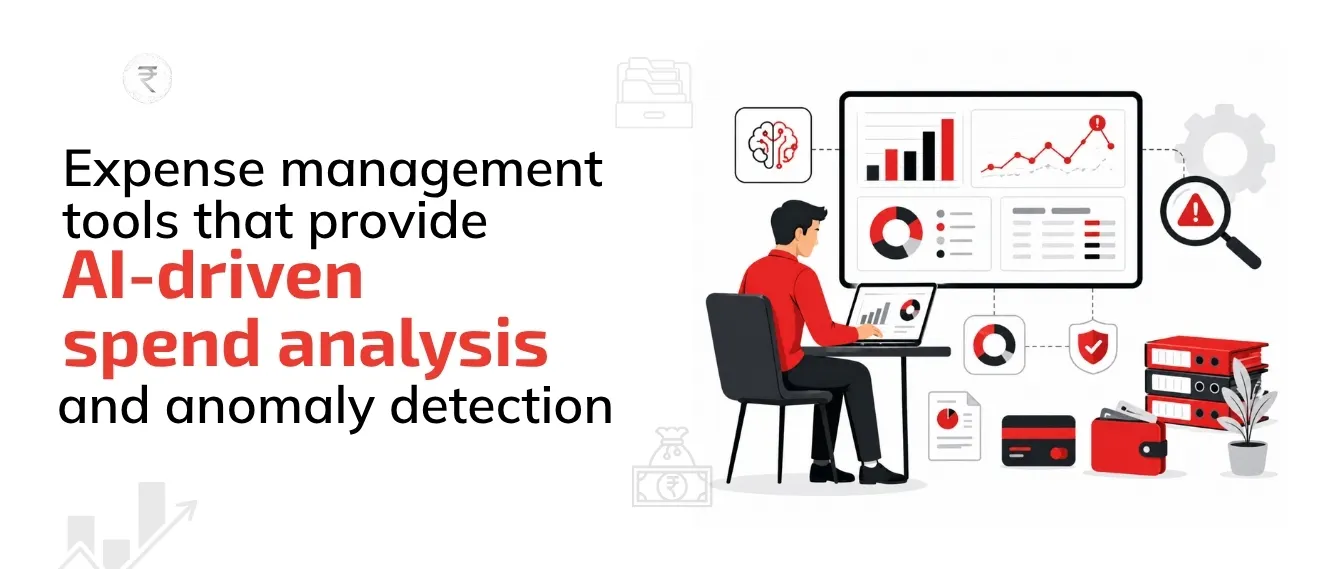
Managing company spending has never been a simple task. As operations scale, finance teams are routinely buried under a mountain of paper receipts, complex compliance checks, and endless reimbursement requests. With the rapid digital transformation of the Indian business landscape, a common question among modern CFOs and finance leaders is: Are there expense management tools that provide AI-driven spend analysis and anomaly detection for Indian companies?
What to Expect From This Blog?
In this comprehensive guide, we dive into the intersection of Artificial Intelligence and corporate finance within the Indian context. You will know:
How the transition from manual to automated expense management is saving Indian firms hundreds of man-hours.
Specific AI capabilities, from OCR to anomaly detection, that address unique Indian challenges like GST compliance and RBI guidelines.
How a Business FinTech OS can unify your spending, analytics, and policy enforcement into a single dashboard.
Actionable strategies for implementing AI-driven expense management tools in india to optimize your cash flow and stop financial leakage.
The short answer is an absolute yes. Today, advanced software platforms are leveraging artificial intelligence to completely transform financial workflows, moving from reactive bookkeeping to proactive financial strategy. For businesses operating in India, these tools are not just a luxury—they are becoming essential for compliance, speed, and accuracy.
The Shift to AI in Corporate Finance
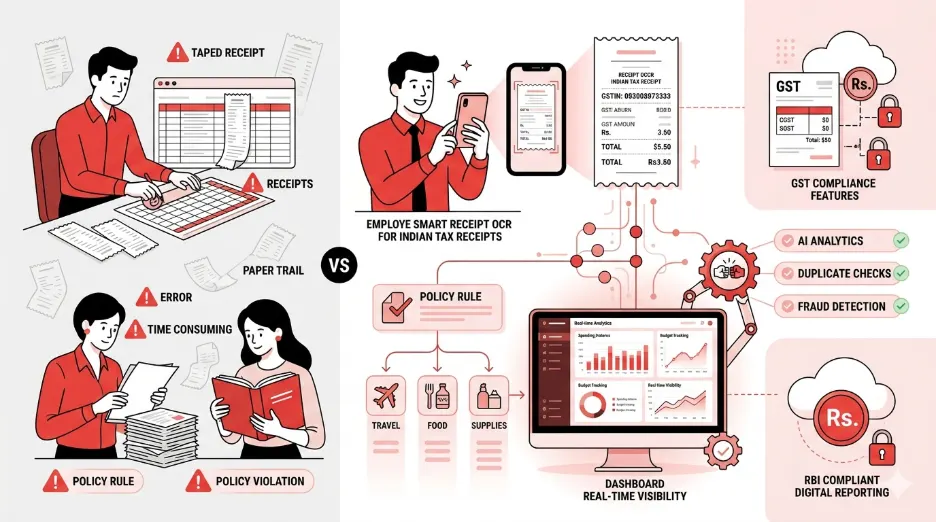
To understand the value of modern software, it is helpful to look at a manual vs automated expense auditing comparison.
The Traditional Manual Setup
Physical Burden: An employee tapes receipts to a piece of paper, fills out a spreadsheet, and hands it over to a manager.
Error-Prone Auditing: The finance team manually checks the math, verifies the company policy, and attempts to spot errors or policy violations by eyeballing the data.
High Latency: This process is incredibly time-consuming, often taking weeks for a single reimbursement to be processed.
Visibility Gap: Management only sees the spend data at the end of the month, making it impossible to adjust budgets in real-time.
The AI-Powered Alternative
Streamlined Workflows: Automated expense management removes the friction by digitizing the entire lifecycle of a transaction.
Intelligent Heavy Lifting: By integrating AI budgeting tools and intelligent analytics, software now does the heavy lifting.
Instant Processing: Instead of just recording transactions, these platforms actively analyze data, categorize spending, and flag suspicious activities in milliseconds.
Strategic Focus: This shift allows finance professionals to focus on strategy rather than basic data entry, transforming the finance department into a value-add unit rather than a cost center.
Key AI Features Changing the Game for Indian Businesses
The new generation of AI-driven expense management tools in India is built with powerful machine learning algorithms designed to understand context, recognize patterns, and enforce rules automatically.
1. Advanced Data Extraction and OCR
Digital Transformation: Leading platforms now feature smart receipt OCR for Indian tax receipts.
Handling Real-World Data: Optical Character Recognition (OCR) technology powered by AI can accurately read faded, crumpled, or even handwritten receipts common in local travel.
GST Integration: It instantly extracts critical data points such as the vendor's name, date, amount, and, crucially for Indian businesses, the GSTIN.
Reduced Friction: Employees no longer need to type in details; they simply "snap and go."
2. Identifying Duplicates and Errors
Fuzzy Matching: AI algorithms utilize sophisticated matching to scan the entire database of past transactions.
Cross-Period Checks: If an employee submits a cab receipt in May and accidentally submits the exact same receipt in August, the system flags it.
Vendor Error Detection: It catches if a vendor has accidentally issued two invoices with the same number or overlapping dates.
3. Spotting Irregularities and Fraud
Behavioral Baselines: By analyzing historical spending patterns, the software establishes a baseline for "normal" behavior.
Predictive Detection: This leads directly to reducing reimbursement fraud. If a sales representative typically spends Rs. 500 on a client lunch but suddenly claims Rs. 5,000 without prior approval, the AI flags it.
Risk Categorization: The system categorizes risk levels (Low, Medium, High), ensuring managers only spend time reviewing high-risk claims.
4. Enforcing Company Policies
Digital Guardrails: Instead of relying on manual handbook checks, modern software uses machine learning for policy compliance.
Contextual Blocking: If your policy dictates that weekend travel requires special executive approval, the AI will automatically flag weekend flight bookings.
Fair Enforcement: It ensures that company rules are applied objectively across every department, without bias or oversight.
Ensuring Compliance with Indian Regulations
Operating a business in India comes with its own unique set of financial regulations and taxation laws. When evaluating ai-driven expense management tools in india, local compliance capabilities are paramount.
Taxation and GST Optimization
ITC Accuracy: To claim Input Tax Credit (ITC) efficiently, your tool must accurately capture GST data.
Automated Categorization: The best platforms offer GST-compliant automated spend analysis, breaking down CGST, SGST, and IGST components.
Reconciliation: This makes month-end reconciliations with the GST portal exponentially faster and significantly reduces tax leakage.
Regulatory Alignment
RBI Compliance: Modern platforms act as RBI-compliant digital expense reporting solutions.
Forex and Limits: They ensure that corporate card data, forex limits, and international spend reporting adhere strictly to Reserve Bank of India guidelines.
Data Residency: Top-tier tools ensure that financial data is stored securely in compliance with Indian data sovereignty expectations.
Why You Need Real-Time Spend Intelligence
Enterprise and mid-market companies generate thousands of data points daily. Harnessing this data through cloud-based T&E automation provides a massive competitive advantage.
Instant Visibility
No Rearview Mirror: Relying on end-of-month reports is outdated. Real-time visibility allows CFOs to see exactly where cash is flowing today.
Vendor Negotiation: You can identify which vendors you spend the most with and negotiate better corporate rates based on real data.
Departmental Accountability: Track departmental budgets live to ensure no team overshoots their quarterly allocation.
Strategic Cash Management
Optimizing Working Capital: The overarching goal is optimizing corporate cash flow with spend intelligence.
Predictive Analysis: By understanding upcoming liabilities and historical trends, finance teams can manage liquidity much more effectively.
OmniCard Advantage: Leveraging a comprehensive Business FinTech OS allows you to issue corporate cards with built-in limits, ensuring spend is controlled before it happens, rather than just analyzed after.
The Value of Anomaly Detection
The benefits of AI-driven financial anomaly detection extend far beyond catching bad actors; it also catches systemic inefficiencies.
Subscription Leaks: Anomaly detection might reveal that a department is overspending on software because of unused legacy licenses.
Travel Inefficiencies: Identify patterns where employees are booking last-minute flights consistently, allowing for a policy shift toward early bookings to save costs.
Plugging Leaks: Identifying these outliers allows leadership to stop financial leaks swiftly, often saving the company 5-10% of their annual T&E budget.
Actionable Tips: Adopting AI in Your Finance Team
Transitioning to ai-driven expense management tools in India can feel daunting, but a phased approach ensures success.
- Start with Clear Policies
Rule-Based Success: AI is only as good as the rules it is given.
Define Limits: Clearly define per diems, acceptable vendors, and approval hierarchies before digitizing.
- Run a Pilot Program
Controlled Testing: Start with a single department, such as Sales or IT.
Feedback Loop: Gather feedback and ensure the AI OCR is accurately reading the specific types of receipts your team generates.
- Educate Your Employees
User Benefits: Emphasize that the system leads to faster reimbursements.
Ease of Use: Show them how a simple photo replaces a manual form. Higher adoption leads to better data.
- Integrate with Your Accounting Software
Seamless Flow: Ensure your tool integrates with Tally, Zoho Books, or SAP.
Single Source of Truth: Approved expenses should flow directly into your general ledger without manual entry.
- Regularly Review AI Flags
Supervised Learning: In the beginning, review what the AI flags as an anomaly.
Refinement: By confirming or dismissing warnings, you train the software to better understand your company's unique culture.
Conclusion
The days of drowning in paperwork and manual ledger entries are rapidly coming to an end. Today, intelligent automation is accessible to businesses of all sizes. From extracting complex GST data off a crumpled taxi receipt to leveraging predictive models to stop fraud, the technology available is revolutionary. By investing in localized, AI-driven expense management tools in India, companies can protect their bottom line and empower their finance teams to become strategic drivers of business growth.
Key Takeaways
Automation is Essential: Automated expense management is no longer optional for scaling Indian businesses; it is the foundation of modern finance.
AI Beyond OCR: Modern tools use ai budgeting tools to not just read receipts, but to detect fraud, enforce policy, and predict cash flow needs.
GST is Central: Any tool chosen must handle Indian GST nuances (CGST/SGST/IGST) to maximize tax savings and compliance.
Real-Time Control: Integrating tools like a Business FinTech OS (e.g., OmniCard) ensures that visibility is immediate and spend is regulated at the source.
Cultural Shift: Success with AI tools requires clear corporate policies and employee buy-in to ensure high-quality data input.
FAQs
- How does AI improve GST compliance for Indian companies?
AI-powered OCR specifically identifies GSTIN numbers on receipts and automatically categorizes the tax components. This ensures that the finance team has accurate data for claiming Input Tax Credit (ITC) without manual reconciliation errors.
- Can AI really detect reimbursement fraud?
Yes. By using "fuzzy matching" and behavioral analysis, AI-driven expense management tools in india can identify duplicate submissions, inflated claims, and transactions that deviate significantly from an employee's typical spending pattern.
- Do these tools integrate with Tally or Zoho Books?
Most leading automated expense management platforms in India offer native integrations or CSV exports tailored for popular accounting software like Tally, Zoho Books, and SAP, ensuring a seamless flow of data to the general ledger.
- Is my data safe with cloud-based expense tools?
Reputable providers follow strict data security protocols, often including encryption and compliance with Indian data residency norms, ensuring that sensitive corporate financial data remains protected.
- What is the difference between simple automation and AI-driven management?
Simple automation might just digitize a form. AI-driven management uses ai budgeting tools to analyze the content of those forms, flagging anomalies and providing insights that help in strategic decision-making.