Are there business fintech tools offering free pilots or proof-of-concept implementations for expense automation in India
Have you ever spent a Sunday night stapling crumpled petrol receipts to a sheet of paper? Industry data from 2026 reveals that this manual paperwork still drains countless productive hours from Indian companies every month.
Instead of tossing bills into a physical shoebox, imagine a smart assistant logging every Rupee instantly. A modern expense automation tool acts as a digital diary, automatically reading the GST amount on an invoice and categorizing the spend so a human does not have to.
Market research into business fintech tools India shows that intense competition is creating a unique advantage for you. Because startups in hubs like Bengaluru are fighting for your attention, finding automated reimbursement tools for Indian SMEs that offer free, customized pilot programs is now a practical reality.

What to Expect From This Blog?
Clarification on Testing: A deep dive into the difference between generic free trials and guided Proof of Concept (PoC) setups.
The Indian Advantage: Why local fintech providers are offering free "test drives" and how this benefits your bottom line.
Feature Checklist: The 4 non-negotiable features you must test during any pilot to ensure GST compliance and efficiency.
The Outreach Script: A step-by-step guide and template on how to approach vendors like OmniCard for a custom pilot without getting "ghosted."
A Roadmap to Transition: How to move from manual spreadsheets to a paperless office in 30 days.

Free Trial vs. Proof of Concept: Choosing the Right 'Test Drive'
If you have ever downloaded an app for seven days before paying, you already know standard trials. Today, most business finance tools are SaaS (Software as a Service)—meaning you simply log in online instead of installing bulky software. While a basic trial lets you click around a generic dashboard, it might not prove if the system can actually replace your physical shoebox of paper receipts.
That is where a Proof of Concept (PoC) steps in. Think of a PoC as a custom test drive on your local roads with your real team. When exploring a free expense management software pilot India, here is how they differ:
Free Trial:
Self-serve and automated.
Lasts a few days (usually 7–14 days).
Uses generic "dummy data" that doesn't reflect your actual spend.
Limited access to premium features or support.
Proof of Concept (PoC):
Vendor-guided and personalized.
Uses your actual bills and real employee data.
Tests specific business needs like GST compliant expense automation tool features.
Involves a dedicated success manager to ensure the tool fits your existing workflow.
Learning how to request fintech proof of concept setups usually takes just one conversation with the vendor's team. While quick self-serve trials suit very small teams, verifying exact tax calculations requires a structured PoC.
Why Indian Fintechs are Giving Away 'Free Samples' of Their Software
India's startup ecosystem is booming, creating a massive advantage for you as a buyer. When searching for reliable business fintech tools India, you will notice companies eagerly offering free, hands-on help to set up their systems. By letting you test drive the software first, vendors completely remove the financial risk of upgrading to SaaS expense management vs manual spreadsheets.
Providing this personalized setup is not charity; it is a strategic move for these tech companies.
Product Evolution: When your team tests their platform with actual local bills, the vendor learns exactly how to improve their product for the Indian market.
Trust Building: Your feedback during these free pilot periods directly helps them build the top fintech tools for startup audit readiness.
Low Friction Entry: Because the current market heavily favors business owners, you can comfortably let a vendor prove their worth on your terms.
A successful test drive evaluates specific features that solve daily operational bottlenecks instead of relying on generic demonstrations.
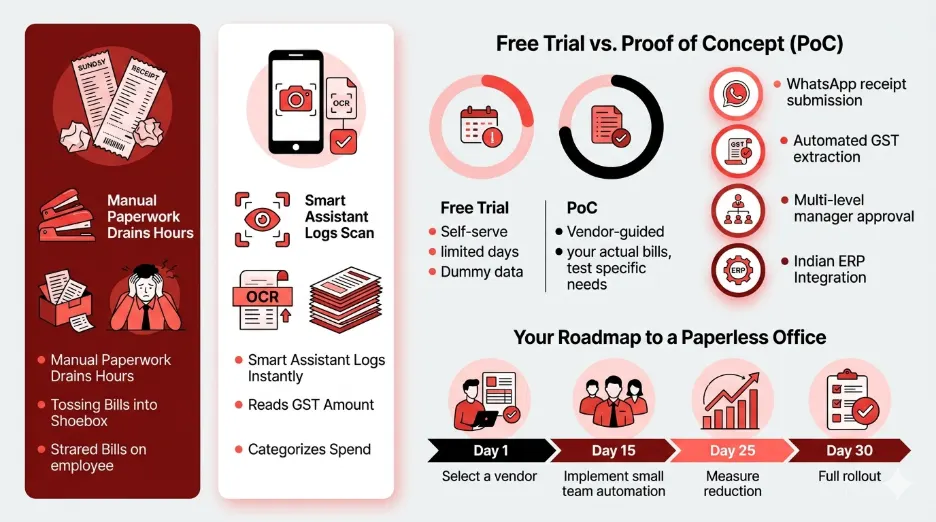
4 'Must-Have' Features to Test During Your Expense Pilot
Taking a digital test drive means looking for features that actually fix your daily headaches. Instead of waiting weeks to see where company money went, you need modern real-time employee spend tracking platforms. These act like a smart digital diary, catching mistakes instantly before they ruin your budget.
The magic behind this is Optical Character Recognition (OCR)—think of it as a smart scanner that actually reads the numbers on a Swiggy bill or petrol receipt. During your pilot, check if the app offers GST compliant expense automation tool features by automatically pulling the exact tax amount from the image. It should also match this data against your bank statements instantly, a process known as real-time reconciliation.
To ensure the software handles Indian business realities, insist on testing these four specific functions during your pilot:
WhatsApp Receipt Submission:
Perfect for staff on the go.
Allows employees to simply take a photo and WhatsApp it to a dedicated number.
Increases adoption rates because it feels like a familiar chat rather than "work."
Automated GST Extraction:
Must pull the GSTIN and amount correctly from local bills.
Crucial for claiming Input Tax Credit (ITC) without manual data entry.
Multi-Level Manager Approval:
Ensures team spends are vetted by the right supervisors.
Automates the flow from the field agent to the manager to the finance team.
Integration with Indian ERPs:
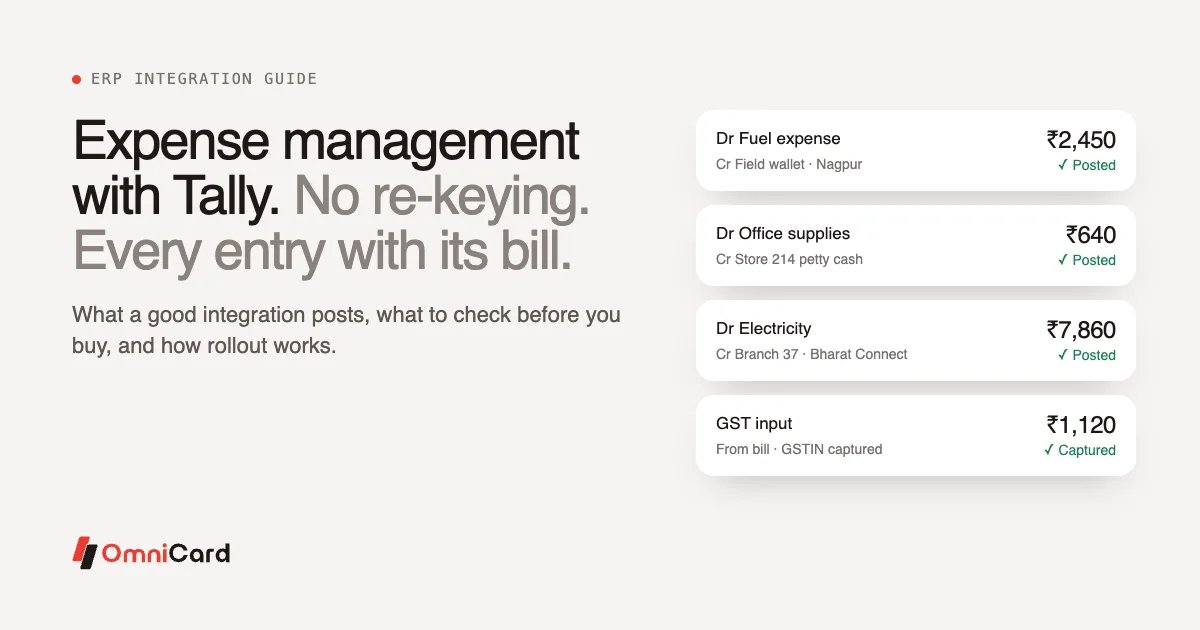
The tool must talk to your accounting software like Tally, Zoho, or SAP.
Avoids "double entry" where you have to type data into two different places.
Finally, if your business uses company cards, getting corporate credit card reconciliation automated India is non-negotiable for saving your accountant's weekends. Platforms like OmniCard provide a unified Business FinTech OS that integrates these cards directly with the expense software, ensuring every Rs. spent is accounted for in real-time.
How to Ask a Vendor for a Custom Pilot Without Getting Ghosted
Contacting sales teams can feel intimidating, but they want your business. Rather than clicking a generic website link, learn how to request fintech proof of concept (PoC)—a tailored test drive on your terms.
When emailing a representative, getting their attention requires a structured approach. Following the best practices for testing fintech pilots, provide this exact information:
Users: State who will test it (e.g., "5 field agents and 1 finance head").
Duration: Request a strict 14-day window to maintain momentum.
Pain Point: Name the exact problem, like "missing GST receipts" or "delayed reimbursements."
Data Privacy: Demand a guarantee that your company's sensitive financial data is safely deleted if you walk away.
Success Metrics: Establish simple pass-or-fail rules to judge the tool.
When evaluating ROI of automated expense software, a winning metric might be saving your accountant three hours of manual typing every Friday. These clear boundaries establish a reliable roadmap toward implementing a paperless office.
Your Roadmap to a Paperless Office: Starting Your First Pilot Today
Stepping away from manual spreadsheets doesn't require a massive IT budget or advanced technical expertise. By testing low cost corporate travel management solutions through risk-free pilots, you can finally reclaim those frustrating hours spent manually processing paperwork.
A typical 30-day transition looks like this:
Days 1–5: Choose one vendor (like OmniCard) and outline your goals.
Days 6–15: Run the pilot with a small, high-spend team (e.g., Sales or Logistics).
Days 16–25: Measure the reduction in Sunday night administrative work and verify GST accuracy.
Days 26–30: Review the Success Metrics and decide on a full rollout.
When comparing top expense management trials India, the choice becomes clear when based on real performance data instead of sales promises. Prioritizing a business finance tools suite that handles the administrative heavy lifting reserves your team's energy for actual business growth.
Key Takeaways
Free Trials vs. PoCs: Trials are for exploration; PoCs are for proving the tool works with your real Indian bills and GST requirements.
The "Bengaluru" Advantage: The competitive market for business fintech tools India means you can demand high-touch, guided setup for free.
OCR is Non-Negotiable: Any modern expense automation tool must be able to read local receipts (Swiggy, petrol, etc.) and extract GST data automatically.
WhatsApp is King: For high employee adoption, look for tools that allow receipt submission via WhatsApp.
Define Success Early: Don't start a pilot without a "Success Metric," such as reducing manual reconciliation time by 50%.
FAQs
- Is my data safe during a free pilot?
Most reputable Indian fintechs follow strict data protection protocols. When requesting a PoC, always ask for a data confidentiality agreement and ensure they have a process to purge your data if you choose not to subscribe.
- Does an expense automation tool handle GST for Indian SMEs?
Yes. Modern business finance tools are designed with the Indian tax landscape in mind. They use AI to identify GSTINs on receipts and can categorize expenses into "taxable" and "exempt" automatically.
- Can I use my existing company cards with these pilots?
Many platforms allow you to sync your existing corporate cards. However, using a unified Business FinTech OS like OmniCard often provides deeper "real-time" visibility because the card and the software are built to work together seamlessly.
- How much time does it take to set up a PoC?
For a standard Indian SME, a guided PoC can be set up in as little as 48 hours. This usually involves a quick training session for your "pilot team" and connecting the tool to your accounting software.